Contents
- Start with the offer, not the ad budget
- Spend first on a prize that filters for buyers
- Build one campaign page you can reuse everywhere
- Use referral sharing before buying more reach
- Promote in places where you already have trust
- Put email follow-up on autopilot
- Use contest actions instead of buying every click
- Protect the budget from fake entries
- A simple budget split for a lean giveaway
- Budget-friendly campaign types to use
- What not to waste money on
- Launch checklist for a low-budget giveaway
- The bottom line
A small-budget giveaway can work. A cheap-looking giveaway usually does not.
The difference is focus. If you only have a few hundred dollars, do not spread it across every ad channel, influencer, design tool, and prize idea someone mentioned in a marketing thread. Put the budget into the parts that make the campaign credible: a prize your real customers want, a landing page that captures email addresses, referral sharing, follow-up emails, and a clean way to pick the winner.
AI summary: The best way to market a giveaway without a big budget is to make the campaign shareable before you spend on promotion. Use a relevant prize, a dedicated landing page, referral rewards or bonus entries, automated email follow-up, and a short promotion calendar. KickoffLabs helps by combining landing pages, referral tracking, contest actions, fraud protection, email, and winner selection in one campaign so you do not have to duct-tape five tools together.
Here is where to spend, where to save, and how to get more reach without pretending organic social is magic.
Start with the offer, not the ad budget
Paid promotion can amplify a good giveaway. It cannot fix a weak one.
Before you spend a dollar, answer four questions:
- Who should enter? Be specific. “People who might buy our product” is better than “everyone who likes free stuff.”
- What prize would attract those people? Your product, a starter kit, an upgrade, a bundle, or a partner prize usually beats a generic gift card.
- What happens after they enter? They should get a confirmation, a share link, and a reason to invite friends.
- How will you measure quality? Leads are useful only if you can follow up, segment, and learn which sources worked.
This is why we like starting with a sweepstakes campaign or waitlist with giveaway instead of a one-off social post. A social comment giveaway can create noise. A campaign page turns that attention into an email list you own.
Spend first on a prize that filters for buyers
The prize is your targeting.
A giant generic prize can produce a giant generic list. That feels good until you send the first follow-up email and nobody cares.
If you are on a tight budget, pick a prize that makes the right person raise their hand:
- Your own product or service. Best for attracting people who actually want what you sell.
- A product bundle. Great when one item alone feels too small.
- A starter kit. Useful for education, fitness, ecommerce, creator, and hobby brands.
- A VIP upgrade. Works for communities, launches, SaaS, memberships, and events.
- A partner prize. Split the cost with a complementary brand and share the audience.
Avoid prizes that only say, “I had $500 and no strategy.” Cash, iPads, and generic Amazon cards can work for broad consumer brands, but they usually attract freebie hunters for niche businesses.
For more examples, use our giveaway prize ideas guide and the newer giveaway prize strategy guide before you lock the reward.
Build one campaign page you can reuse everywhere
Your giveaway needs a home.
Not a messy link in bio. Not a buried form. Not a comment thread where you manually copy names into a spreadsheet.
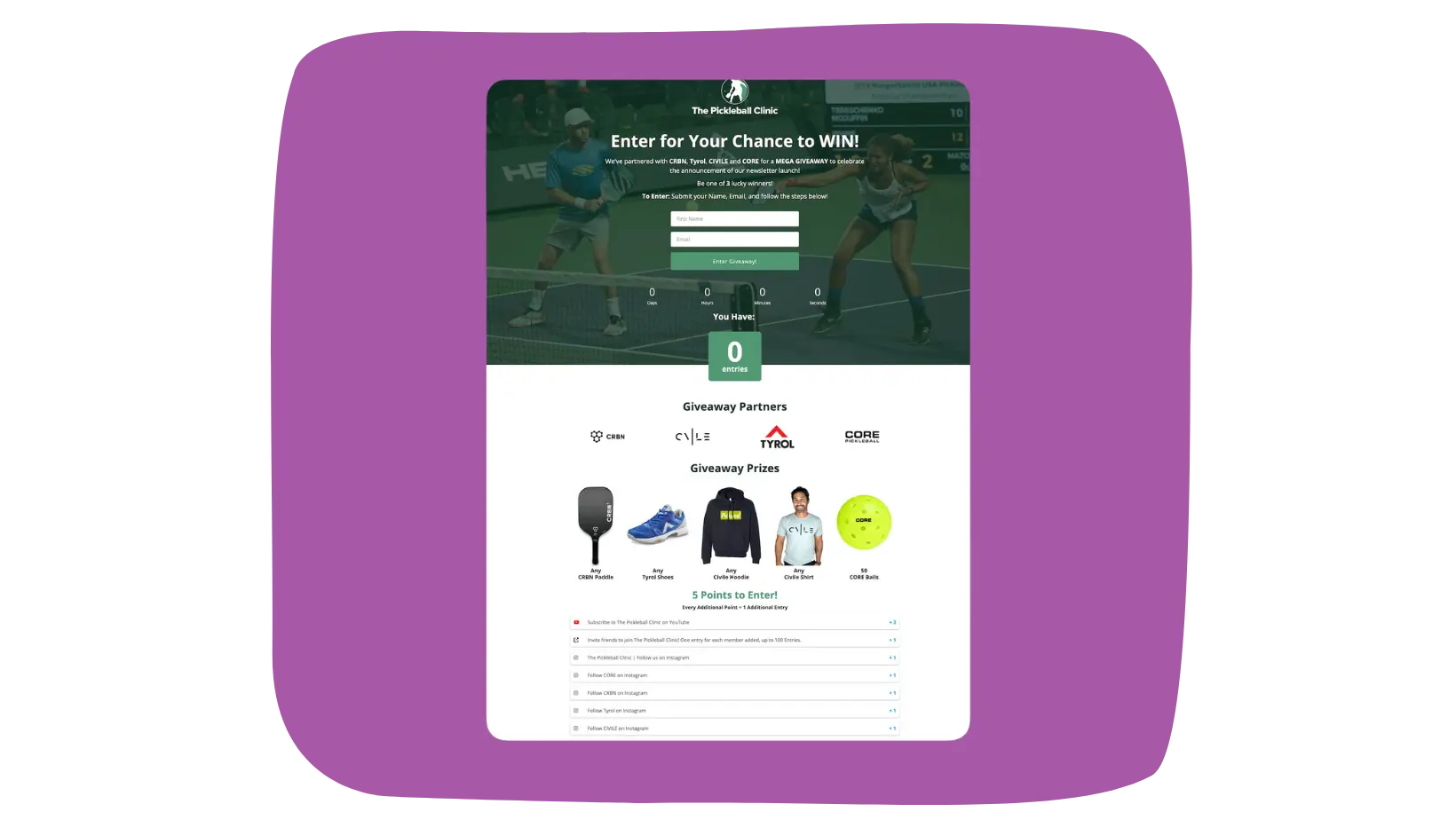
Build a dedicated landing page with:
- A clear headline that names the prize and audience.
- A short explanation of who can enter.
- A simple form.
- Official rules or a link to rules.
- A post-entry share step.
- A referral link every entrant can copy.
- A reminder of what they get for sharing.
This is the part KickoffLabs was built for. You can start from an enter-to-win landing page template, connect a sweepstakes or reward-level campaign, and let entrants share their own tracked link instead of asking you to manually reconcile referrals later.
A reusable page also makes every free channel easier. Your email, Instagram bio, Facebook post, podcast mention, QR code, partner newsletter, and customer receipt can all point to one URL.
Use referral sharing before buying more reach
The cheapest promotion is not “post more.” It is getting every entrant to bring in the next entrant.
That means your thank-you page matters as much as your entry page.
After someone enters, show them:
- Their unique share link.
- Their current referral count or score.
- The reward or bonus they can unlock.
- A one-click share option for the channels your audience actually uses.
- A short message they can copy without sounding like a robot.
If you want a simple setup, offer bonus entries for every verified friend. If you want stronger motivation, use reward levels so people can unlock prizes at milestones like 3, 5, or 10 referrals. If competition fits your audience, use a leaderboard giveaway so people can see where they stand.
The point is not to make your audience “go viral.” The point is to make sharing obvious, measurable, and worth doing.
Promote in places where you already have trust
When the budget is small, trust beats reach.
Start with channels where people already know you:
- Your existing email list.
- Your homepage or announcement bar.
- Customer receipts and order confirmation pages.
- Your Instagram, TikTok, Facebook, LinkedIn, or X profiles.
- Community posts where promotion is allowed.
- Podcast appearances or newsletter swaps.
- Partner emails.
- Shopify, Squarespace, or ecommerce post-purchase pages.
Do not blast every channel with the same copy. The campaign page can be the same, but the angle should match the channel.
For customers, lead with “share this with a friend and unlock a bonus.” For prospects, lead with the prize and outcome. For partners, lead with why their audience will care. For social, make the action obvious and include the direct link.
If you need a social plan, our social media giveaway ideas guide and comment giveaway lead capture guide show how to keep social attention from disappearing inside the platform.
Put email follow-up on autopilot
A giveaway is not done when someone enters.
That is when the actual marketing starts.
At minimum, send these emails:
- Welcome / confirmation. Confirm the entry and show the referral link.
- Referral reminder. Remind entrants what they can unlock by sharing.
- Progress update. Show score, rank, referrals, or reward progress.
- Last chance. Create urgency before entries close.
- Winner / next step. Announce the winner and point everyone else toward the next offer.
KickoffLabs includes email automation so the campaign can respond to entrant behavior without you manually chasing people. You can also connect your ESP through email integrations when you want the giveaway to feed your longer-term lifecycle flows.
Budget note: do not pay for a huge email stack before you know your campaign works. Start with the smallest setup that can send the right message at the right time.
Use contest actions instead of buying every click
Sometimes you do not need more ads. You need better actions.
Contest actions let you award points when entrants do useful things: visit a page, follow a social account, watch a video, answer a question, join a list, or share with friends.
Use them carefully. Too many actions make the campaign feel like homework. A few well-chosen actions can turn one entry into a better-qualified lead.
Good low-budget actions include:
- Visit the product page before entering.
- Answer “What are you trying to solve?”
- Follow the brand on the channel where you are actually active.
- Share the campaign with one friend.
- Join a launch waitlist.
- Read the rules or prize details.
The goal is not points for points’ sake. The goal is to teach you who is engaged and give entrants more ways to raise their hand.
Protect the budget from fake entries
Small budgets cannot afford fake momentum.
If you are offering referrals, bonus entries, or leaderboard points, build in fraud protection from the start. Watch for suspicious domains, duplicate IP patterns, fake emails, self-referrals, and sudden referral spikes that do not match real engagement.
KickoffLabs includes contest fraud detection so you can catch obvious abuse before it ruins the campaign or rewards the wrong person.
Also write clear rules. If you are running a chance-based promotion, read our USA sweepstakes laws guide and legal giveaway best practices before launch. This is not legal advice, but it is a good reminder: “we are small” is not a compliance strategy.
A simple budget split for a lean giveaway
If you have a small budget, here is a sane starting point:
| Budget area | Suggested focus |
|---|---|
| Prize | 40-60% of spend. Make it relevant, not just expensive. |
| Campaign platform | Use a tool that handles pages, referrals, email, fraud, and winner selection together. |
| Creative | Keep it simple: one landing page, one hero image, a few social posts, one email sequence. |
| Promotion | Start with owned channels and partners. Add paid spend only after the page converts. |
| Follow-up | Reserve time for winner announcement, non-winner offer, and lead segmentation. |
You can spend less than this. You can spend more. The principle is the same: fund the parts that compound.
A prize compounds when it attracts the right people. A landing page compounds when every channel points to it. Referral tracking compounds when entrants bring friends. Email compounds when the list keeps hearing from you after the giveaway ends.
Budget-friendly campaign types to use
Not every giveaway format needs a paid media machine.
Start here:
- Bonus entry sweepstakes — simple, familiar, and easy to promote.
- Waitlist with giveaway — strong for product launches and early access.
- Leaderboard giveaways — good when competition motivates your audience.
- Reward levels — useful when you want guaranteed milestones instead of only one winner.
- Newsletter referral campaigns — good for creators, publishers, and communities growing an email list.
If you are not sure which one fits, choose the format that matches the behavior you want. Want email signups? Use a sweepstakes or waitlist. Want sharing? Use bonus entries or reward levels. Want repeat action? Use a leaderboard or contest actions.
What not to waste money on
A few things look productive and quietly drain the budget:
- Custom design before you have a validated offer.
- Paid traffic to a page that does not explain the prize clearly.
- Influencers who have reach but no audience fit.
- A giant prize that attracts everyone except buyers.
- Manual spreadsheets for referral tracking.
- One social post with no email follow-up.
- A campaign with no post-entry share step.
None of those are fatal by themselves. Together, they create the classic “we got entries but no business value” campaign.
Launch checklist for a low-budget giveaway
Before you publish, check this:
- The prize attracts likely customers.
- The landing page explains the offer in five seconds.
- Entrants receive a unique referral link.
- The thank-you page tells people exactly how to share.
- Email follow-up is ready before the first entrant arrives.
- Rules, eligibility, dates, and winner selection are clear.
- Fraud controls are enabled.
- You know which source each entrant came from.
- You have a plan for non-winners after the campaign ends.
If you can check those boxes, you have something worth promoting.
The bottom line
You do not need a huge budget to run a giveaway. You need a campaign that does not waste the budget you have.
Start with a prize real customers want. Put it on a dedicated page. Give every entrant a reason to share. Follow up while the campaign is still warm. Measure what happened.
That is the whole game.
KickoffLabs helps you do that without building a landing page tool, referral system, email workflow, fraud checker, and winner picker from scratch. Start with a free account and put the money you save into the prize people actually want.