Contents
- What is a milestone referral program?
- Why milestone rewards work
- Milestone referral program examples you can actually see
- Milestone referral reward ideas by business model
- How to choose referral milestones
- Model the economics before launch
- Define the rules before anyone shares
- Build the participant experience around progress
- Launch the smallest reward ladder that can work
- Milestone referral program FAQ
- Sources and further reading

A milestone referral program rewards progress, not promises.
Someone refers three qualified friends and unlocks one reward. Five referrals earn something better. Ten unlocks the reward worth bragging about.
That structure works because the next win is visible and attainable. A vague “share with your friends” request is easy to ignore. “Two more verified referrals unlock a free month” gives people a reason to act.
If you want the landing page, personal links, progress tracking, automated emails, reward delivery, and fraud controls already connected, KickoffLabs milestone rewards campaigns are built for this exact job.
This guide covers the part software cannot decide for you: where to put the milestones, what to give away, what counts as a real referral, and how to keep the economics from becoming a very successful disaster.
What is a milestone referral program?
A milestone referral program gives participants guaranteed rewards when they reach specific referral thresholds.
The basic loop is simple:
- A person joins your campaign.
- They receive a personal referral link.
- Qualified friends join or buy through that link.
- The participant sees progress toward the next milestone.
- Your program unlocks a reward when the threshold is reached.
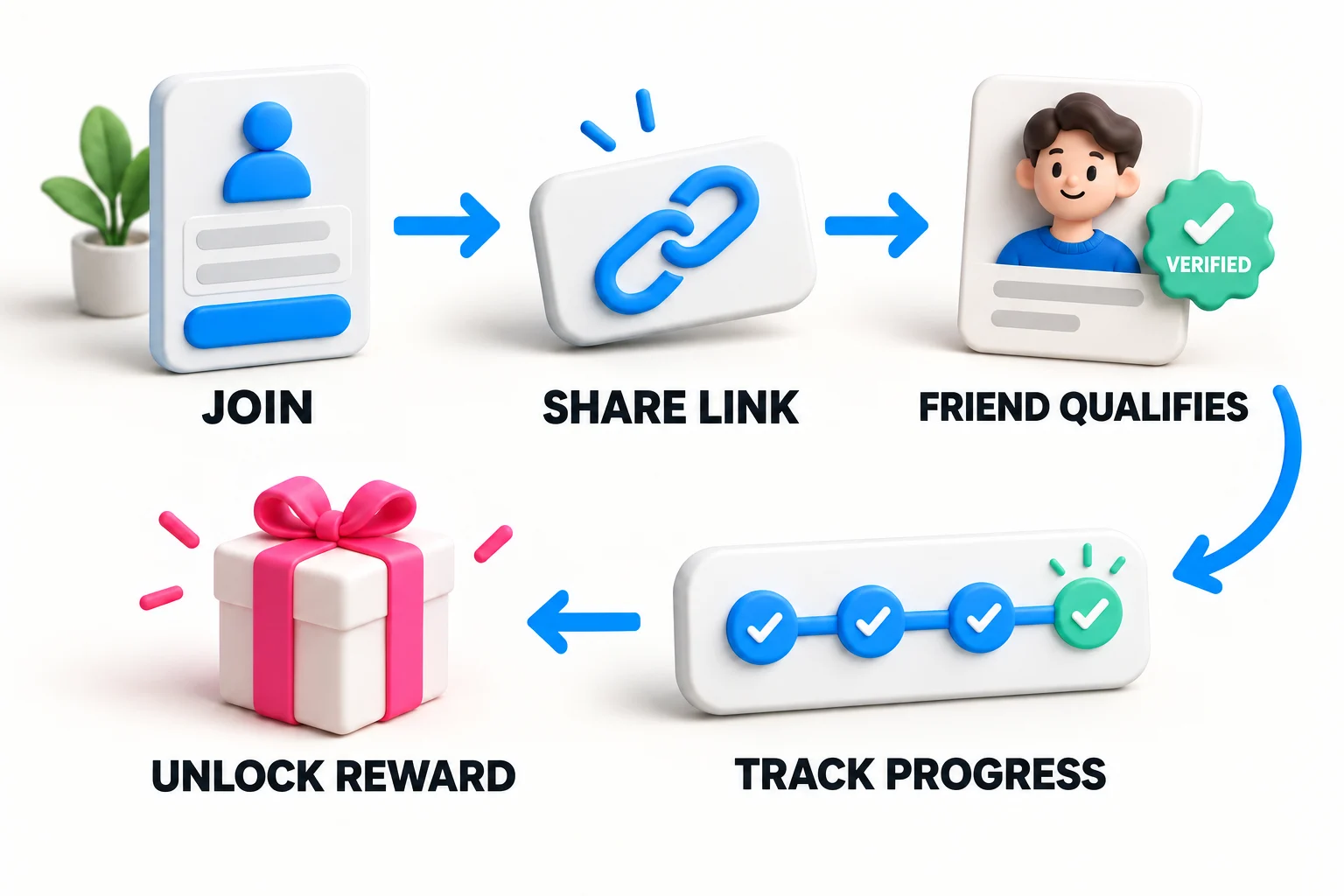
The friend must qualify under your campaign rules before their referral moves the participant toward a guaranteed reward. This is an explanatory infographic, not a product screenshot. View the full-size flow.
See it in a real KickoffLabs campaign: Anthem Boxer Briefs
Anthem Boxer Briefs (Comfortable Boxers) used KickoffLabs to make the first win cheaper than the later ones. Its sharing page showed $5 off at 5 friend signups, one free pair at 10, three pairs at 25, and seven pairs at 50. The participant could see both their current count and the next reward on the same page.
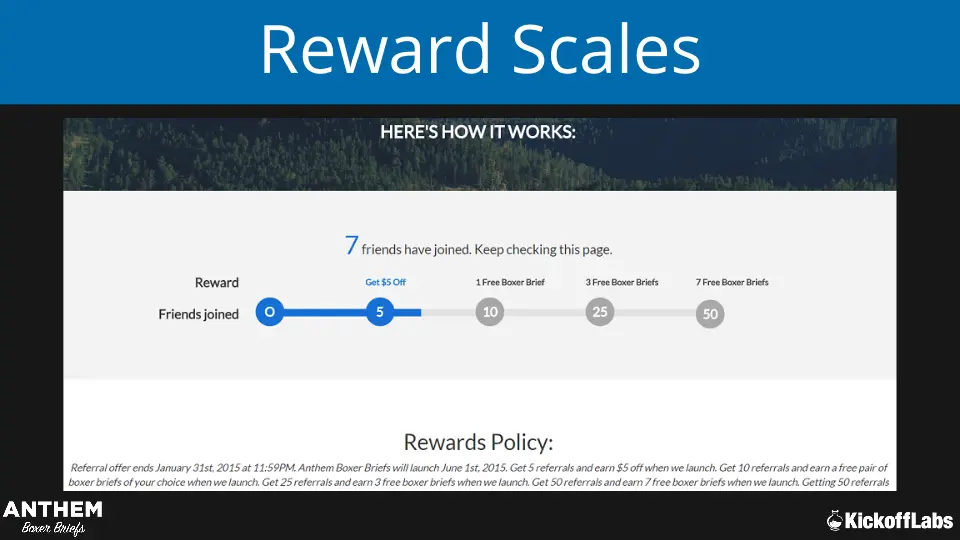
From our interview with founder Mike Madrid: at seven signups, the first discount is unlocked and the free-product threshold is next. View the full-size reward ladder.
Mike’s logic was economic, not arbitrary: most participants would get a discount instead of a free product. Once someone brought in ten friends, a pair of boxer briefs was worth the fulfillment cost. The customer interview explains the decision in his own words. That is the useful part to copy—make the early reward attainable, then reserve physical fulfillment for advocates who have earned it.
A flat referral program might give $10 for every new customer. A milestone program creates a ladder: a small reward at three referrals, a stronger reward at ten, and a premium reward at twenty-five.
Some vendors use milestone and tiered interchangeably. We use milestone for one-time rewards unlocked at fixed thresholds. A tiered program may also change the ongoing earning rate—for example, $10 per referral until ten sales, then $15 per referral after that.
Do not make participants decode the distinction. Publish the exact rules.
Why milestone rewards work
Milestones turn one intimidating goal into a series of smaller wins.
The first reward proves the program is real. The progress bar creates a reason to return. The next locked reward gives your best advocates another target without forcing everyone to chase an absurd grand prize.
They also let you reward different levels of enthusiasm. Most people will never refer twenty-five friends. That is fine. Your first milestone can motivate the broad middle while later milestones recognize the small group willing to do much more.
This structure is especially useful for:
- Prelaunch and referral waitlist campaigns.
- Newsletters and creator communities.
- SaaS products with credits, usage, or premium features.
- Ecommerce brands with samples, bundles, or store credit.
- Memberships, courses, and events with access-based perks.
- Giveaways that combine guaranteed rewards with a separate grand prize.
Milestones are a bad fit when the offer itself is weak, referrals are hard to verify, or fulfillment costs are unknown. Rewards amplify a good campaign. They do not rescue a boring product.
Milestone referral program examples you can actually see
These real campaign screenshots and first-party accounts show how teams made the next reward visible and worth sharing for. The lesson is the reward progression, not any particular price or prize.
Harry’s: attainable product rewards before launch
Harry’s ran the milestone campaign marketers still copy for a reason.
In a first-person account published by cofounder Jeff Raider, the prelaunch ladder offered:
- 5 successful referrals: free shave cream.
- 10 referrals: a free razor.
- 25 referrals: a premium Winston shave set.
- 50 referrals: a year of free shaving.
The team collected more than 85,000 valid email addresses in seven days. More than 200 people reached the highest tier.
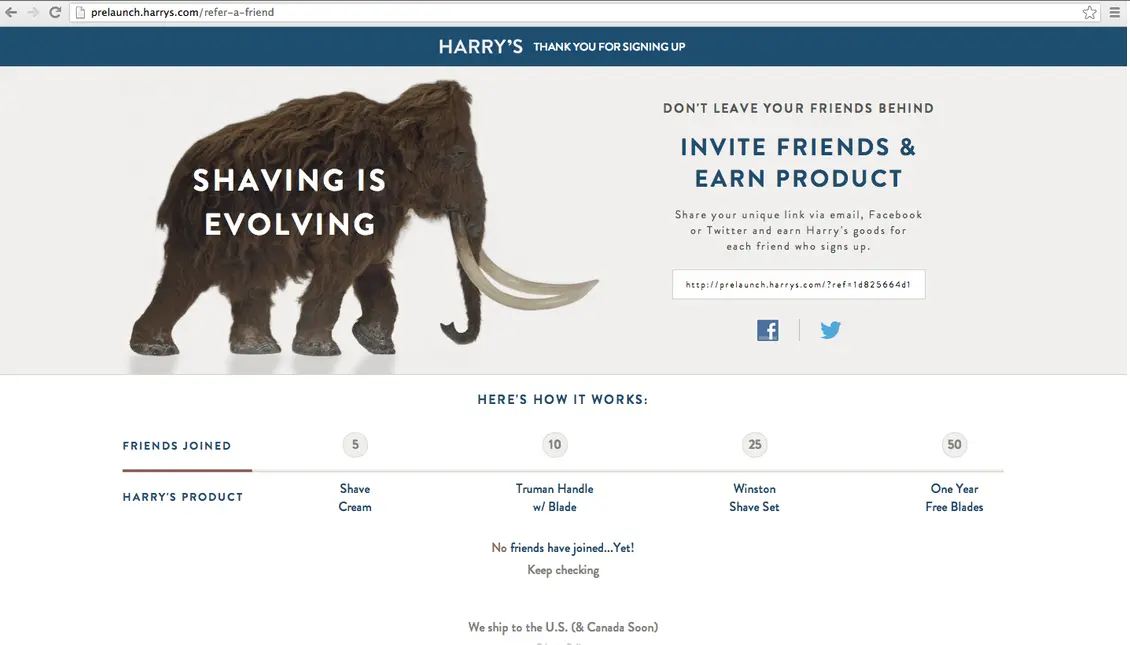
Harry’s prelaunch sharing page from our campaign walkthrough. The referral link sits above a visible reward ladder. View the full-size screenshot.
The smartest decision was not the grand prize. It was killing a proposed 1,000-referral reward because the team believed it would discourage participation. The first milestone felt possible, each step became more valuable, and every reward reinforced the product.
Steal that structure. Do not steal the exact numbers without checking your audience size and sharing behavior.
Read the Harry’s referral rewards campaign walkthrough for the tactical setup.
Morning Brew: turn readers into distributors
Morning Brew reported in 2020 that referrals drove 35% of its 2.4+ million subscribers. Each subscriber could find a unique link in the newsletter and unlock branded rewards at referral milestones.
That is a strong newsletter model because the sharing prompt lives inside the product. Readers do not have to remember a separate referral portal. Rewards such as a mug or sweatshirt also turn top referrers into visible fans.
For a smaller newsletter, start with rewards that cost almost nothing to deliver: an exclusive report, private Q&A, bonus issue, template pack, or member-only community. Save physical swag for higher thresholds where the economics can support shipping.
Our newsletter referral campaign guide covers reward models and follow-up emails in more detail.
Another visible newsletter example: Milk Road’s reward pitch
Milk Road’s published referral rewards guide shows the invitation to share its newsletter and a branded sticker reward. It makes the reward tangible before a reader even opens a referral dashboard.
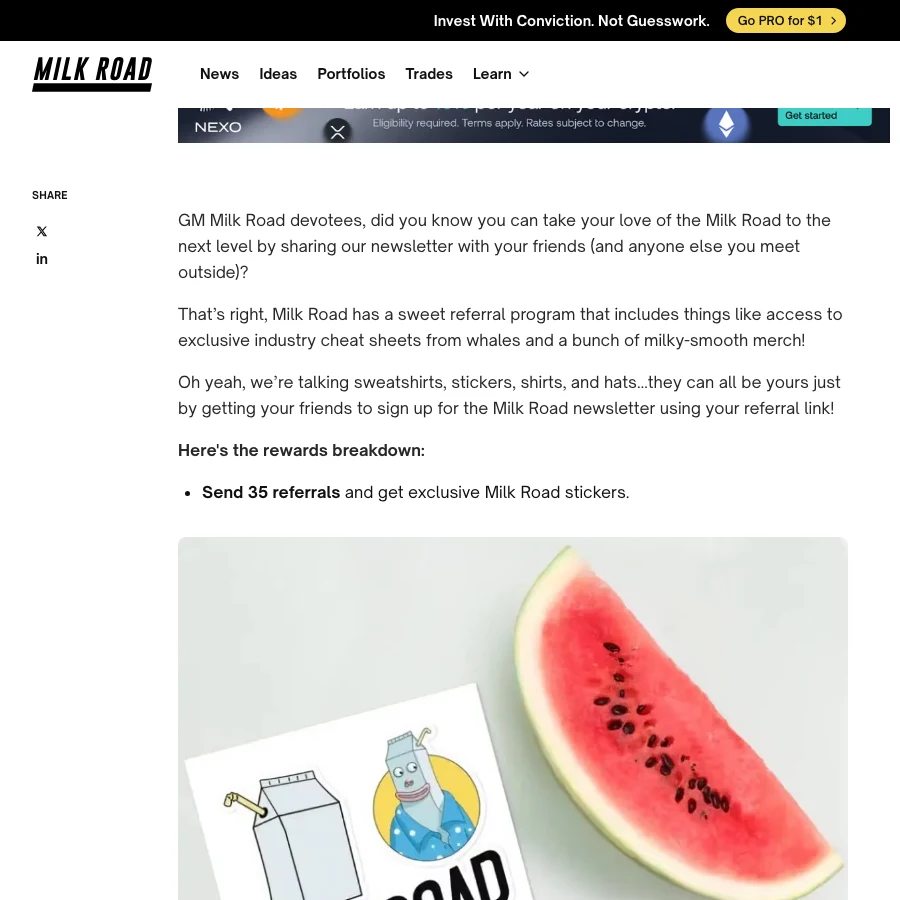
Milk Road’s published rewards guide shows the newsletter referral invitation and sticker reward. View the full-size screenshot.
Not a milestone ladder: Dropbox qualifies the action, not the click
Dropbox is a useful contrast. Its current program is a capped per-referral model rather than a classic milestone ladder, but its qualification flow is worth copying.
A referred person must create an account through the link, install and log in to the desktop app, and verify their email before the referral is complete. Dropbox also shows statuses such as invitation sent, waiting for install, waiting for verification, completed, and ineligible.
That prevents the program from paying for a click that produced no real user.
Your qualifying event should match the value you need. A newsletter may count a verified subscriber. A SaaS product may count activation. An ecommerce program may wait for a paid order to clear the return window.
The lesson: reward the outcome, not the easiest event to fake.
Milestone referral reward ideas by business model
The best reward is rarely a generic gift card. It should attract more people who want your product and encourage the advocate to keep using it.

Newsletter or creator business
- 1–3 referrals: bonus guide, archive access, or exclusive issue.
- 5 referrals: private community or live Q&A access.
- 10 referrals: limited merchandise or a premium content bundle.
- 25+ referrals: annual membership, guest access, or a founder session.
Start digital. A $4 mug becomes a much more expensive mug after printing, storage, pick-and-pack, international shipping, replacement shipments, and support.
SaaS or app
- 1 referral: feature preview or trial extension.
- 3 referrals: account credit or a premium feature for one month.
- 5 referrals: several free months or additional usage.
- 10+ referrals: annual plan, concierge onboarding, or VIP roadmap access.
Product value usually beats unrelated merchandise. Dropbox’s extra storage worked because the reward made the product more useful.
Ecommerce or subscription brand
- 1–3 referrals: free shipping, sample, or modest store credit.
- 5 referrals: free core product or subscription box.
- 10 referrals: premium bundle or several months free.
- 25+ referrals: limited edition, annual supply, or high-value experience.
Use gross margin, not retail price, when calculating cost. Also include shipping, returns, and customer support.
Prelaunch or waitlist
- 1 referral: launch bonus or insider update.
- 3 referrals: earlier access or priority onboarding.
- 5 referrals: launch credit, accessory, or beta feature.
- 10+ referrals: premium onboarding, founder session, or a meaningful product bundle.
If access is the reward, define what “early” means. Fake scarcity damages trust faster than a progress bar can rebuild it.
Community, course, or event
- 1–3 referrals: downloadable resource or bonus session.
- 5 referrals: member badge, workshop, or guest pass.
- 10 referrals: premium ticket, coaching credit, or annual membership.
- 25+ referrals: VIP experience or private group session.
Status works when the community already matters. A digital badge nobody sees is not a reward. It is clip art.
How to choose referral milestones
Three or four milestones are enough for most programs. More levels create more copy, more edge cases, and more fulfillment work without necessarily creating more motivation.
Use this framework.
Put the first win within reach
The first milestone should happen soon enough to prove the system works.
For a consumer launch, that might be three verified referrals. For a narrow B2B product, even one qualified referral may be meaningful. For a broad creator audience, five may be realistic.
Do not choose ten because it looks tidy in a spreadsheet. Estimate how many relevant people a typical participant can comfortably invite.
Widen the gaps gradually
A ladder such as 3, 5, 10, and 25 referrals feels more achievable than 5, 25, 100, and 500.
The exact sequence is not sacred. The principle is: early momentum should be easy to understand, while premium rewards require clearly more effort.
Increase perceived value faster than cost
Your highest tier should feel dramatically better without costing dramatically more.
A premium feature, annual credit, limited access, or founder session may have high perceived value and manageable marginal cost. Physical products can work too, but only after you model inventory and delivery.
Give the friend a reason to say yes
A one-sided program asks the participant to request a favor. A double-sided program lets them offer value.
The referred friend might receive a welcome credit, extended trial, free shipping, bonus resource, or priority access. Keep the offer relevant and disclose the incentive where a recommendation could otherwise look independent.
Model the economics before launch
Reward liability is not a future problem. It is part of campaign design.

For each milestone, estimate:
expected achievers × reward cost × fulfillment factor
The fulfillment factor covers the costs teams forget: shipping, packaging, payment fees, support, failed deliveries, substitutions, and returns.
Then compare total referral cost with the value of the qualified outcome. If a verified lead is worth $8 and a five-referral reward costs $25 delivered, the basic math can work. If most referred leads never activate, your real value per referral is lower.
Track:
- Participant-to-share rate.
- Referred visitor-to-signup rate.
- Email verification or purchase qualification rate.
- Qualified referrals per participant.
- Percentage reaching each milestone.
- Reward and fulfillment cost per qualified referral.
- Activation, retention, and revenue from referred people.
A giant referral count with weak activation is not growth. It is an expensive email list.
Define the rules before anyone shares
Write the qualification rule in one sentence.
For example: “A referral counts when a new person joins through your link and verifies their email.”
Then document:
- Who can participate and which countries are eligible.
- Whether existing customers or subscribers count.
- The attribution window and last-click rules.
- How duplicate accounts and self-referrals are handled.
- Whether rewards are cumulative or only the highest tier applies.
- Inventory limits, substitutions, expiration, and delivery timing.
- What happens after a refund, cancellation, or deleted account.
- Whether rewards are transferable or redeemable for cash.
- Program caps and the right to review suspicious activity.
If participants promote your product because they can earn something of value, the FTC’s endorsement guidance says that kind of material connection should be disclosed clearly and conspicuously when it could affect how people judge the recommendation.
That is the only legal question this guide covers. Other requirements can depend on your reward, audience, and location, especially if you add a chance-based grand-prize drawing. Get legal advice for the jurisdictions where you operate. This article is practical marketing guidance, not legal or tax advice.
Build the participant experience around progress
Every participant should be able to answer four questions immediately:
- How many qualified referrals do I have?
- What have I unlocked?
- What is the next milestone?
- How do I share again?
What this looks like in KickoffLabs today
In the current KickoffLabs Rewards screen, you add campaign-wide milestone rewards with thresholds and decide whether each reward appears on the page. This product screenshot shows a demo campaign with point thresholds, not Harry’s or Milk Road’s settings. Set thresholds to match your own qualification and scoring rules.
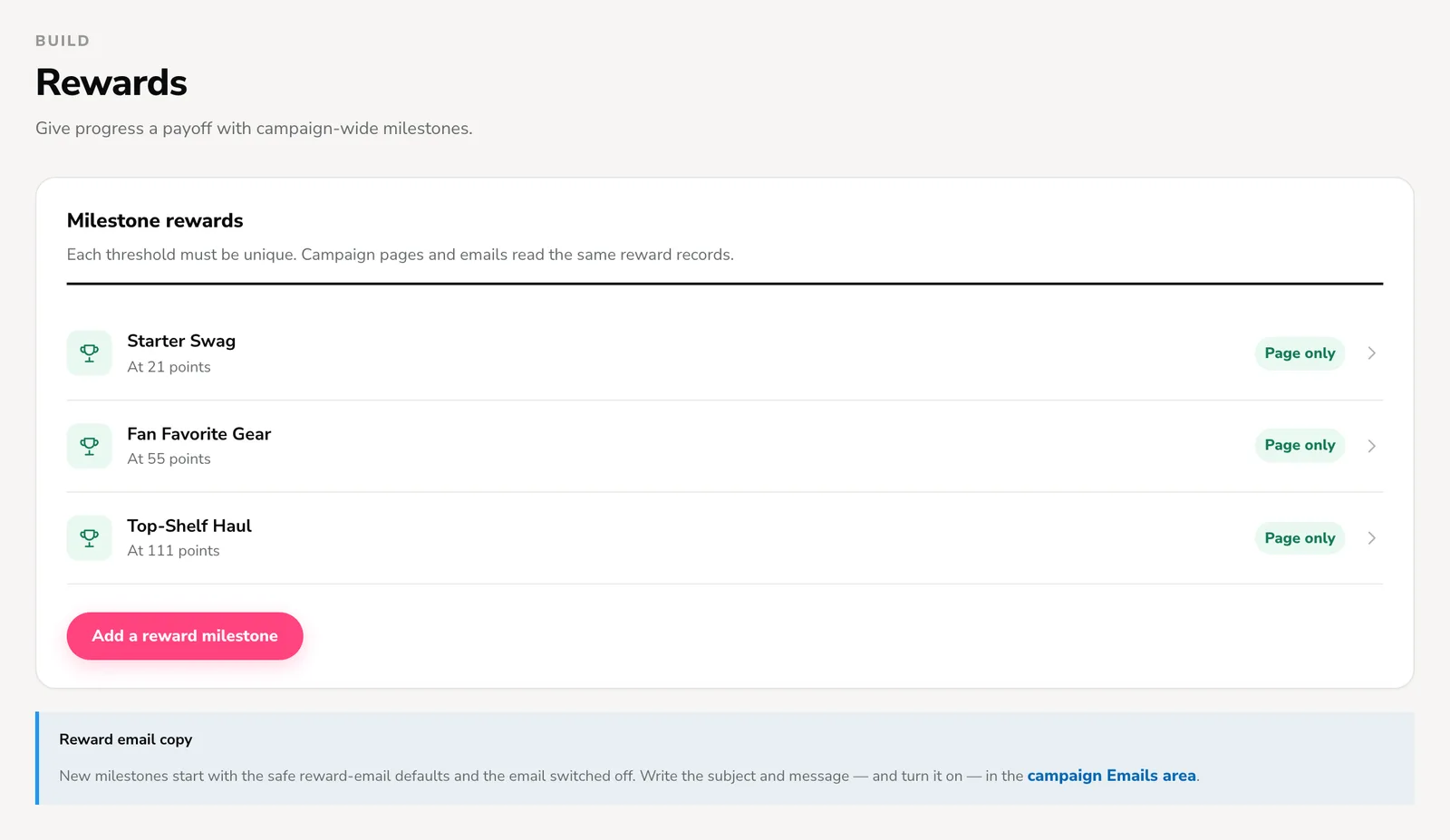
The current Rewards setup screen. The demo’s 21, 55, and 111 points are sample values, not recommended referral counts. View the full-size UI.
Here is the reward box in context on a sample page made with KickoffLabs’ new page builder. Fernway’s indoor-jungle giveaway pairs a grand-prize drawing with guaranteed referral rewards: a sticker pack at 3 friends, potted pothos at 10, a $50 gift card at 25, and a plant-care class at 50. Sharing also earns drawing entries, but the four reward milestones are a separate, visible ladder.
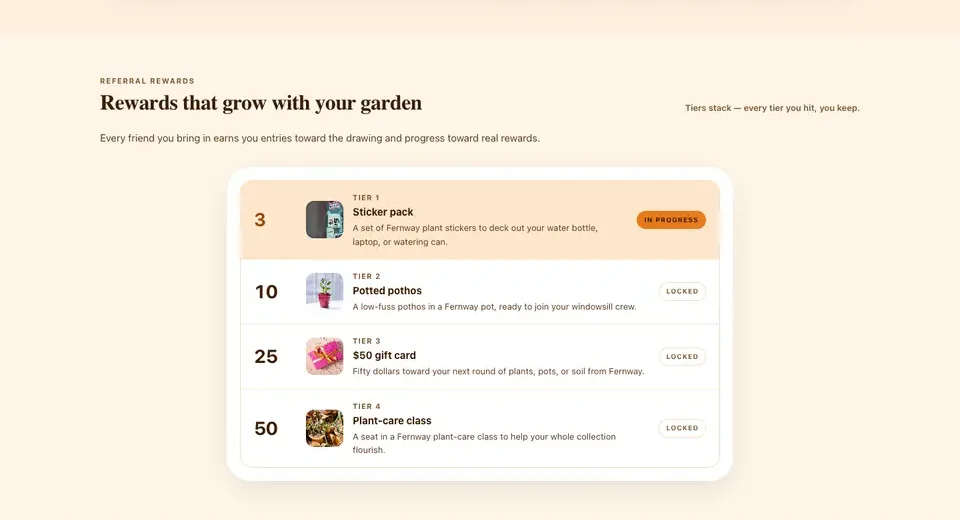
The complete reward section cropped from the full campaign page below, including every tier. This is a sample page, not a customer campaign. View the full-size reward section.
The full page puts those rewards in the campaign’s flow: the $500 indoor-jungle prize, entry form, ways to earn more entries, then the referral reward ladder. A participant can understand what they joined and what referring friends unlocks without seeing an isolated settings panel.
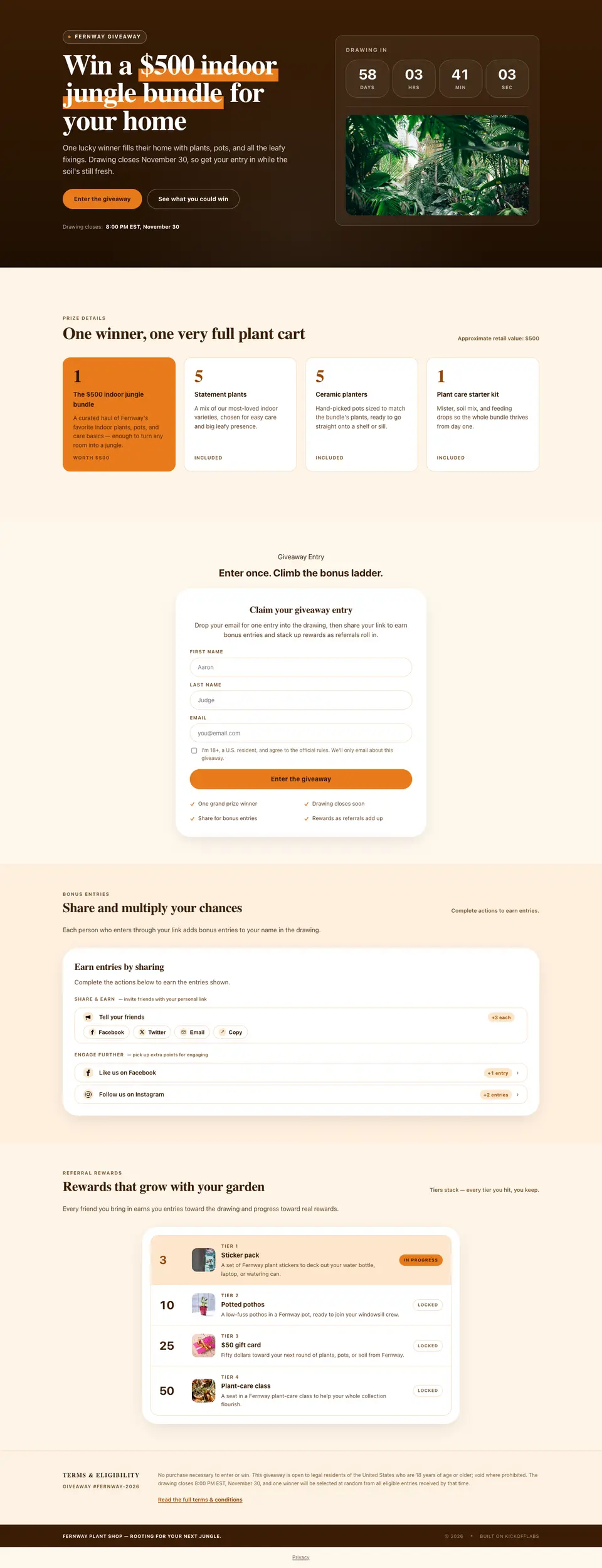
Full-page example from the new page builder. View the full-size campaign page.
Show progress on the post-signup page. Repeat it in email. Distinguish pending referrals from verified ones so people do not assume the tracker is broken.
Send a confirmation email, a milestone-unlocked email, and occasional progress reminders. Every reward email should celebrate the win and tease the next attainable step.
Then test the entire loop with different real inboxes and devices: signup, personal link, attribution, verification, progress, milestone email, reward instructions, fraud review, and reset or correction paths.
If you want more structure, start with our broader guide to building a referral program and browse these referral program examples.
Launch the smallest reward ladder that can work
You do not need seven tiers, a warehouse of swag, or a leaderboard that looks like an esports final.
Start with three milestones:
- One attainable digital or access reward.
- One meaningful product-connected reward.
- One premium reward for proven advocates.
Count qualified actions, show honest progress, budget fulfillment, and review fraud before delivery.
Build a milestone referral program with KickoffLabs and spend the time you save on the part people actually care about: an offer worth sharing.
Milestone referral program FAQ
What is a milestone referral program?
A milestone referral program gives participants a guaranteed reward when they reach a defined number of qualified referrals, such as three, five, ten, or twenty-five. Better rewards unlock at higher thresholds.
How many milestones should a referral program have?
Three or four milestones are enough for most campaigns. Put the first meaningful reward within reach, increase the gaps gradually, and reserve the most expensive reward for proven advocates.
What should count as a successful referral?
For most lead-generation programs, count a new person who joined through the participant’s unique link and verified their email. Paid programs may wait for a completed purchase and the end of any refund period.
What are good milestone referral rewards?
Good rewards reinforce the product: account credit, premium access, free months, useful digital resources, product samples, limited merchandise, or VIP experiences. Avoid broad prizes that attract people who do not want what you sell.
What is the difference between a milestone and tiered referral program?
A milestone program unlocks one-time rewards at fixed thresholds. A tiered program can also change the ongoing reward rate after a participant reaches a level. In practice, many teams use the terms interchangeably, so publish the exact earning rules.
Are milestone referral rewards legal?
The rules depend on the reward, promotion, audience, and location. FTC endorsement guidance says a connection people would not expect, such as an earned reward, should be clearly disclosed when it could affect how they judge a recommendation. Publish qualification and fulfillment terms, and get legal advice for your specific program, especially if it adds a chance-based prize drawing.
Sources and further reading
- Harry’s cofounder account of its prelaunch referral campaign — published July 21, 2014
- Morning Brew: How to Get Morning Brew Swag for Free — published October 27, 2020
- Dropbox: How to refer friends — updated September 30, 2026
- FTC Endorsement Guides: What People Are Asking — revised June 2023
- KickoffLabs milestone rewards campaigns
- KickoffLabs referral fraud detection