Contents
- Start with context, not commands
- Prompt 1: Build the campaign brief
- Prompt 2: Write landing page headlines
- Prompt 3: Make the prize sound worth entering for
- Prompt 4: Create entry instructions people will actually follow
- Prompt 5: Turn a basic giveaway into a referral campaign
- Prompt 6: Write welcome emails that keep momentum
- Prompt 7: Generate social posts without sounding desperate
- Prompt 8: Rewrite copy in your brand voice
- Prompt 9: Make your CTA specific
- Prompt 10: Create FAQ answers for skeptical visitors
- Prompt 11: Turn campaign data into better copy after launch
- Prompt 12: Build a reusable prompt library
- What AI should not do for your campaign
- A simple AI copy workflow for your next campaign
- Final word
AI will not save weak marketing. It will just help you create weak marketing faster.
The win is not “write my landing page.” The win is giving AI enough context to produce sharper headlines, cleaner email sequences, better giveaway descriptions, and more testable campaign ideas in minutes instead of hours.
Use the prompts below as a campaign copy system. Start with the audience. Give the model your offer, prize, product, deadline, rules, and brand voice. Then make it produce options you can judge, edit, and publish.
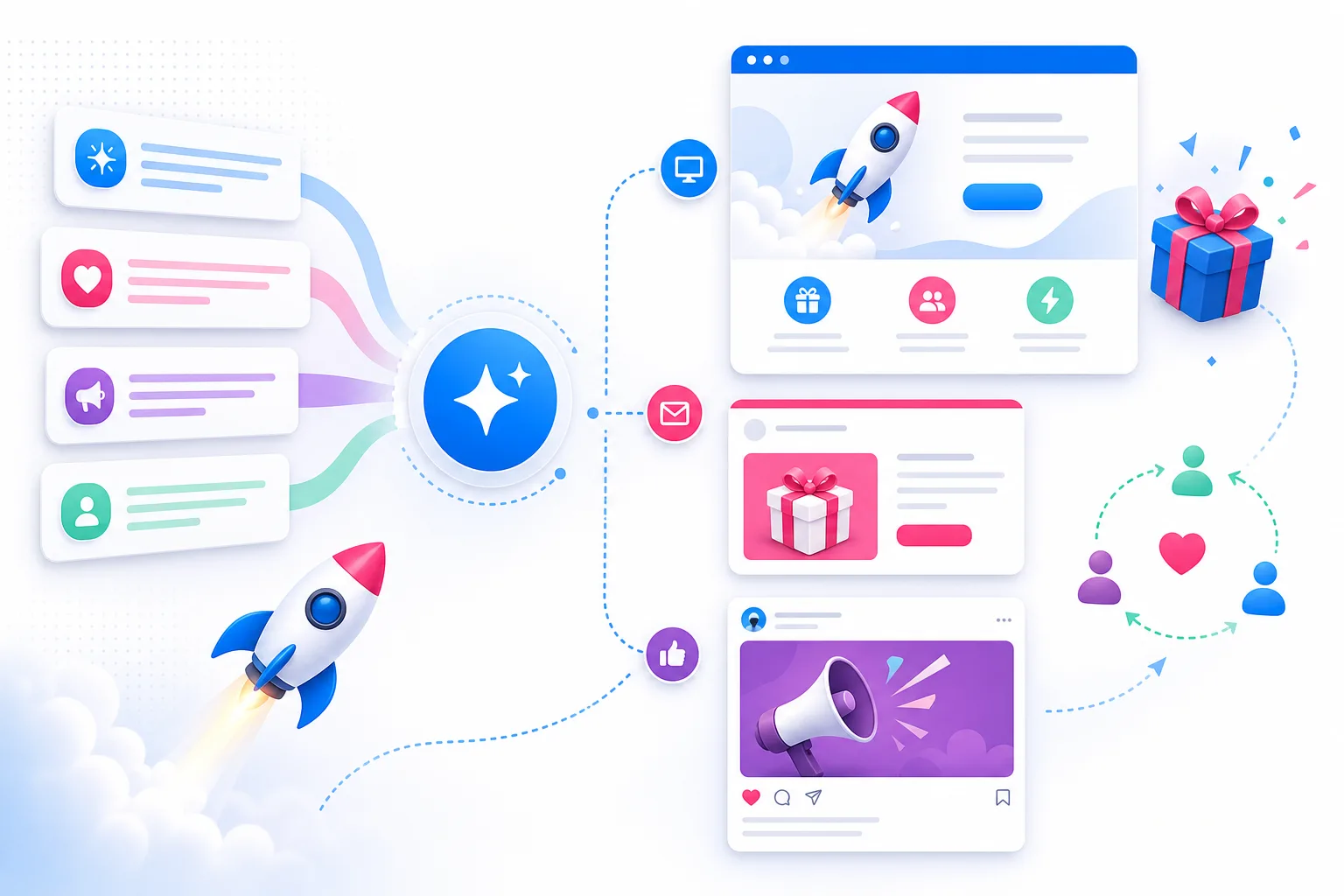
Quick answer: The best AI copywriting prompts describe the audience, the campaign goal, the offer, the proof, the tone, and the channel. For giveaways and launches, ask AI to generate multiple options for the headline, prize description, entry instructions, referral/share copy, email follow-up, and compliance-friendly reminder language. Never publish the first draft. Use AI for range, speed, and structure; use your judgment for trust.
Start with context, not commands
Bad prompt:
Write giveaway copy.
Better prompt:
You are a direct-response copywriter helping a DTC fitness brand launch a giveaway. The prize is a $1,500 home gym bundle. The goal is email list growth before a new product launch. The audience is busy parents who want short workouts at home. Write five landing page headlines, each under 12 words, with a clear benefit and no hype.
That second prompt gives AI a job. It also gives you something useful to edit.
Before you ask for copy, collect the basics:
- Audience: who you are trying to reach.
- Campaign type: sweepstakes, waitlist, leaderboard giveaway, or referral reward program.
- Offer: prize, product, bonus, access, discount, or early invite.
- Goal: email list growth, waitlist signups, product validation, preorders, event registrations, or referrals.
- Proof: customer quote, number of past winners, founder story, product value, or social proof.
- Constraints: location rules, age limits, deadline, entry requirements, brand tone, words to avoid.
If you skip this, AI fills the gaps with beige marketing fog.
Prompt 1: Build the campaign brief
Use this before you write anything else.
Act as a senior campaign strategist. Build a one-page copy brief for this campaign.

Campaign type: [giveaway / waitlist / referral program / product launch]
Product or brand: [describe it]
Audience: [describe the exact buyer or participant]
Goal: [email signups / referrals / waitlist / sales / survey responses]
Offer or prize: [describe the prize, product, bonus, or access]
Deadline: [date or campaign length]
Eligibility constraints: [age, geography, purchase rules, or legal notes]
Brand voice: [paste your voice notes]
Proof points: [customer quote, metric, founder story, product benefit]

Return:
1. Core promise
2. Main audience pain or desire
3. Reasons someone would enter
4. Reasons someone would hesitate
5. Best angle for the landing page
6. Best angle for email follow-up
7. Five words or claims to avoid
This gives you a working brief. It is not magic. It is a map.
Prompt 2: Write landing page headlines
Your headline should make the right person stop. It should not try to explain the entire campaign.
Using this campaign brief, write 20 landing page headlines.

Rules:
- Under 12 words each
- Specific, not generic
- No exclamation points
- No "unlock," "ultimate," "revolutionary," or "game-changing"
- Include a mix of benefit-led, prize-led, urgency-led, and curiosity-led options
- Mark the strongest five and explain why

Campaign brief:
[paste brief]
For a giveaway, your best headline usually combines the prize with the desire behind the prize.
“Win a $1,500 Home Gym Bundle” is clear.
“Build Your Home Gym Without Blowing Your Budget” gives the prize a reason to matter.
Prompt 3: Make the prize sound worth entering for
Most giveaway pages under-sell the prize. They list the item and hope people care.
Make the prize feel tangible.
Write five prize descriptions for this giveaway.

Prize: [describe prize]
Audience: [describe audience]
Campaign goal: [goal]
Brand tone: [tone]

Rules:
- 60-90 words each
- Lead with what the winner gets to do, not just what the item is
- Mention value only if it is credible and useful
- Avoid fake urgency and inflated claims
- End with one clear reason to enter now
If it is a gift card, do not stop at “Win a $500 gift card.” Say what the person can actually do with it.
That is the difference between a prize and a reason.
Prompt 4: Create entry instructions people will actually follow
Confused people do not enter. They bounce.
Write simple entry instructions for this campaign.

Campaign details:
[paste details]

Return three versions:
1. Ultra-short version for under the form
2. Friendly version for the landing page body
3. Legal-friendly version that avoids implying purchase is required

Rules:
- Use plain language
- Keep each step under 12 words
- Do not create legal terms that were not provided
- Include "check your email" only if email verification is required
Use this with your giveaway landing page and your official rules. AI can simplify language, but it should not invent legal terms.
Prompt 5: Turn a basic giveaway into a referral campaign
A giveaway without sharing is just a signup form with a prize.
Use AI to make the sharing page clearer.
We are adding referral incentives to this giveaway.

Campaign: [describe]
Prize: [describe]
Audience: [describe]
Referral mechanic: [extra entries / reward levels / leaderboard / milestone rewards]

Write:
1. A thank-you page headline
2. A short paragraph explaining how referrals work
3. Five share message options for participants
4. Three button labels for copying a share link
5. A short explanation of reward levels or bonus entries

Rules:
- Make the participant feel smart for sharing
- Do not overpromise odds of winning
- Keep copy friendly and direct
This is where KickoffLabs earns its keep: referral links, referral tracking, contest actions, reward levels, and post-entry pages are built for this job.
Prompt 6: Write welcome emails that keep momentum
The first email after signup should not be a receipt with a logo.
It should confirm the entry, repeat the prize or promise, and tell the lead what to do next.
Write a welcome email for someone who just entered this campaign.

Campaign: [describe]
Offer/prize: [describe]
Referral incentive: [describe]
Deadline: [date]
Brand voice: [paste voice]

Return:
- Subject line options
- Preview text options
- Email body under 175 words
- A version that emphasizes referrals
- A version that emphasizes checking back before the deadline

Rules:
- Use short paragraphs
- No fake personalization
- One CTA
- Clear next step
Then connect the email to your campaign email sequence and email automation.
Prompt 7: Generate social posts without sounding desperate
“Enter now!!!” is not a strategy.
Social copy should give people a reason to care, not just a link.
Create 15 social posts promoting this giveaway.

Channels: [Instagram / X / LinkedIn / Facebook / TikTok caption]
Audience: [describe]
Prize: [describe]
Deadline: [date]
Brand tone: [describe]

Rules:
- No engagement bait
- No fake scarcity
- Include a mix of benefit, story, proof, and deadline angles
- Keep each post native to the channel
- Include a CTA, but do not start every post with the CTA
For social giveaways, pair this with your rules checklist. Your promotion copy should match the platform requirements and the campaign rules.
Prompt 8: Rewrite copy in your brand voice
This is one of the most useful AI workflows.
Do not ask AI to “make it better.” Tell it what better means.
Rewrite the copy below in our brand voice.

Brand voice:
[paste brand voice guide]

Audience:
[describe]

Goal:
[describe conversion goal]

Copy to rewrite:
[paste copy]

Rules:
- Keep the meaning
- Cut filler
- Use shorter paragraphs
- Make the CTA clearer
- Flag any claims that need proof
- Return a before/after table for the five biggest changes
The “flag any claims that need proof” instruction is important. It turns AI from a hype machine into an editor.
Prompt 9: Make your CTA specific
“Submit” is a crime against conversions.
Write 25 CTA button options for this campaign.

Campaign: [describe]
Offer: [describe]
Audience: [describe]
Conversion action: [enter giveaway / join waitlist / invite friends / claim bonus]

Rules:
- 2-5 words each
- Start with a verb when possible
- Avoid hype
- Group by tone: direct, playful, urgent, premium, simple
Good CTAs tell people what happens next:
- Enter the giveaway
- Join the waitlist
- Get my share link
- Unlock bonus entries
- Save my spot
Specific beats clever.
Prompt 10: Create FAQ answers for skeptical visitors
Skepticism is healthy. Address it.
Write FAQ answers for skeptical campaign visitors.

Campaign: [describe]
Rules: [paste official rules summary]
Brand: [describe]

Questions to answer:
- Is this giveaway real?
- Who can enter?
- Do I need to buy anything?
- How is the winner chosen?
- When will the winner be contacted?
- How do bonus entries work?
- What happens after I sign up?

Rules:
- Keep answers under 60 words
- Do not invent legal terms
- Make the copy reassuring without sounding defensive
FAQs are not just SEO padding. They remove friction.
Prompt 11: Turn campaign data into better copy after launch
Once the campaign is live, your first draft is not sacred.
Use performance data to improve it.
Review this campaign performance and suggest copy tests.

Landing page conversion rate: [number]
Top traffic source: [source]
Email open rate: [number]
Referral rate: [number]
Most clicked CTA: [CTA]
Least clicked CTA: [CTA]
Audience comments/questions: [paste]
Current landing page copy: [paste]

Return:
1. Three headline tests
2. Three CTA tests
3. Two prize-description changes
4. Two FAQ additions
5. One email follow-up improvement
6. Why each test might help
If people ask the same question twice, your page copy is missing something.
Prompt 12: Build a reusable prompt library
The real productivity gain is not one prompt. It is a repeatable set of prompts you can use for every campaign.
Create a library for:
- Campaign brief
- Landing page headline
- Prize description
- Entry instructions
- Referral sharing page
- Welcome email
- Reminder email
- Last-chance email
- Social posts
- FAQ
- CTA tests
- Post-campaign follow-up
Then improve the library each time you launch.
What AI should not do for your campaign
AI should not write official rules from scratch. It should not invent eligibility requirements. It should not claim someone will win. It should not manufacture testimonials, customer examples, or conversion stats.
Use it to draft. Use a human to verify.
That matters even more for giveaways, sweepstakes, and referral campaigns because trust is the conversion lever. If your copy feels fake, people will assume the whole promotion is fake.
A simple AI copy workflow for your next campaign
Here is the order I would use:
- Write the campaign brief.
- Generate headline angles.
- Write the prize or offer description.
- Draft the form instructions.
- Draft the referral/share page.
- Write the first three emails.
- Generate social posts by channel.
- Add FAQs for skepticism and rules.
- Edit everything in your brand voice.
- Launch, measure, and test the weak spots.
KickoffLabs helps with the campaign plumbing: landing pages, referrals, emails, fraud controls, leaderboards, winner selection, and analytics.
AI helps you get to a stronger first draft faster.
That is the right division of labor.
Final word
AI copywriting works when you stop treating it like a vending machine.
Give it context. Give it constraints. Ask for options. Make it explain the choices. Then edit like a person who cares about the campaign.
The copy still has to earn the signup.
The prize still has to be worth entering for.
The referral ask still has to feel natural.
But with the right prompts, you can get from blank page to launch-ready campaign copy a lot faster — and spend your real energy on the part AI cannot fake: knowing what your audience actually wants.