
Contents
- Start with trust
- Write a headline that explains the win
- Make the prize feel real
- Keep entry instructions painfully simple
- Scale the form with the prize
- Put rules where people can find them
- Add urgency without sounding fake
- Give everyone a reason to feel good about entering
- Write the post-entry page like it matters
- Give people share copy they can actually use
- Write emails that continue the campaign
- Use social proof carefully
- Strong giveaway copy checklist
- Example: simple giveaway page structure
- Where AI fits
- Final word
Your prize gets attention. Your copy gets the entry.
That is the part too many giveaway campaigns miss. They pick a good prize, build a landing page, throw “Enter to win!” above a form, and wonder why the conversion rate is flat.
People are skeptical online. They should be. A good giveaway page has to answer the quiet questions running through their head: Is this real? Do I want this? What happens if I enter? Am I going to get spammed? Can I improve my odds by sharing?
Good copy answers those questions before doubt wins.
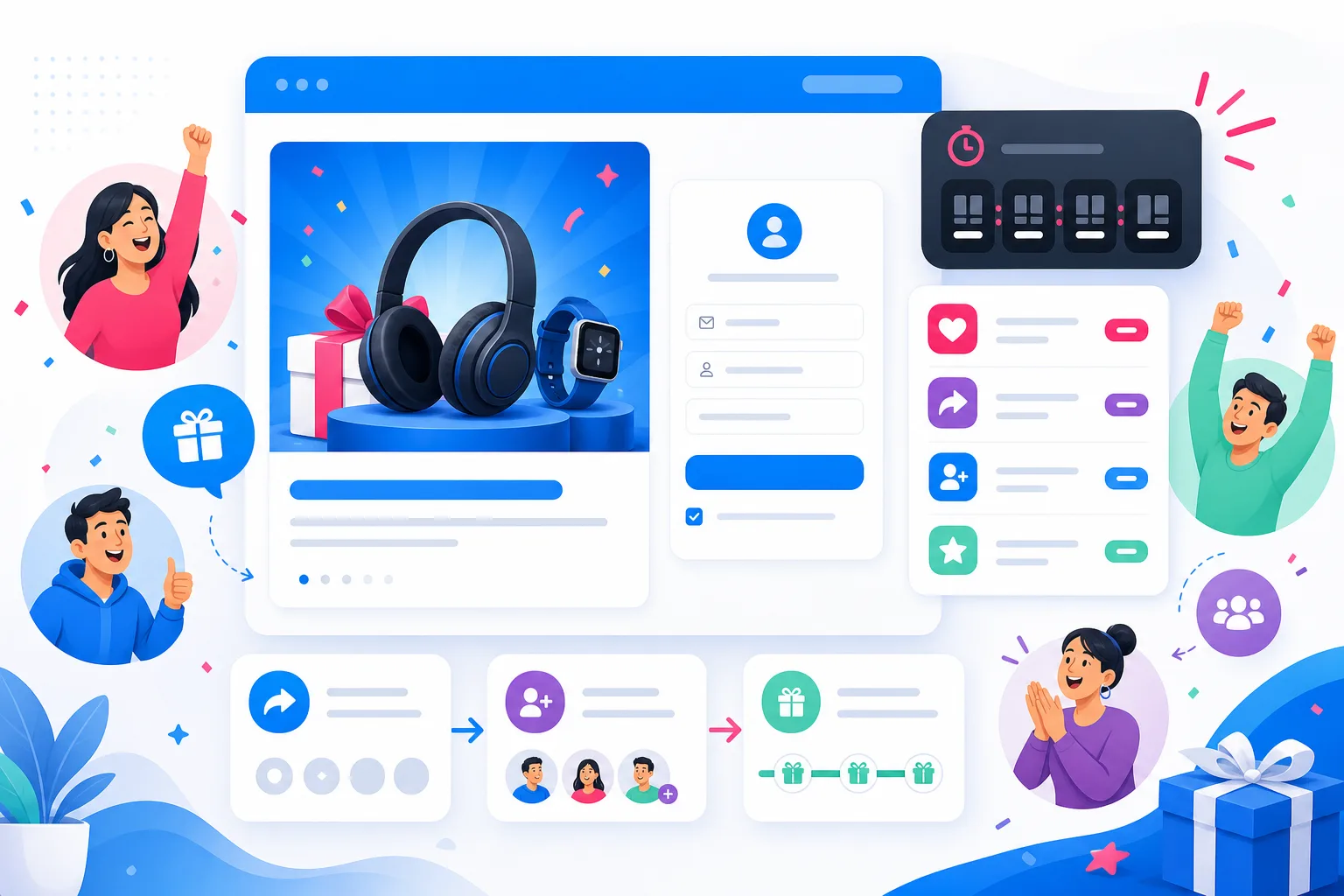
Quick answer: Giveaway copywriting is the landing page, email, and referral copy that explains the prize, builds trust, makes entry simple, and motivates sharing. Strong giveaway copy includes a clear headline, specific prize description, simple entry instructions, eligibility notes, urgency, social proof, referral/share messaging, and follow-up emails that keep people engaged after they enter.
Start with trust
Giveaways attract attention. They also attract skepticism.
That means the first job of your copy is not excitement. It is trust.
Show people the campaign is real:
- Use your logo and brand name clearly.
- Explain who is sponsoring the giveaway.
- Show the prize or product.
- Link to rules and eligibility requirements.
- Tell people when the winner will be chosen.
- Explain what happens after they enter.
If you are running a sweepstakes, a leaderboard giveaway, or a referral reward program, the same rule applies: the more value you offer, the more trust you need to build.
A $25 gift card can get away with simple copy.
A $5,000 travel package needs more proof, more clarity, and better rules.
Write a headline that explains the win
Your headline does not need to be clever. It needs to make the right person want to keep reading.
Weak headline:
Enter our amazing giveaway today!
Better headline:
Win a $1,500 Home Gym Bundle
Even better:
Build Your Home Gym Without Blowing Your Budget
The first one is generic. The second one is clear. The third one connects the prize to the desire behind it.
Use these headline formulas:
- Win [specific prize] for [specific use]
- Get [outcome] with [prize]
- Enter to win [prize] before [deadline]
- Want [desired result]? Win [prize]
- Join the [brand] giveaway for a chance to [specific benefit]
Do not make the headline carry the entire campaign. That is what the rest of the page is for.
Make the prize feel real
A prize description should do more than list the item.
It should tell people why they want it.
Bad:
Win a $500 gift card.
Better:
Win a $500 gift card to build your back-to-school setup — backpacks, supplies, lunch gear, and the little extras that somehow cost more every year.
Bad:
Win our software for a year.
Better:
Win a free year of our Pro plan and build your first automated referral campaign without duct-taping five tools together.
Mention value when it helps. Show the prize when you can. If the prize is your product, use the giveaway as education. Explain what the winner gets to do with it.
This is especially important for gift card giveaways. A dollar amount is fine. A concrete use case is better.
Keep entry instructions painfully simple
People should understand how to enter in seconds.
Use short steps:
- Enter your email.
- Confirm your entry.
- Share your link for bonus entries.
- Watch your inbox for winner updates.
That is enough for most campaigns.
If you need more fields, explain why. If you use email verification, say so. If bonus entries require a specific action, make the action obvious.
Confusion kills conversions faster than a boring prize.
Scale the form with the prize
Do not ask for a phone number, address, birthday, company size, favorite sandwich, and annual budget for a $20 prize.
The bigger the prize and the higher the intent, the more you can ask.
For a simple list-building giveaway, start with email and maybe first name. For a B2B qualification campaign, ask one useful qualifying question. For a high-value contest, you can ask more — but the copy has to justify the ask.
KickoffLabs lets you collect extra information after signup with Contest Actions. That is usually smarter than making the first form too heavy.
Get the entry first. Ask for more once people are already engaged.
Put rules where people can find them
You do not need to turn your landing page into a legal document.
You do need to make the basics visible:
- Who can enter.
- Whether purchase is required.
- Start and end dates.
- How the winner is selected.
- When the winner is contacted.
- Where the full rules live.
Use plain language and link to the full terms. If your campaign has jurisdiction, age, or platform restrictions, do not hide them.
For deeper legal context, read Contest Law Best Practices, USA Giveaway and Sweepstakes Laws, and Social Media Rules for Giveaways.
Also: AI can help simplify rules copy. It should not invent your rules.
Add urgency without sounding fake
Urgency works when it is real.
Good urgency:
- Entry closes Friday at midnight.
- Winner announced May 31.
- Bonus entries double this weekend.
- Early entrants get first access.
Bad urgency:
- Hurry!!!
- Limited spots!!!
- Once-in-a-lifetime opportunity!!!
A countdown timer can help when the deadline matters. So can reminder emails. But urgency without trust feels like a scam.
Use the real deadline. Say what happens next.
Give everyone a reason to feel good about entering
Not everyone wins the prize. Everyone should still feel like entering was worth it.
You can offer:
- A discount code.
- A free guide.
- Early product access.
- A bonus template.
- Extra entries for referrals.
- A waitlist position.
- A useful email series.
This is where a giveaway becomes more than a one-time traffic spike.
If you pair your giveaway with a waitlist or reward levels, the campaign can keep momentum after the first signup.
Write the post-entry page like it matters
The thank-you page is not a dead end. It is where the viral loop starts.
After someone enters, your copy should:
- Thank them.
- Confirm what happens next.
- Tell them how to earn bonus entries.
- Give them a personal share link.
- Explain reward levels or leaderboard rules.
- Make sharing feel easy and worth it.
Weak:
Thanks for entering.
Better:
You are in. Want a better shot? Share your link with friends — every qualified referral earns you 10 bonus entries.
Even better:
You are in. Share your link with friends who would love this prize. Every qualified referral earns 10 bonus entries, and you can track your progress right here.
That copy is clear, specific, and tied to the action.
Give people share copy they can actually use
Do not make entrants write their own post from scratch.
Give them options:
- “I just entered to win [prize] from [brand]. You can enter here: [link]”
- “This is exactly the kind of [prize/category] I have been looking for. Enter with me: [link]”
- “If you are into [topic], this giveaway is worth a look: [link]”
Write share copy for the channels your audience actually uses. LinkedIn copy for a B2B SaaS campaign should not sound like Instagram copy for a beauty giveaway.
KickoffLabs handles the share links and referral tracking. Your job is to make the share feel natural.
Write emails that continue the campaign
The first email should confirm the entry and repeat the next step.
A good giveaway email sequence usually includes:
- Entry confirmation.
- Referral reminder.
- Value or story email about the prize.
- Deadline reminder.
- Winner announcement or post-campaign follow-up.
If you want templates, start with 5 Email Templates to Send After Someone Signs Up to Your Giveaway.
Your email copy should not just say “remember to share.” It should explain why sharing helps and what the entrant gets for doing it.
Use social proof carefully
Social proof helps when it is real.
Use:
- Past winner photos with permission.
- Customer quotes.
- Sponsor logos.
- Real product reviews.
- Real campaign examples.
Do not fake testimonials. Do not imply someone won if they did not. Do not borrow logos without permission.
If you need inspiration, look at real KickoffLabs customer stories in the showcase and podcast library. Keep the claims tied to what is actually documented.
Strong giveaway copy checklist
Before you launch, check the page against this list:
- Does the headline explain the prize or outcome?
- Is the prize description specific?
- Can someone understand how to enter in five seconds?
- Are eligibility and rules easy to find?
- Is the deadline obvious?
- Does the form ask only what it needs?
- Does the thank-you page explain referrals?
- Are share messages pre-written?
- Does the welcome email match the landing page promise?
- Are any claims backed by proof?
If the answer is no, fix the copy before you buy traffic.
Example: simple giveaway page structure
Use this structure for most campaigns:
- Logo and sponsor line.
- Headline.
- Prize image.
- Prize description.
- Entry form.
- Deadline and eligibility note.
- Why enter / what you get.
- How bonus entries work.
- FAQ.
- Full rules link.
That is enough. Do not bury the form below a 3,000-word essay.
A giveaway landing page should be clear, fast, and trustworthy.
Where AI fits
AI is useful for generating headline options, prize descriptions, email drafts, FAQ answers, and share copy.
It is not useful for deciding whether your offer is credible. It cannot know if your rules are legally sound. It will happily invent proof if you let it.
Use AI prompts to get drafts. Then edit with judgment.
For a full prompt library, read AI Copywriting Prompts for Campaigns That Actually Convert.
Final word
Giveaway copywriting is not about sounding clever.
It is about reducing doubt, making the prize feel worth entering for, and giving people a reason to share.
Start with trust. Make the prize specific. Keep the form simple. Explain the rules. Write the thank-you page like the campaign depends on it — because it does.
KickoffLabs gives you the campaign engine: pages, forms, referral links, bonus entries, emails, fraud controls, and winner tools.
Your copy gives people the confidence to use it.