Contents
A giveaway can grow your list fast. It can also create a legal mess fast if you treat official rules like footer copy.
The baseline in the United States is simple: don’t run an illegal lottery. That means your promotion needs clear rules, a free method of entry when chance is involved, accurate prize disclosures, and a winner-selection process you can defend. Then the state-by-state quirks kick in.
Quick answer: In 2026, U.S. giveaway and sweepstakes law still comes down to removing at least one lottery element — prize, chance, or consideration — and checking state rules before launch. Florida and New York registration/bonding thresholds, Rhode Island retail requirements, alcohol rules, social-platform disclosures, and winner-list obligations are the big traps. Start with our copy-ready official giveaway rules template, use this state guide as a planning checklist, then have counsel review your final rules.
Not legal advice. Last reviewed October 5, 2026. This guide is general information for planning a promotion. Statutes, thresholds, and agency procedures change; check the official sources below and have a licensed attorney review your official rules before you accept entries.
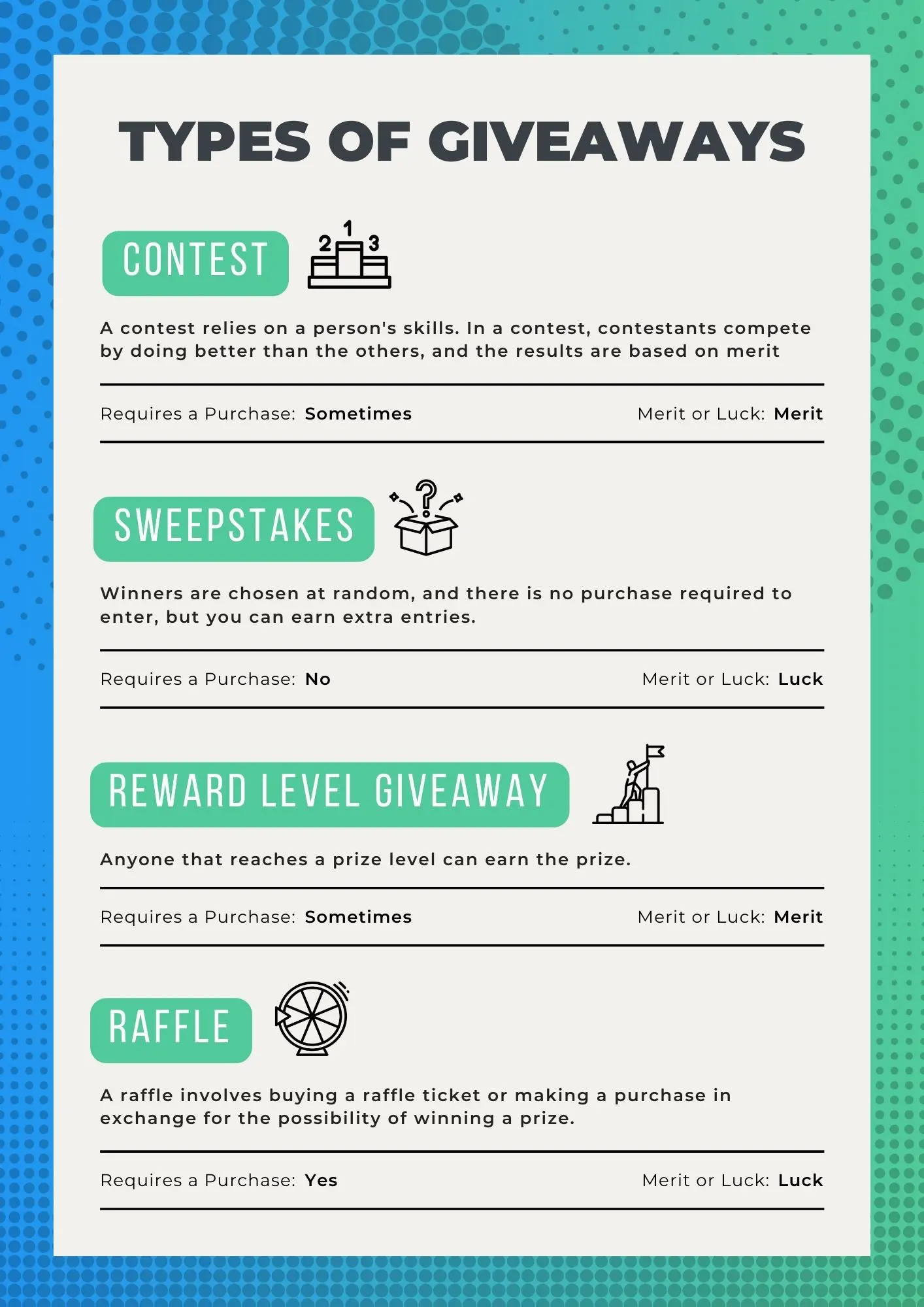
Types of Giveaways in the U.S.
Use the right promotion type before you write a single rule. Calling a sweepstakes a contest will not automatically break the law, but sloppy language usually means sloppy mechanics. Read our breakdown of contests, sweepstakes, rewards, and raffles if you need the full distinction.
Here is the short version.
General Laws in the U.S. For Giveaways
Lottery and gambling laws are the reason giveaway rules matter. If your promotion has all three elements — prize, chance, and consideration — you have probably created an illegal lottery. Remove one. Most brand sweepstakes remove consideration by offering a free no-purchase entry method. Skill contests remove chance by judging entries against published criteria.
Federal and state rules also expect transparency. Tell entrants who is eligible, what the prize is worth, how to enter, whether a purchase is required, when the winner will be selected, how odds are calculated, and where to request a winners list. If the giveaway runs through a landing page, social post, referral link, or email, your digital entry method should be spelled out in the rules.
And don’t forget our Best Practices for Making Contests Legal and Transparent. If you’re running your promotion on social platforms, also read our guide to social media rules for giveaways — each platform has its own policies on top of state law.
For a broader look at federal requirements, check out our U.S.A. giveaway and sweepstakes laws guide.
Our sweepstakes platform includes built-in compliance features like official rules templates and fraud detection to help you meet state requirements.
2026 State Law Updates and Enforcement Trends
The big picture has not changed: free entry, clear rules, accurate prize values, and documented winner selection. What has changed is how quickly a sloppy promotion gets reported, screenshotted, and escalated. Here’s what to watch in 2026:
FTC scrutiny on social media sweepstakes is increasing. The FTC has been paying closer attention to how promotions are run on social platforms, particularly around disclosure requirements and influencer-run giveaways. If your sweepstakes lives on Instagram, TikTok, or YouTube, you need clear and conspicuous disclosures — not buried in a wall of hashtags.
State rules are enforced, not decorative. Registration, bonding, and disclosure requirements in states like New York and Florida are not optional suggestions. Treat them as part of the campaign launch checklist before you collect entries.
Online promotions still need clear rules. If you collect entries through a website, social media, or referral link, make sure your official rules explain the digital entry method, eligibility, prize details, odds, timing, and winner selection process.
Laws change. Always verify with legal counsel. This guide gives you a solid starting point, but state legislatures update their statutes regularly. Before launching any promotion, have an attorney review your official rules against the current laws in every state where you’ll accept entries. The cost of a legal review is nothing compared to a state AG investigation.
If you want a practical launch workflow, pair this page with our contest law best practices, U.S.A. sweepstakes laws guide, social media giveaway rules, and pick-a-winner feature.
Specific Laws by State
Some states have additional requirements or restrictions. If either your business or any of your entrants reside in these states, the following laws apply.
Alabama
Any sweepstakes involving alcohol must be pre-approved by the state’s alcohol control board. If your contest does not involve alcohol then you must simply comply with the general U.S. giveaway laws outline above.
Alaska
Contests and sweepstakes are subject to general U.S. promotion law. Be sure to consult your legal advisor and/or reach out to the state’s relevant department.
Arizona
There are three things to consider in Arizona beyond the standard U.S. promotion laws.
- Skill-based contests that require a product purchase must be registered with the state’s Attorney General.
- Product prices must not be increased during the contest period.
- A list of winners must be sent to the state within 10 days of awarding the prize(s).
Arkansas
Contests and sweepstakes are subject to general U.S. promotion law.
California
In California no sweepstakes or contest may require a purchase of any sort, including contest submission fees. Any sweepstakes or contest involving alcohol must not require entrants to visit a certain premise and must be open to all residents. General U.S. promotion laws apply after that.
Colorado
No sweepstakes or contest may require a purchase of any sort, including contest submission fees. For mail-in events, entrants must receive detailed disclosures, e.g. that they have not yet won, that purchase is not required and will not increase their odds of winning, the value of the prize(s), and the chance of winning. General U.S. promotion laws apply after that.
Connecticut
Skill-based contests are permitted to require a submission fee on a case-by-case basis. Check with your the gaming department in the state to clarify if your contest is allowed to require a fee. General U.S. promotion laws apply after that.
Delaware
Contests and sweepstakes are subject to general promotion law. (Consult your legal advisor and/or reach out to the state’s relevant department.)
Florida
When the total announced prize value is more than $5,000, the promotion must be bonded (or a trust account established) and registered with the Florida Department of Agriculture and Consumer Services at least 7 days prior to the sweepstakes’ opening date. The list of winners must be provided to anyone who requests it. General U.S. promotion laws apply after that.
Georgia
Contests and sweepstakes are subject to general promotion law. (Consult your legal advisor and/or reach out to the state’s relevant department.)
Hawaii
Contests and sweepstakes are subject to general promotion law. (Consult your legal advisor and/or reach out to the state’s relevant department.)
Idaho
Contests and sweepstakes are subject to general promotion law. (Consult your legal advisor and/or reach out to the state’s relevant department.)
Illinois
Contests and sweepstakes are subject to general promotion law. (Consult your legal advisor and/or reach out to the state’s relevant department.)
Indiana
Any sweepstakes involving alcohol must be pre-approved by the state’s alcohol control board. General U.S. promotion laws apply after that.
Iowa
Contests and sweepstakes are subject to general promotion law. (Consult your legal advisor and/or reach out to the state’s relevant department.)
Kansas
Contests and sweepstakes are subject to general promotion law. (Consult your legal advisor and/or reach out to the state’s relevant department.)
Kentucky
Contests and sweepstakes are subject to general promotion law. (Consult your legal advisor and/or reach out to the state’s relevant department.)
Louisiana
Contests and sweepstakes are subject to general promotion law. (Consult your legal advisor and/or reach out to the state’s relevant department.)
Maine
Any sweepstakes and contests open to minors may not collect health or personal information without consent from a parent or legal guardian. General U.S. promotion laws apply after that.
Maryland
No skill-based contest may require a purchase of any sort, including contest submission fees. General U.S. promotion laws apply after that.
Massachusetts
No sweepstakes or contest may include tobacco-related activities or prizes. General U.S. promotion laws apply after that.
Michigan
Sweepstakes must not require entrants to enter a store (assuming entrants haven’t otherwise visited the location to make a purchase or attend a sales presentation). Distributing entry forms solely in-store constitutes consideration. No sweepstakes or contest may include tobacco-related activities or prizes. General U.S. promotion laws apply after that.
Minnesota
Contests and sweepstakes are subject to general promotion law. (Consult your legal advisor and/or reach out to the state’s relevant department.)
Mississippi
Contests and sweepstakes are subject to general promotion law. (Consult your legal advisor and/or reach out to the state’s relevant department.)
Missouri
Contests and sweepstakes are subject to general promotion law. (Consult your legal advisor and/or reach out to the state’s relevant department.)
Montana
Contests and sweepstakes are subject to general promotion law. (Consult your legal advisor and/or reach out to the state’s relevant department.)
Nebraska
No sweepstakes or contest may require a purchase of any sort, including contest submission fees. General U.S. promotion laws apply after that.
Nevada
Contests and sweepstakes are subject to general promotion law. (Consult your legal advisor and/or reach out to the state’s relevant department.)
New Hampshire
Contests and sweepstakes are subject to general promotion law. (Consult your legal advisor and/or reach out to the state’s relevant department.)
New Jersey
No sweepstakes or contest may require a purchase of any sort, including contest submission fees. General U.S. promotion laws apply after that.
New Mexico
Contests and sweepstakes are subject to general promotion law. (Consult your legal advisor and/or reach out to the state’s relevant department.)
New York
When the total announced prize value is more than $5,000, the promotion must be bonded and registered with the Secretary of State at least 30 days prior to the sweepstakes’ opening date. The list of winners must be provided to anyone who requests it, as well as registered with the state. General U.S. promotion laws apply after that.
North Carolina
Contests and sweepstakes are subject to general promotion law. (Consult your legal advisor and/or reach out to the state’s relevant department.)
North Dakota
No skills-based contest may require a purchase of any sort, including contest submission fees. General U.S. promotion laws apply after that.
Ohio
Sweepstakes must not require entrants to enter a store (assuming entrants haven’t otherwise visited the location to make a purchase or attend a sales presentation). Distributing entry forms solely in-store constitutes consideration. General U.S. promotion laws apply after that.
Oklahoma
Contests and sweepstakes are subject to general promotion law. (Consult your legal advisor and/or reach out to the state’s relevant department.)
Oregon
Contests and sweepstakes are subject to general promotion law. (Consult your legal advisor and/or reach out to the state’s relevant department.)
Pennsylvania
Contests and sweepstakes are subject to general promotion law. (Consult your legal advisor and/or reach out to the state’s relevant department.)
Rhode Island
Retail businesses running chance-based promotions with a total announced prize value of more than $500 must file a statement with the Secretary of State (R.I. Gen. Laws § 11-50-1). General U.S. promotion laws apply after that.
South Carolina
Contests and sweepstakes are subject to general promotion law. (Consult your legal advisor and/or reach out to the state’s relevant department.)
South Dakota
Contests and sweepstakes are subject to general promotion law. (Consult your legal advisor and/or reach out to the state’s relevant department.)
Tennessee
Sweepstakes winners must not be required to accept publicity releases in perpetuity. General U.S. promotion laws apply after that.
Texas
Contests and sweepstakes are subject to general promotion law. (Consult your legal advisor and/or reach out to the state’s relevant department.)
Utah
Contests and sweepstakes are subject to general promotion law. (Consult your legal advisor and/or reach out to the state’s relevant department.)
Vermont
No sweepstakes or contest may require a purchase of any sort, including contest submission fees. Those who request a list of sweepstakes winners must not be required to pay for postage. Any sweepstakes involving alcohol must be pre-approved by the state’s alcohol control board. General U.S. promotion laws apply after that.
Virginia
Entrants must not be required to visit a specific location in order to enter. No sweepstakes or contest may include tobacco-related activities or prizes. General U.S. promotion laws apply after that.
Washington
Contests and sweepstakes are subject to general promotion law. (Consult your legal advisor and/or reach out to the state’s relevant department.)
West Virginia
Contests and sweepstakes are subject to general promotion law. (Consult your legal advisor and/or reach out to the state’s relevant department.)
Wisconsin
Contests and sweepstakes are subject to general promotion law. (Consult your legal advisor and/or reach out to the state’s relevant department.)
Wyoming
Contests and sweepstakes are subject to general promotion law. (Consult your legal advisor and/or reach out to the state’s relevant department.)
Official Sources
The registration and bonding thresholds above come from these statutes and agency guidance. Read the current text before you launch:
- New York: General Business Law § 369-e — registration and bonding for games of chance with prizes over $5,000, filed at least 30 days before the start.
- Florida: Florida Statutes § 849.094 — game promotions with prizes over $5,000 must file rules and a bond or trust account at least 7 days before the start.
- Rhode Island: R.I. Gen. Laws § 11-50-1 — retail chance promotions with prizes over $500 must file with the Secretary of State.
- Influencer and social disclosures: the FTC’s Endorsements, Influencers, and Reviews guidance on disclosing material connections in promoted posts.
Run Legal Giveaways with Confidence
Legal does not have to mean slow. It just means you need the right structure before you invite people in.
Start with a campaign type that fits the promotion:
- Giveaways & Contests — the pillar page comparing every giveaway mechanic
- Bonus Entry Giveaway — classic no-purchase sweepstakes structure with referral sharing
- Leaderboard Giveaway — transparent rankings for points-based campaigns
- Reward Programs — milestone incentives that keep people sharing
- Waitlist with Giveaway — product-launch buzz with a clear entry path
Then make the operations boring in the best way: use written official rules, collect entries through one system, log referrals, screen for fraud, and select winners through a repeatable process. KickoffLabs helps with fraud detection, fair winner selection, referral tracking, and automated email follow-up.
Wrapping Up
Don’t wing it on legal compliance. Get an attorney to review your official rules before you launch. The states with registration requirements — especially New York, Florida, and Rhode Island — are not decorative footnotes, and social-platform disclosures are easier to audit than ever.
The win is simple: choose a compliant campaign type, disclose the rules, make entry free when chance is involved, document winner selection, and keep your promotion records. Do that, and your giveaway can focus on growth instead of cleanup.
When you’re ready to launch, start with a KickoffLabs sweepstakes campaign or compare more giveaway ideas before choosing your format. You handle the prize. We’ll help with the launch machinery.