Contents
- TL;DR: waitlists stop you from wasting time on products you cannot sell
- Traffic is applause. Validation is commitment.
- Start with one validation question
- Set a decision rule before you launch
- Build the landing page around one promise
- Add referrals when the idea is easy to explain
- Ask one qualifying question
- Measure intent, not just email volume
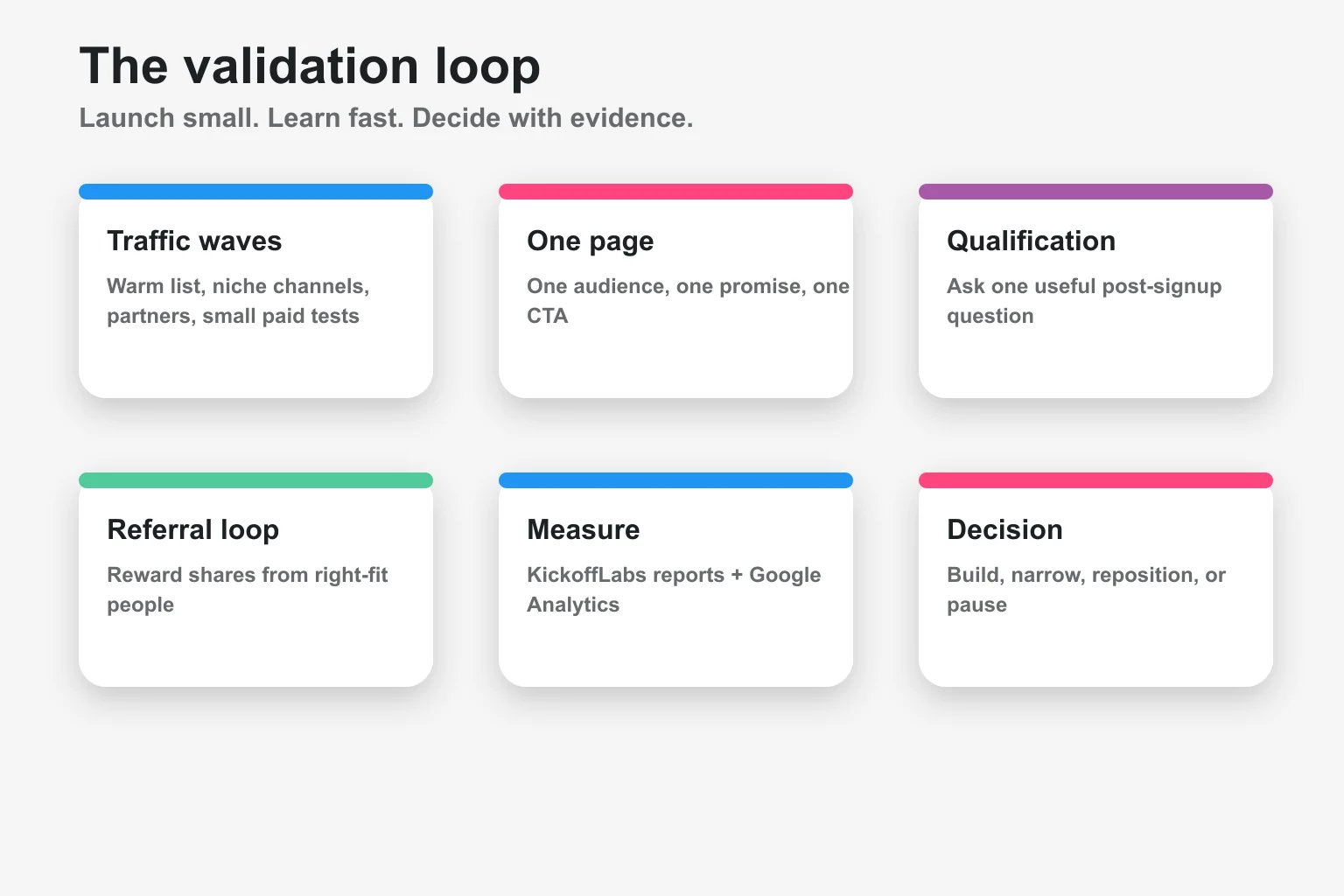
- Promote in waves, not one big blast
- Follow up while the signal is fresh
- What real launch validation can look like
- How to set this up in KickoffLabs
- Launch validation checklist
- Validate the promise before the product
Most founders do not need another month of building.
They need one clean signal from real people.
Not compliments. Not “this sounds cool.” Not survey answers from friends who want to be supportive.
You need to know if the right people will take action before the product is finished. Will they join? Will they share? Will they answer a qualifying question? Will they book a call? Will they raise their hand when the only thing you have is a promise?
That is what a waitlist referral campaign is built to answer.
TL;DR: waitlists stop you from wasting time on products you cannot sell
A product launch is validated when the right audience takes measurable action before the full product exists. A waitlist referral campaign helps you test that by sending traffic to one clear landing page, capturing qualified leads, rewarding referrals, and tracking which people share, respond, and stay engaged. The goal is not “more emails.” The goal is evidence: who wants this, why they want it, how they found you, and whether the promise is strong enough to spread.
If you want the tactical waitlist setup, start with our guide to a pre-launch waitlist that converts. If you are still sorting out the concept, read what a product launch waitlist is first.
This post is about the validation layer: how to use that waitlist to make a smarter build/no-build decision.
Traffic is applause. Validation is commitment.
A launch page can get traffic for the wrong reasons.
A clever headline can get clicks. A giveaway can attract people who only want the prize. A big social post can create a spike that looks exciting for 48 hours and then disappears.
That is not validation.
Validation means the right people are doing something that costs them a little effort.
They join the waitlist. They refer someone. They answer a question. They ask for access. They reply to your follow-up. They tell you the problem in their own words.
That behavior is much harder to fake.
A waitlist with referrals turns interest into evidence:
- Who signs up
- Who shares
- Which channels bring qualified people
- Which message converts
- Which segment cares enough to keep engaging
- Which rewards create useful referrals instead of junk leads
That is the stuff you can build from.
Start with one validation question
Do not start with “how do we get more signups?”
That question is too broad. It pushes you toward vanity numbers.
Start with the decision you need to make.
Good validation questions sound like this:
- Will freelance designers join a waitlist for an AI proposal assistant?
- Will parents of youth athletes invite other parents to get early access to a scheduling app?
- Will ecommerce operators request a demo for a returns automation tool?
- Will creators share a waitlist if the reward is first access instead of a discount?
- Will our current audience care more about speed, price, or exclusivity?
Each question points to a different campaign.
If you are testing audience demand, your page should qualify people clearly.
If you are testing the promise, your page should try different headlines and benefits.
If you are testing virality, your referral reward needs to be front and center.
If you are testing sales intent, your signup flow should include a demo request, deposit, beta interview, or “tell us your use case” question.
The mistake is trying to learn everything from one page.
Pick the riskiest assumption and design the campaign around that.
Set a decision rule before you launch
This is where founders get slippery.
They launch a page, get some signups, feel good, and keep building anyway. The campaign becomes emotional support for a decision they already made.
Do not do that.
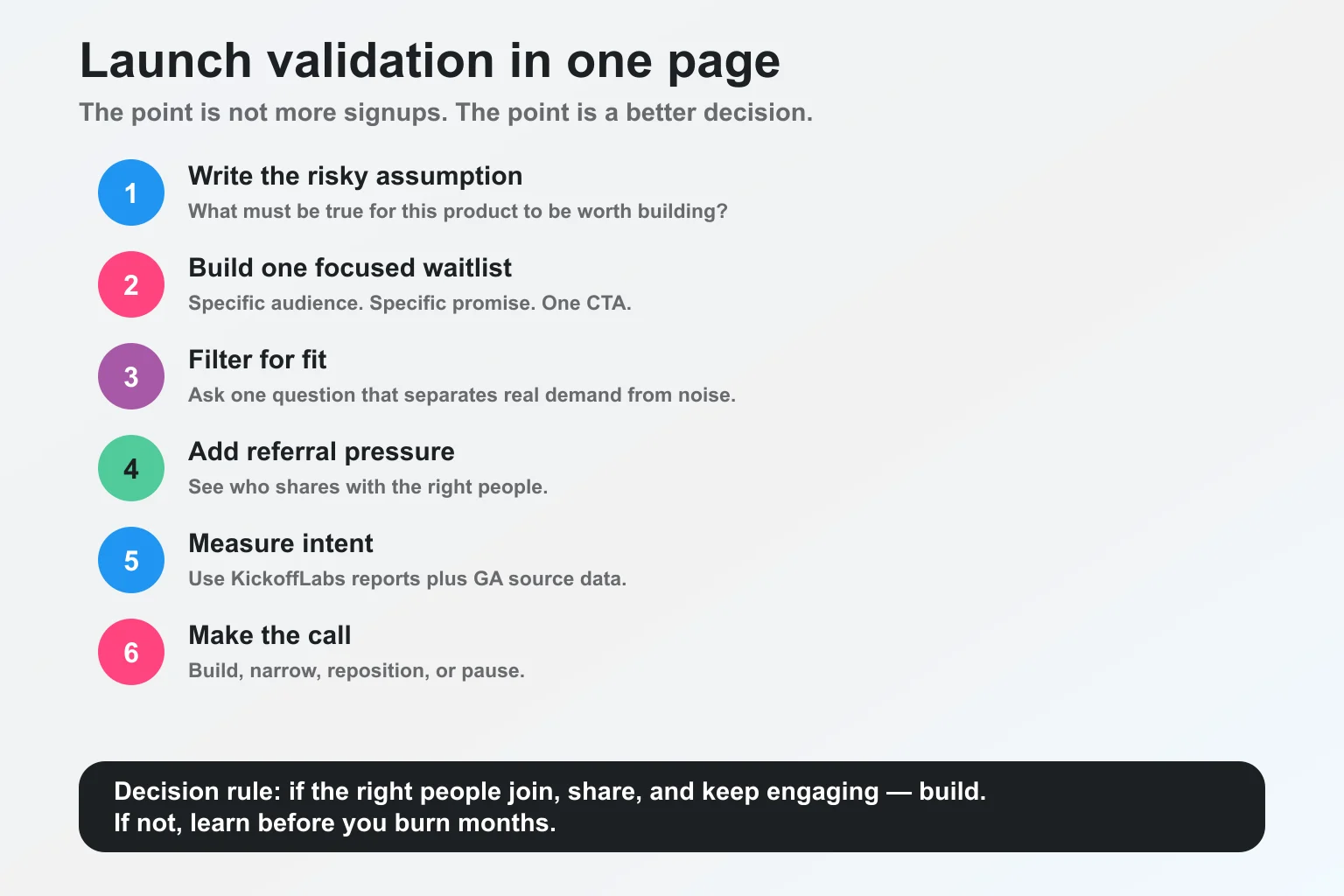
Before you drive traffic, write down what would make you build, narrow, reposition, or pause.
A hypothetical decision rule might look like this:
If 300 independent fitness coaches join the waitlist in 21 days, 20% refer at least one peer, and 25 qualified leads agree to a beta interview, we will build the first version for that segment.
Those numbers are hypothetical. Your threshold depends on your audience, price point, traffic source, and how expensive the product is to build.
The point is not that 300 is magic.
The point is that you decide what matters before the results show up.
Use a simple scorecard:
- Minimum qualified signups
- Visitor-to-signup conversion rate
- Referral participation rate
- Number of referrals per active sharer
- Number of beta interviews, demo requests, deposits, or pre-orders
- Best acquisition channel
- Best-performing message
- Most common objection
- Segment with the strongest intent
Now your waitlist is not just a list.
It is a decision tool.
Build the landing page around one promise
Your launch landing page does not need to explain the full future product.
It should not.
The job is simple: make the right person say, “That is for me. I want in.”
That means one audience, one promise, one call to action.
A useful page structure:
- Headline: Name the outcome, not the feature list.
- Subheadline: Say who it is for and why it is different.
- Visual: Show the workflow, result, or emotional payoff.
- Bullets: Give the top three reasons to join.
- Credibility: Add a founder note, prototype screenshot, relevant experience, or early proof.
- CTA: Invite people to join the waitlist, request access, reserve a spot, or apply.
- Referral hook: Tell them what they unlock by sharing.
Weak headline:
The Future of Team Productivity Is Here
Better headline:
Plan your remote team’s week in 12 minutes
The second one gives a specific person a specific reason to care.
That is what you want.
If your page tries to sound impressive to everyone, it will convert no one useful.
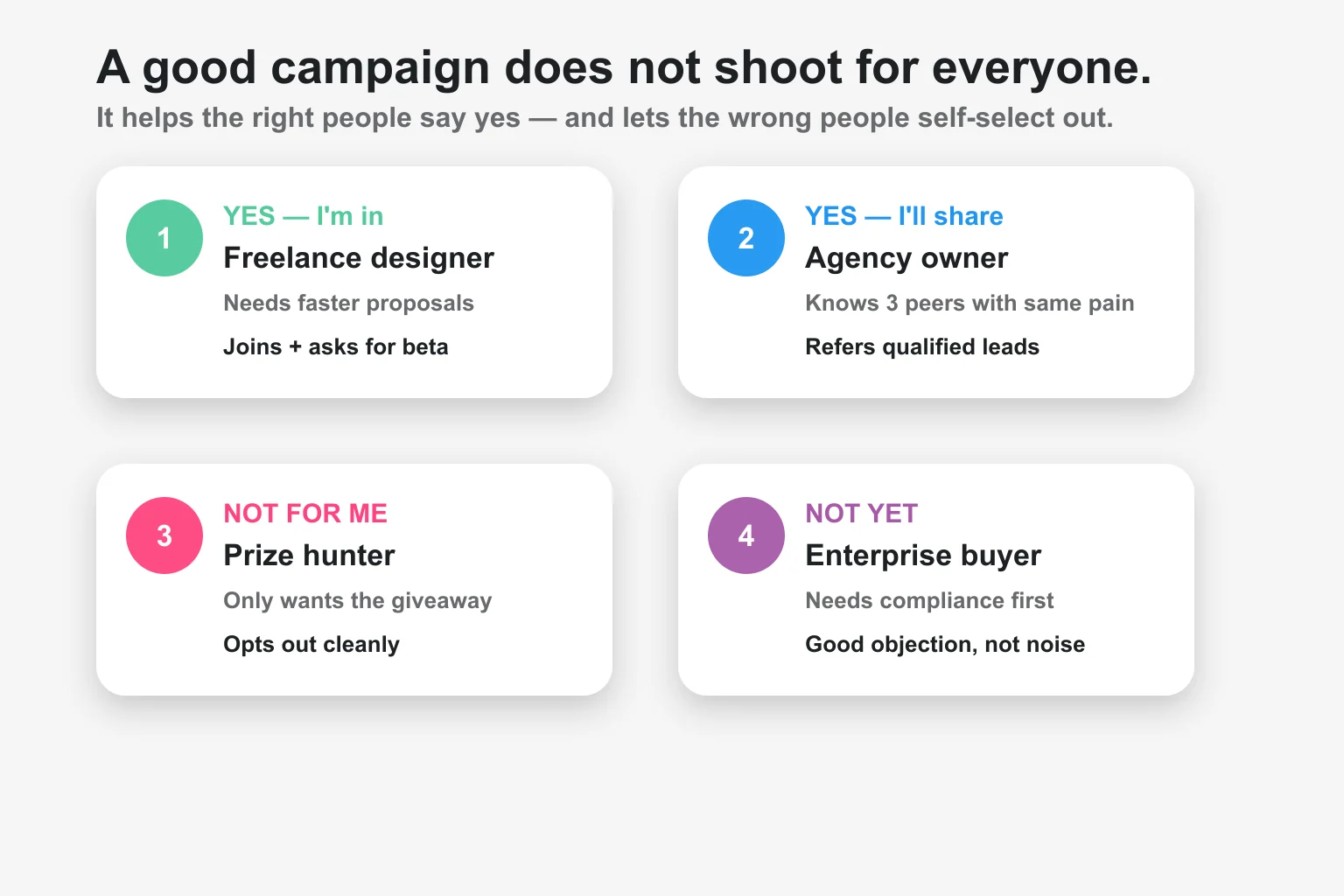
A good validation campaign is allowed to repel people. That is not a bug. If the wrong visitor says “not for me,” your reporting gets cleaner and your follow-up gets sharper.
Add referrals when the idea is easy to explain
Referral campaigns work best when the value is simple enough to share in one sentence.
People share things that make them look helpful, early, smart, generous, or connected.
Your waitlist should make that easy.
A simple referral prompt might be:
Know another indie founder planning a launch? Invite them and move up the early access list.
Or:
Share with two teammates to unlock the beta checklist.
The reward does not have to be expensive. For pre-launch campaigns, the best rewards are often access, status, useful resources, or a better version of the thing people already want.
Example reward ladder:
- 1 referral: private beta checklist
- 3 referrals: priority early access
- 5 referrals: invite to a live teardown or founder Q&A
- 10 referrals: VIP onboarding, free month, or founder call
The key is alignment.
If you are validating a serious B2B product, do not give away an iPad. You will learn that people like iPads. Congratulations.
Give people something tied to the product, the problem, or the status of being early.
If you want the mechanics, KickoffLabs has a full waitlist campaign type built for this. You can pair that with built-in referral tracking so every signup, share, and referred lead stays connected.
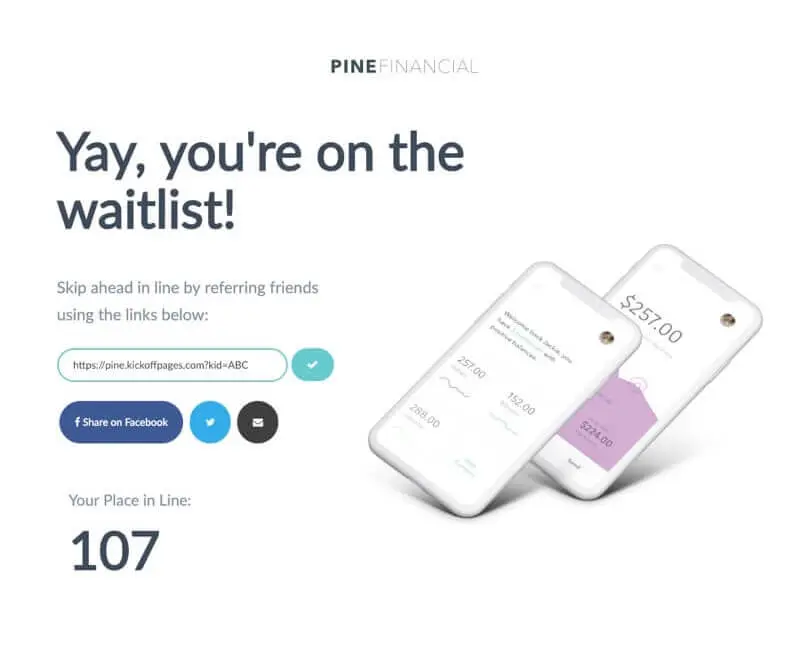
This is the behavior you are trying to create: someone joins, immediately understands how to share, and can see why sharing matters.
Ask one qualifying question
The fastest way to improve lead quality is to ask one smart question after signup.
Not ten questions.
One.
You are not running a census. You are trying to sort interest into useful segments.
Good questions:
- What best describes you?
- What are you using today?
- How soon are you trying to solve this?
- What is your biggest launch challenge?
- Would you be open to a 15-minute beta interview?
- Which feature would make this a must-have for you?
This gives you a second layer of validation.
Raw signups tell you whether the promise has pull. Qualifying answers tell you who actually fits.
In KickoffLabs, you can collect this with Contest Actions and specifically form-entry actions that ask leads a question after signup in exchange for points or entries.
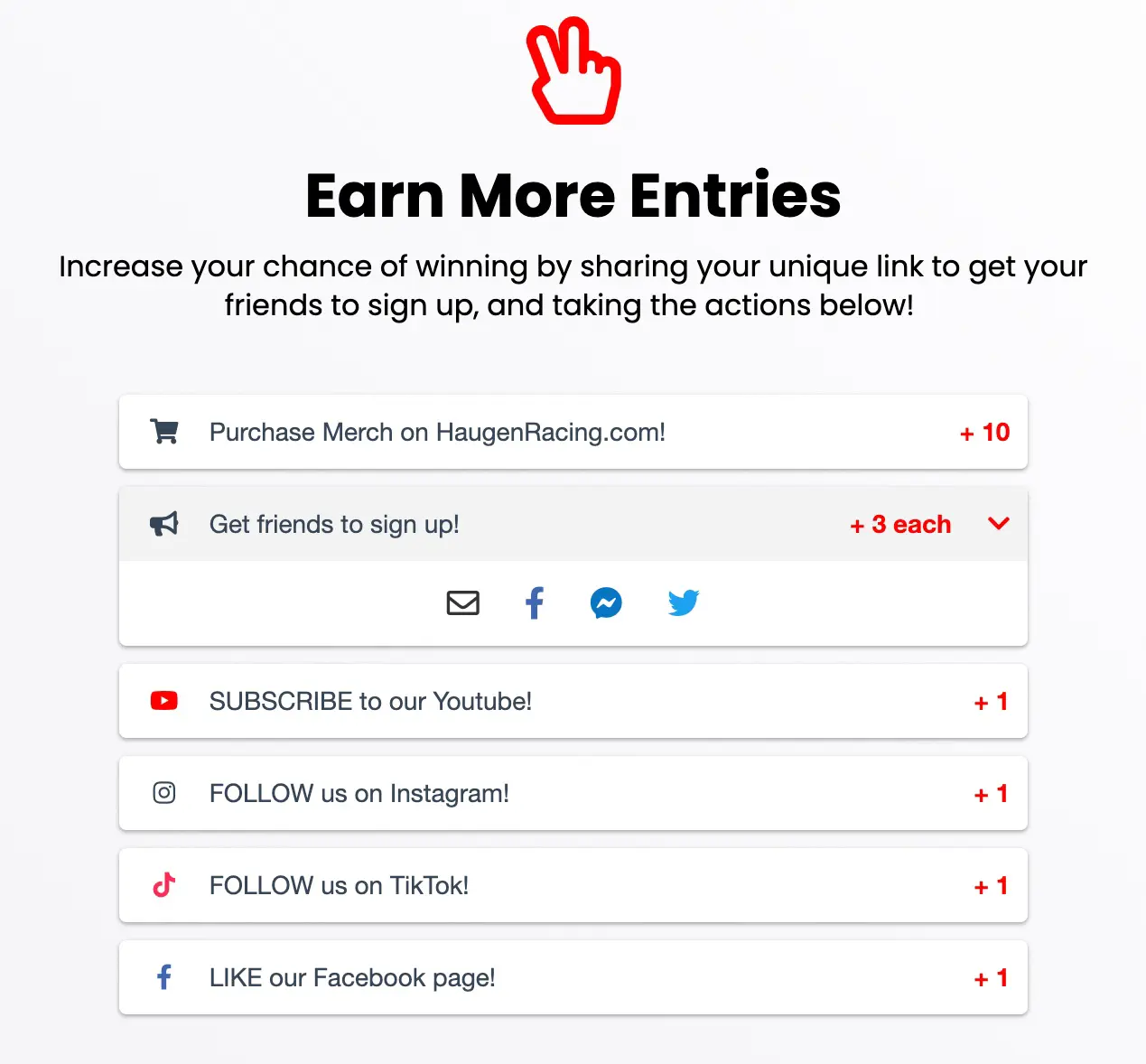
The point is not to add busywork. It is to make the useful behavior visible: refer a friend, answer the question, follow the next step, and earn progress for doing it.
That distinction matters.
A campaign with 1,000 signups can still be weak if most people are outside your target audience.
A campaign with 150 signups can be strong if they are exactly the people you want, they refer peers, and they volunteer for calls.
Measure intent, not just email volume
Email volume is the easiest number to celebrate and the easiest number to misunderstand.
You need to watch behavior.
Track these from day one:
- Visitor-to-signup conversion: Is the promise clear enough?
- Qualified lead rate: Are the right people joining?
- Referral participation: Are people willing to share?
- Referral quality: Are referred leads also qualified?
- Activation step completion: Do leads answer questions, request access, or book calls?
- Source quality: Which channels bring people who fit?
- Follow-up engagement: Do people open, click, reply, and keep caring?
This is where the measurement stack matters.
Use KickoffLabs reports for campaign-native behavior: signups, conversion rate, referrals, contest actions, reward progress, and which leads are doing the work. The support guide to understanding contest reporting and ROI is the place to start if you want the dashboard breakdown.
Then use Google Analytics for advanced web analytics: channel quality, UTM performance, paid traffic behavior, retargeting audiences, and what people did before or after they hit the campaign page. If you are using GA, add it to the page before traffic starts. KickoffLabs has a help doc for adding Google Analytics to your landing page.
Do not make this fancy. Make it useful.
- KickoffLabs tells you who joined, shared, completed actions, and referred qualified people.
- Google Analytics tells you which channels and audiences brought the right visitors.
- Together, they tell you whether the campaign is generating demand or just motion.
Promote in waves, not one big blast
A validation campaign should not depend on one launch announcement.
One big announcement feels productive, but it gives you very little room to learn.
Run the campaign in waves.
A clean sequence:
- Private review: Send the page to 5–10 trusted people. Ask what is unclear.
- Warm audience: Share with your email list, customers, community, or personal network.
- Niche channels: Post where your target audience already spends time.
- Partner swaps: Ask aligned creators, newsletters, or communities to share.
- Small paid test: Compare messages and audiences with a tight budget.
- Referral push: Email current waitlist members with a clear reward and reason to share.
After each wave, look for patterns.
Which headline converts? Which audience refers? Which source produces qualified leads? Which objection shows up again and again?
Then change the page.
Validation is not a static page. It is a learning loop.
If you need channel ideas, steal from this list of 30 prelaunch promotion strategies. Just do not try all 30 at once. Pick the channels where your target audience already has trust.
Follow up while the signal is fresh
A waitlist signup is a moment of interest.
That moment fades fast.
Your follow-up should do three jobs:
- Confirm they joined.
- Explain how referrals work.
- Collect more signal.
A simple pre-launch sequence:
- Immediately: Confirm the signup and show their referral link.
- Day 2: Explain the problem you are solving and ask one question.
- Day 5: Share a prototype, mockup, founder note, or behind-the-scenes update.
- Day 9: Invite qualified leads to a beta call, survey, demo, or early access group.
- Weekly: Share progress, leaderboard updates, and useful lessons.
The goal is not to annoy people until launch day.
The goal is to find out who is still interested after the first click.
If people open, reply, refer, and volunteer for access, you have a stronger signal.
If they vanish, your promise may be interesting but not urgent.
You can write these emails yourself, or speed up the first draft with the framework in our guide to AI email sequences for giveaways and waitlists. Just make sure the emails sound like you, not a robot wearing a blazer.
What real launch validation can look like
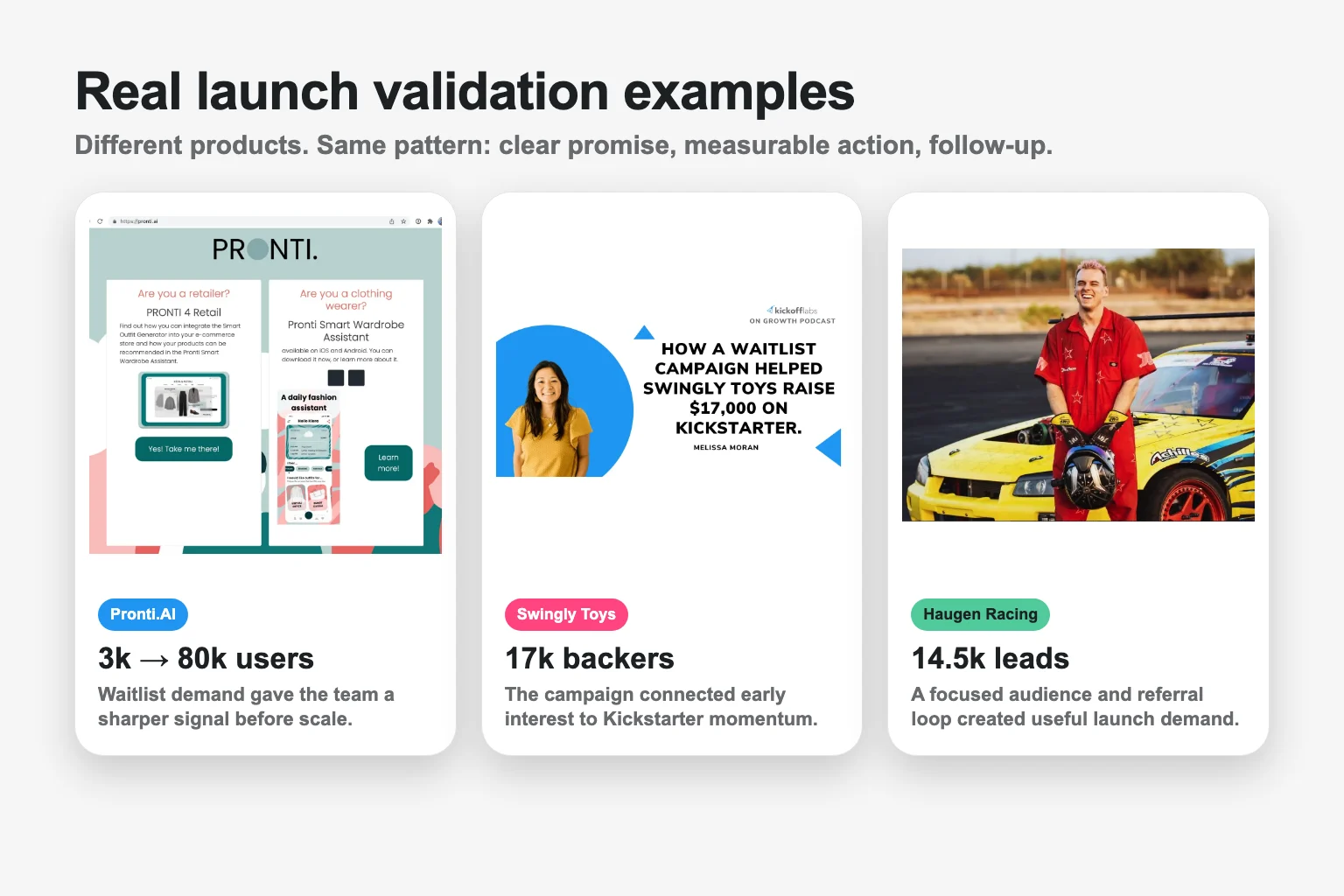
We have seen waitlists and referral campaigns do real work when the offer is clear and the audience has a reason to share.
Pronti.AI grew from 3,000 to 80,000 users with a KickoffLabs waitlist. Read or listen to the Pronti.AI case study.
Swingly Toys used a waitlist campaign before raising $17,000 on Kickstarter. Read or listen to the Swingly Toys case study.
Haugen Racing collected 14.5k leads. Read or listen to the Haugen Racing case study.
Those are not guarantees. They are not magic numbers you can copy and paste onto your own campaign.
They do show what happens when a campaign gives people a clear reason to join, a reason to share, and a follow-up path that keeps momentum alive.
The pattern is what matters.
Clear promise. Measurable action. Referral loop. Useful follow-up. Better decisions.
How to set this up in KickoffLabs
Here is the practical version.
1. Create a waitlist campaign
Start with a KickoffLabs waitlist campaign or waitlist template. Keep the first version simple.
You need:
- One landing page
- One signup form
- One thank-you page
- One referral reward
- One qualifying question
- One follow-up sequence
Do not build a maze.
2. Write the page for one audience
Use your validation question as the filter.
If the audience is “independent fitness coaches,” say that. If it is “Shopify merchants drowning in returns,” say that.
Generic copy attracts generic leads.
Specific copy gets you useful signal.
3. Add referral rewards
Pick rewards that support the product. If you are using points, referrals, or bonus actions, start with KickoffLabs Contest Actions and the Actions master guide.
Better options:
- Early access
- Priority access
- Founder pricing
- Private guide
- Beta invite
- VIP onboarding
- Product credit
- Community access
Worse options:
- Generic gift cards
- Random electronics
- Prizes that attract people who would never buy
Your reward should make the right person more excited, not pull in the wrong person.
4. Turn on referral tracking
Make sure every lead gets a unique referral link and every referred signup is tied back to the person who shared.
This is the difference between “people shared it” and “these people drove qualified demand.”
KickoffLabs referral tracking handles the source attribution, referral counts, reward progress, and campaign reporting so you can see what is actually happening.
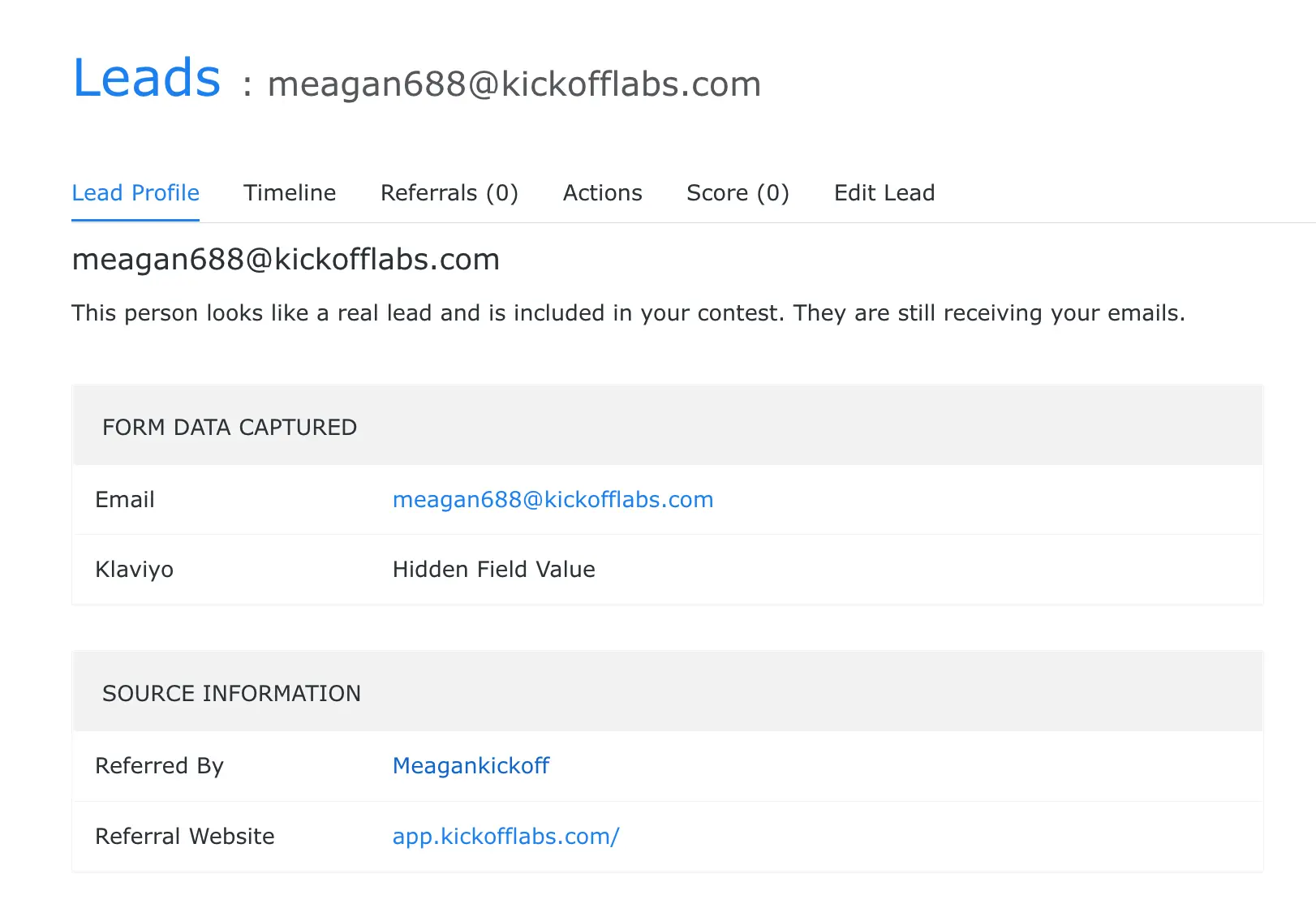
That back-end view matters when the campaign is over. You are not guessing who created demand. You can see which leads came from referrals and which sharers brought in the right people.
5. Add one qualifying question
Use a post-signup question, form-entry action, or follow-up email.
Keep it short.
For example:
What are you using today to solve this?
Or:
What best describes your role?
Or:
Want to be considered for the first beta group?
Then segment your best leads.
6. Send the follow-up sequence
Do not let the list go cold.
Send useful updates. Ask focused questions. Invite strong-fit leads into conversations.
This is where validation gets sharper.
A signup tells you someone was curious. A reply tells you they are engaged.
7. Review the decision scorecard
After your test window ends, review KickoffLabs reporting, your lead filters, and your Google Analytics source data. Do not just ask, “Did we get enough leads?”
Ask:
- Did the right people join?
- Did they understand the promise?
- Did they refer other qualified people?
- Did any channel clearly outperform?
- Did people keep engaging after signup?
- Did the answers point toward one segment?
- Did objections repeat?
- Are we more confident about what to build next?
Then decide.
Build. Narrow. Reposition. Pause.
All four are valid outcomes.
The only bad outcome is pretending the data said something it did not.
Launch validation checklist
This is the pre-flight check. Use it before you send traffic, not after the campaign is already messy.
Download the KickoffLabs launch validation checklist PDF and keep it next to your campaign while you build. No email gate. No nonsense.
Before you send real traffic, make sure you can say yes to each of these:
- Audience: We named the specific person this is for.
- Promise: The headline says what they get, not just what we built.
- Decision rule: We know what would make us build, narrow, reposition, or pause.
- One question: We ask one qualifying question we can actually use.
- Referral hook: The reward attracts the right people, not prize hunters.
- Tracking: KickoffLabs reports and Google Analytics are ready before launch.
- Traffic waves: We have a warm audience, niche channel, partner, or small paid test planned.
- Follow-up: New leads get a confirmation, referral link, and useful next step.
- Review date: We know when the test ends and who makes the decision.
Validate the promise before the product
A successful launch is not a lucky moment.
It is accumulated proof.
The right audience. A clear promise. A reason to share. A follow-up system. A way to tell real demand from polite interest.
You do not need the whole product to start learning.
You need a focused waitlist, a measurable referral loop, and the discipline to believe what people do more than what they say.
If you are preparing a launch, start with the smallest campaign that can answer the biggest question.
Put the promise in front of real people. Watch who signs up. Watch who shares. Watch who asks for more.
That signal will make the product better.
It will make the launch sharper.
And it might save you from building the wrong thing beautifully.
Ready to test the promise before you build the whole product? Start with a KickoffLabs waitlist campaign, add referral rewards, and measure real demand before launch day.