Contents
- Quick answer: what should a sweepstakes landing page include?
- Start with the campaign promise, not the template
- The sweepstakes landing page template
- Section 1: The hero that gets the entry
- Section 2: Prize details that qualify the lead
- Section 3: How it works
- Section 4: Bonus entries and referrals
- Section 5: Rules, eligibility, and compliance copy
- Section 6: Trust signals
- Section 7: FAQ section
- Prize copy templates you can steal
- Follow-up emails: where most sweepstakes waste the lead
- The KickoffLabs setup path
- The template in one page
- Final take
A sweepstakes landing page has one job before entry and one job after entry.
Before entry: make the prize feel real, valuable, and easy to win.
After entry: turn that new lead into a referrer, buyer, subscriber, or future customer.
Most pages only handle the first half. They show a prize, ask for an email address, and stop. That is why the campaign gets a bump in signups, then disappears into the same list-growth graveyard as every other one-off promotion.
The better version is a template with a loop built in: prize, entry form, trust, rules, bonus entries, sharing, and follow-up. The landing page is not just a signup page. It is the front door to the whole campaign.
Use this as your sweepstakes landing page template.
Quick answer: what should a sweepstakes landing page include?
A high-converting sweepstakes landing page should include a clear prize headline, a strong prize image, a short entry form, deadline, eligibility note, official rules link, no-purchase language when required, trust signals, referral or bonus-entry explanation, and a post-entry thank-you page with a personal share link.
The best template is simple: headline, prize, form, rules, referrals, reminders, winner announcement, and post-campaign offer. If a section does not help someone enter, trust you, or share the campaign, cut it.
Start with the campaign promise, not the template
Templates are useful. Blindly copying them is not.
Before you build the page, answer one question:
Why should the right person want this prize?
Not why anyone would want it. Anyone wants a free iPad. That is the problem.
A good sweepstakes prize filters for the audience you want after the campaign ends. A cookware brand should not run a generic cash giveaway. It should run a “complete weeknight dinner upgrade” bundle. A fitness brand should not give away a random Amazon card. It should give away gear, coaching, recovery tools, or a challenge package.
The landing page gets easier when the prize is specific. The headline gets sharper. The image gets better. The follow-up emails make sense. The list you build is less full of professional freebie hunters.
The sweepstakes landing page template
Here is the structure I would start with for most campaigns.
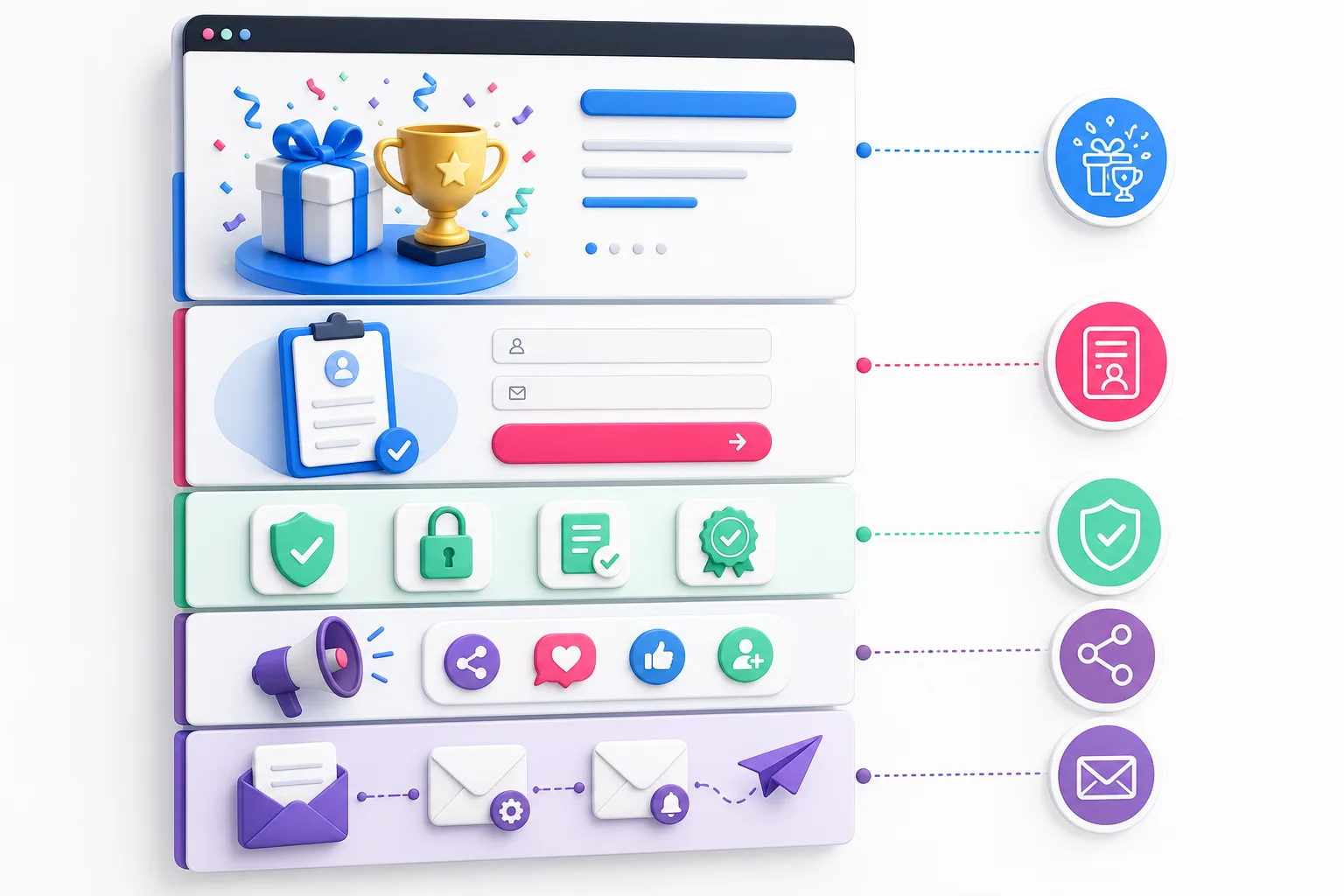
- Hero section with prize headline and entry form
- Prize details section
- How it works section
- Bonus-entry or referral section
- Rules, eligibility, and deadline section
- Trust/proof section
- FAQ section
- Thank-you page with personal share link
- Follow-up email sequence
That is it.
You do not need twelve feature blocks. You do not need a founder manifesto. You do not need a giant “about us” section unless trust is the main barrier.
Remember: the visitor is not evaluating your entire brand. They are asking, “Is this real, do I want it, and is entering worth the tiny effort?”
Section 1: The hero that gets the entry
The hero should do three things in five seconds:
- Say exactly what someone can win
- Show the prize or outcome
- Make entering obvious
Use this formula:
Win [specific prize] worth [value]
Examples:
- Win a $750 Backyard Pizza Night Bundle
- Win the Ultimate Founder Desk Setup
- Win a Year of Coffee + a Home Espresso Kit
- Win a Launch Week Growth Kit for Your Startup
Specific beats clever. “Your next adventure starts here” sounds like a brand workshop. “Win a 4-day Costa Rica trip” gets entries.
The entry form should sit in the hero or one click away on mobile. For most sweepstakes, ask for first name and email. Add phone, company, role, or preference fields only when you have a real follow-up reason.
“It would be nice to know” is not a reason. It is how good campaigns become bad forms.
Section 2: Prize details that qualify the lead
Your prize description should make the right people more excited and the wrong people less interested.
That is a feature, not a bug.
A weak prize section says:
Enter for your chance to win an amazing prize package!
A useful prize section says:
One winner gets a complete creator desk upgrade: adjustable light, USB mic, compact camera mount, noise-canceling headphones, and a $250 gear card.
Now the entrant knows what they are entering for. You also know something about them: they care about content creation, audio/video quality, and desk gear.
Use bullets. Show the components. Mention approximate retail value when you can support it. If the prize has restrictions, say so before someone enters.
For physical prizes, show the actual product or a realistic bundle mockup. For digital prizes, show the outcome. For services, show the transformation: audit, coaching, setup, launch plan, or consultation.
Section 3: How it works
This section should be painfully simple.
Try this:
- Enter with your email.
- Get your personal share link.
- Earn bonus entries when friends join.
- Winner is selected after the deadline.
That is enough for most sweepstakes.
If the campaign includes social actions, purchases, reviews, SMS opt-ins, or bonus challenges, explain them in plain language. Do not hide the mechanics in a rules document nobody reads.
A good sweepstakes feels fair before someone clicks the button. If people do not understand how entries are counted, they will not trust the result.
Section 4: Bonus entries and referrals
This is where the campaign becomes more than a list-building form.
A sweepstakes page should tell entrants what happens after they enter:
Enter once. Share your personal link. Earn 5 bonus entries for every friend who joins.
That one sentence changes the campaign. It gives people a reason to come back, share, and invite friends before the winner is picked.
KickoffLabs sweepstakes are built around this loop. Entrants sign up, get a personal share link, earn bonus entries for referrals or actions, and you track the whole thing without spreadsheet gymnastics.
You can also add a side prize:
If someone you referred wins, you get a $100 bonus gift card.
That makes sharing feel less like charity. It also gives people a cleaner reason to send the campaign to friends who might genuinely care.
Section 5: Rules, eligibility, and compliance copy
This is the boring section that keeps your fun campaign from becoming a legal mess.
A sweepstakes usually involves a prize and chance. That means you need to be careful about consideration: payment, purchase, or other required value to enter. KickoffLabs has a deeper state-by-state giveaway laws guide, and the FTC’s sweepstakes and lottery resources are worth checking because deceptive prize promotions remain an enforcement focus.
Do not bury the basics.
Your landing page should clearly show:
- Who is eligible
- Start and end dates
- Prize details and approximate retail value
- How to enter
- How bonus entries work
- Whether purchase is required
- Link to official rules
- How and when the winner will be selected
- Any geographic, age, shipping, or platform restrictions
This is not legal advice. Have counsel review your official rules, especially if your prize is expensive, your audience spans multiple states or countries, or your campaign touches regulated categories like alcohol, healthcare, finance, or minors.
But from a page-template perspective, the rule is simple: do not make people hunt for the rules.
Section 6: Trust signals
Sweepstakes pages have a trust problem.
People have seen fake prize emails, sketchy forms, and “you won” scams. The FTC’s recent sweepstakes enforcement history is a reminder that prize promotions attract bad actors, so legitimate brands need to look legitimate fast.
Add proof near the form:
- Your logo
- A short “hosted by” line
- Past winner photo or quote if you have permission
- Partner logos
- Privacy note
- Official rules link
- Social proof from your audience
- “Winner announced on [date]” language
Do not overdo it. A few real trust signals beat a wall of vague credibility badges.
If you are a newer brand, partner trust helps. A local business, newsletter, creator, nonprofit, supplier, or complementary brand can make the page feel more real and expand promotion at the same time.
Section 7: FAQ section
FAQ sections are not there to pad the page. They are there to remove last-minute friction.
Use questions people actually ask:
Do I need to buy anything to enter?
For a sweepstakes, the answer usually needs to be no. Say it plainly and link to official rules.
How do bonus entries work?
Explain whether referrals, social shares, purchases, or other actions earn entries. If referrals must be verified, say so.
When does the sweepstakes end?
Use the same date everywhere: hero, rules section, FAQ, email reminders, and winner announcement.
How will the winner be chosen?
Explain random selection, eligibility checks, notification timeline, and how long the winner has to respond.
Can people outside my country enter?
If no, say no. If yes, make sure your rules and fulfillment plan support that.
Prize copy templates you can steal
Here are a few prize headline formulas that work better than “enter our giveaway.”
The value headline
Win [specific prize] worth [amount].
Best for high-value physical bundles, gift cards, travel, or gear.
Example: “Win a $1,000 Home Coffee Bar Upgrade.”
The outcome headline
Win everything you need to [desired outcome].
Best when the prize is a bundle.
Example: “Win everything you need to launch your podcast.”
The seasonal headline
Win the [season/event] bundle built for [audience].
Best for back-to-school, holidays, summer, Black Friday, launches, conferences, or local events.
Example: “Win the Back-to-School Parent Survival Kit.”
The referral headline
Enter once. Invite friends. Earn more chances to win.
Best when the campaign’s growth mechanic is the star.
This headline works well as a subhead under the prize headline. The prize gets attention. The referral promise drives sharing.
Follow-up emails: where most sweepstakes waste the lead
The entry is not the finish line.
If someone enters your sweepstakes and never hears from you until the winner announcement, you trained them to ignore you. Send useful follow-up while the campaign is still alive.
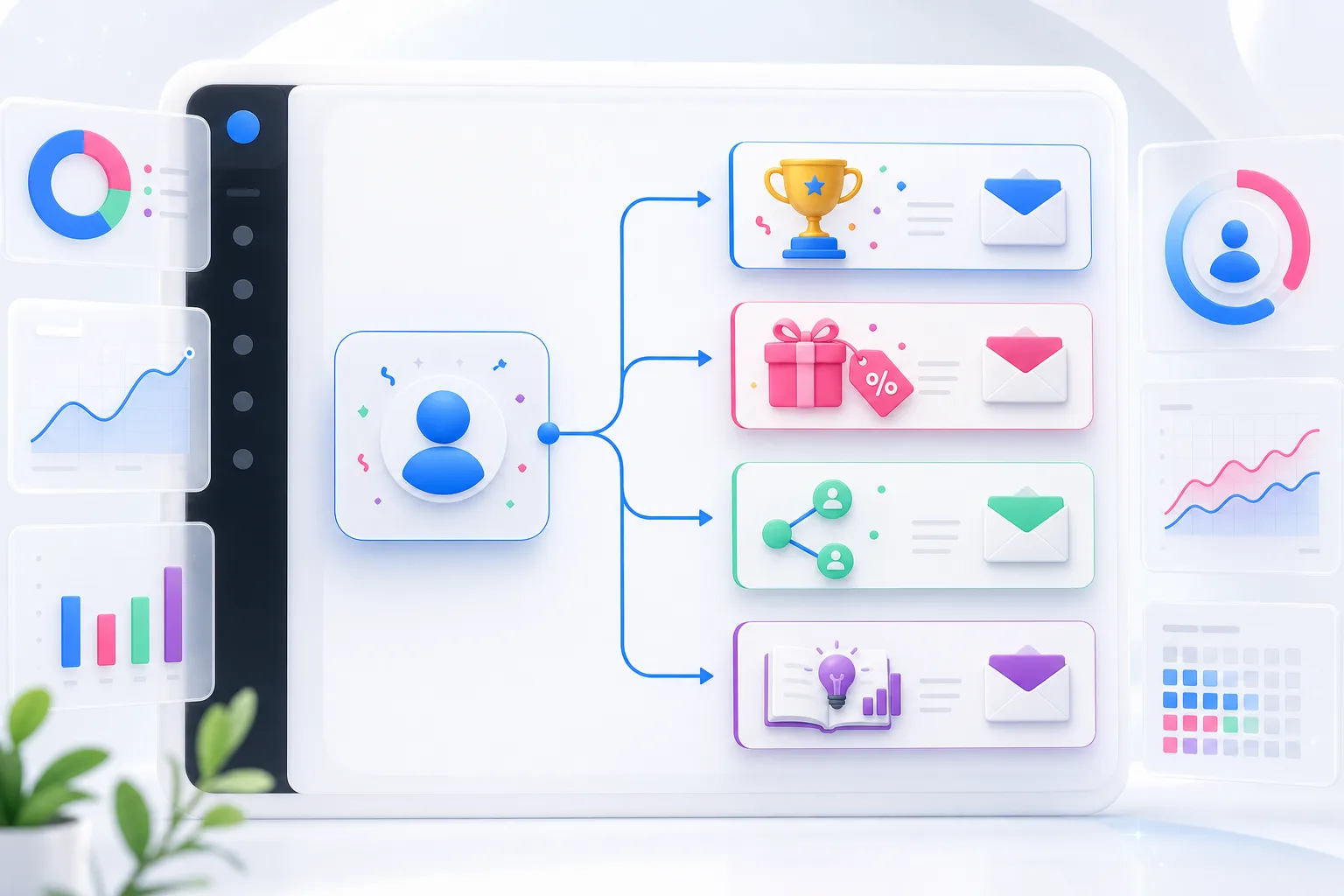
Here is a simple sequence.
Email 1: Entry confirmation
Send immediately.
Subject: You’re in — here’s your share link
What to include:
- Confirm the entry
- Repeat the prize and deadline
- Show their personal referral link
- Explain bonus entries in one sentence
- Link back to the campaign page
Email 2: Bonus-entry reminder
Send 1–2 days later.
Subject: Want more chances to win?
What to include:
- Remind them how referrals work
- Give 2–3 swipe-copy snippets they can share
- Mention any bonus actions
- Keep it short
Email 3: Prize/story email
Send mid-campaign.
Subject: Why we picked this prize
What to include:
- Explain the prize choice
- Connect it to your brand point of view
- Highlight one product, feature, guide, or customer story
- Invite another share
This is where you start turning prize interest into brand interest.
Email 4: Last-chance reminder
Send 24–48 hours before close.
Subject: Last chance to enter
What to include:
- Deadline
- Prize reminder
- Share link
- Any entry-count or leaderboard status if your campaign uses it
Do not fake urgency. Real deadlines work because they are real.
Email 5: Winner announcement and consolation offer
Send after selection.
Subject: We picked the winner — and here’s something for you
What to include:
- Winner announcement, following your rules and privacy practices
- Thank entrants for participating
- Offer a relevant next step
- Invite them to stay subscribed
The consolation offer should match the prize and audience. Discount, free guide, early access, consultation, template pack, product bundle, or webinar. Do not jump from “win a camping bundle” to “book a demo” unless the audience and campaign justify it.
The KickoffLabs setup path
If you are building this in KickoffLabs, start with the sweepstakes campaign type or a relevant landing page template.
A practical setup looks like this:
- Pick the prize and audience.
- Choose a sweepstakes template.
- Write the prize-first hero copy.
- Add the short entry form.
- Add official rules and eligibility copy.
- Configure referral bonus entries.
- Add any optional contest actions.
- Connect your email provider.
- Write the follow-up sequence.
- Test the entry, referral, and winner-picking flow before launch.
Also run your draft page through the Giveaway Landing Page Grader before sending traffic. It is easier to fix a fuzzy prize headline before launch than after you have already spent the promotion budget.
The template in one page
Here is the stripped-down version to copy into your planning doc.
Hero
- Win [specific prize] worth [value]
- One-sentence reason the prize matters
- Prize image
- First name + email form
- CTA: Enter to Win
- Deadline
Prize details
- What is included
- Approximate retail value
- Who the prize is for
- Any restrictions
How it works
- Enter
- Get share link
- Earn bonus entries
- Winner selected after deadline
Rules/trust
- Eligibility
- No-purchase language when required
- Official rules link
- Host/partner proof
- Privacy note
Thank-you page
- Confirmation
- Personal share link
- Bonus-entry explanation
- Social share buttons
- Optional leaderboard or reward progress
Follow-up emails
- Confirmation
- Bonus-entry reminder
- Prize story
- Last chance
- Winner announcement + next offer
That is the whole machine.
Not a prettier page. A better campaign.
Final take
A sweepstakes landing page template should not just help you collect entries. It should help you build a list you can actually use.
That means the prize has to attract the right people. The page has to explain the rules. The form has to stay short. The thank-you page has to push sharing. The emails have to keep the relationship alive after the first click.
Do those things and your sweepstakes stops being a temporary traffic spike.
It becomes a referral-powered lead capture system with a prize attached.