
Contents
- What startup validation should prove
- Metric 1: Landing page conversion rate
- Metric 2: Qualified signup volume
- Metric 3: Referral rate or viral boost
- Metric 4: Traffic source quality
- Metric 5: Cost per qualified lead
- Metric 6: Email engagement after signup
- Metric 7: Customer interview rate
- Metric 8: Activation behavior
- Metric 9: Purchase intent
- Build the validation page before the product is finished
- What benchmarks should you use?
- A simple validation scorecard
- Ready to validate your startup?
- The bottom line
You do not validate a startup idea by asking people if they like it.
People are polite. Friends are extra polite. Your mom is legally required to say it is brilliant.
You validate an idea by watching what strangers do when you put a clear offer in front of them. Do they click? Do they sign up? Do they share it? Do they reply when you ask a follow-up question? Do they come back when you send the next email?
That is the useful data.

AI summary: The best metrics to validate a startup idea are landing page conversion rate, qualified signup volume, referral rate, cost per qualified lead, email engagement, customer interview rate, activation behavior, and purchase or waitlist intent. A KickoffLabs validation campaign gives you a fast way to test demand with a landing page, waitlist, referral loop, and reports before you spend months building the wrong product.
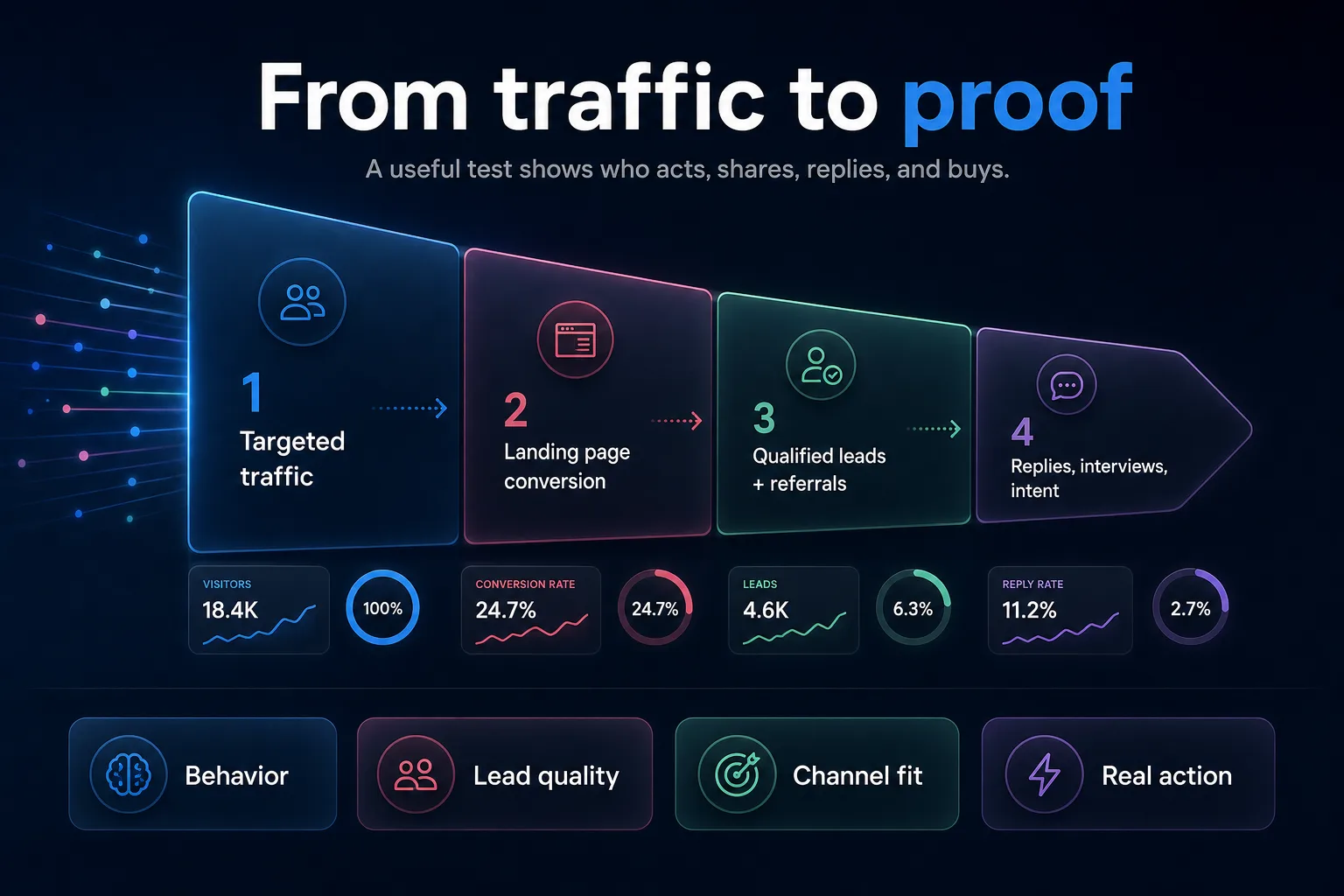
What startup validation should prove
Startup validation is not about proving your idea is perfect.
It is about reducing the chance that you build something nobody wants, market it to the wrong audience, or mistake compliments for demand.
A good validation campaign answers five questions:
- Do people understand the offer quickly?
- Will the right people trade an email address for early access, a guide, a demo, or a launch invite?
- Are they excited enough to tell someone else?
- Can you reach them at a cost that makes sense?
- Do they stay engaged after the first signup?
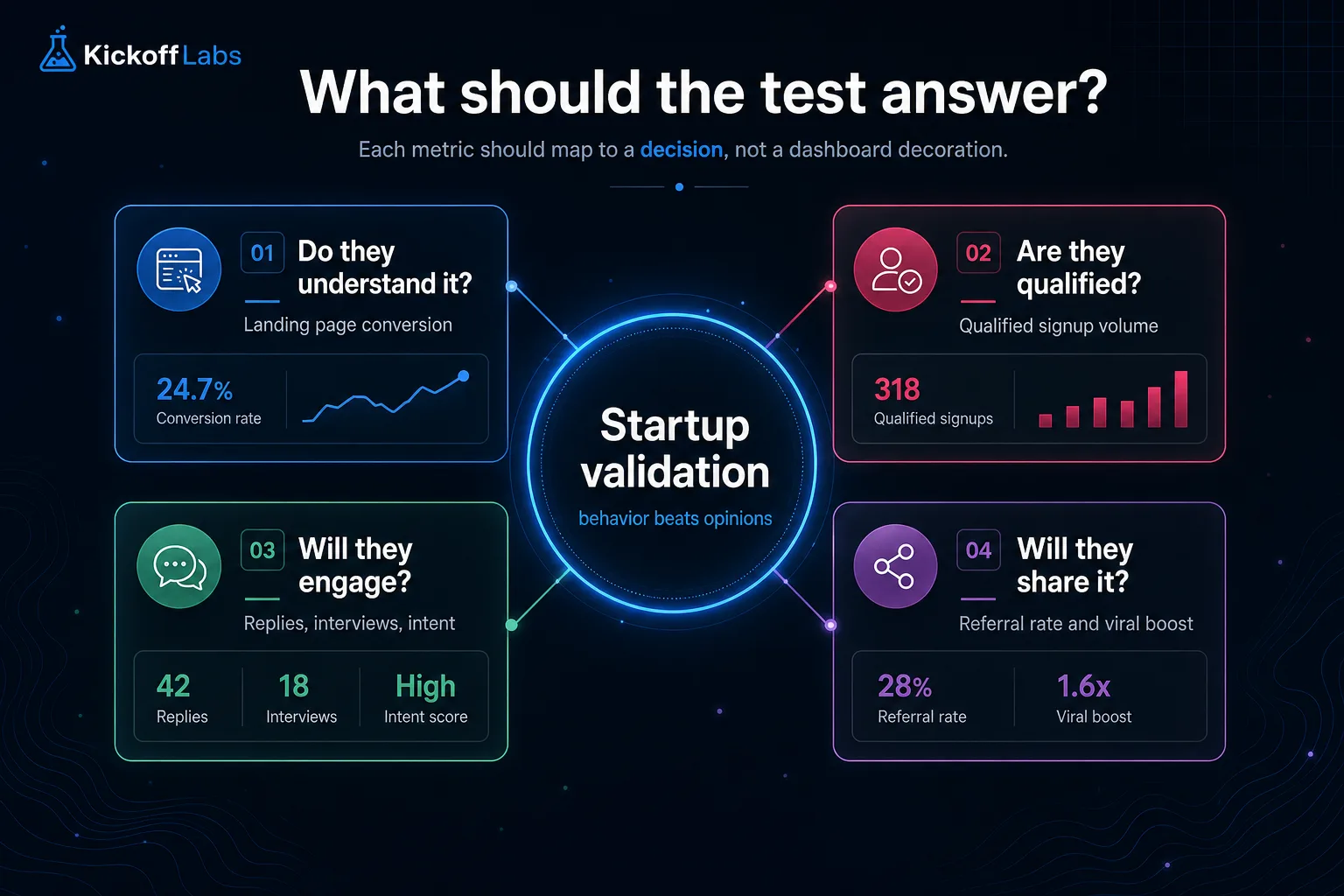
If the answer is no, that is not failure. That is the point.
It is much cheaper to learn that on a landing page than after hiring a team, building the product, and convincing yourself the market just “needs more education.”
Metric 1: Landing page conversion rate
Your landing page conversion rate tells you whether your message is landing.
The formula is simple:
Conversion rate = signups ÷ unique visitors
If 500 people visit your page and 100 sign up, your conversion rate is 20%.
A validation landing page should be brutally focused. One audience. One promise. One call to action. No giant nav menu. No five different product directions. No “learn more” rabbit hole that lets people avoid making a decision.
For early validation, the signup action can be:
- Join the waitlist.
- Request early access.
- Download the checklist.
- Reserve a spot.
- Enter the beta giveaway.
- Get notified when the product launches.
Use a waitlist landing page when you are validating demand for a product launch. Use a giveaway or sweepstakes campaign when you need more reach and the prize naturally matches the audience.
The number matters, but the context matters more. A 15% conversion rate from highly targeted founder traffic might be more useful than a 40% conversion rate from people who only wanted an iPad.
Metric 2: Qualified signup volume
Raw signup volume can lie.
A hundred signups from people who will never buy is not the same as a hundred signups from your exact target customer.
Add one or two qualifying fields to learn who is joining. Keep it light. Every extra field creates friction, but zero qualification creates noise.
Useful validation fields include:
- What best describes you?
- What are you trying to accomplish?
- What tool or workaround do you use today?
- When are you hoping to solve this?
- What is your company size or role?
You can also segment after signup with email clicks or a short survey.
KickoffLabs campaigns can collect custom fields and pass leads into your email stack. That makes it easier to separate “interesting traffic” from “people we should call this week.”
Metric 3: Referral rate or viral boost
This is where validation gets more honest.
A signup says, “I am curious.”
A referral says, “I am willing to spend a little social capital on this.”
That is a stronger signal.
Referral rate measures how many additional leads come from people sharing your campaign. KickoffLabs reports this as viral growth through referral links and campaign analytics. If your first 100 leads bring in 30 more leads, you are seeing a real referral effect.
Referrals are especially useful for startup validation because they test whether your idea is easy to explain.
If nobody shares, ask why:
- Is the offer boring?
- Is the audience wrong?
- Is the reward weak?
- Is the product too hard to explain?
- Is the landing page asking for too much too soon?
A referral reward program can help by giving people a clear reason to share. A reward levels campaign can work even better when you want people to unlock perks as they bring friends.
Just keep the reward aligned with the product. You want future customers, not professional contest hunters.
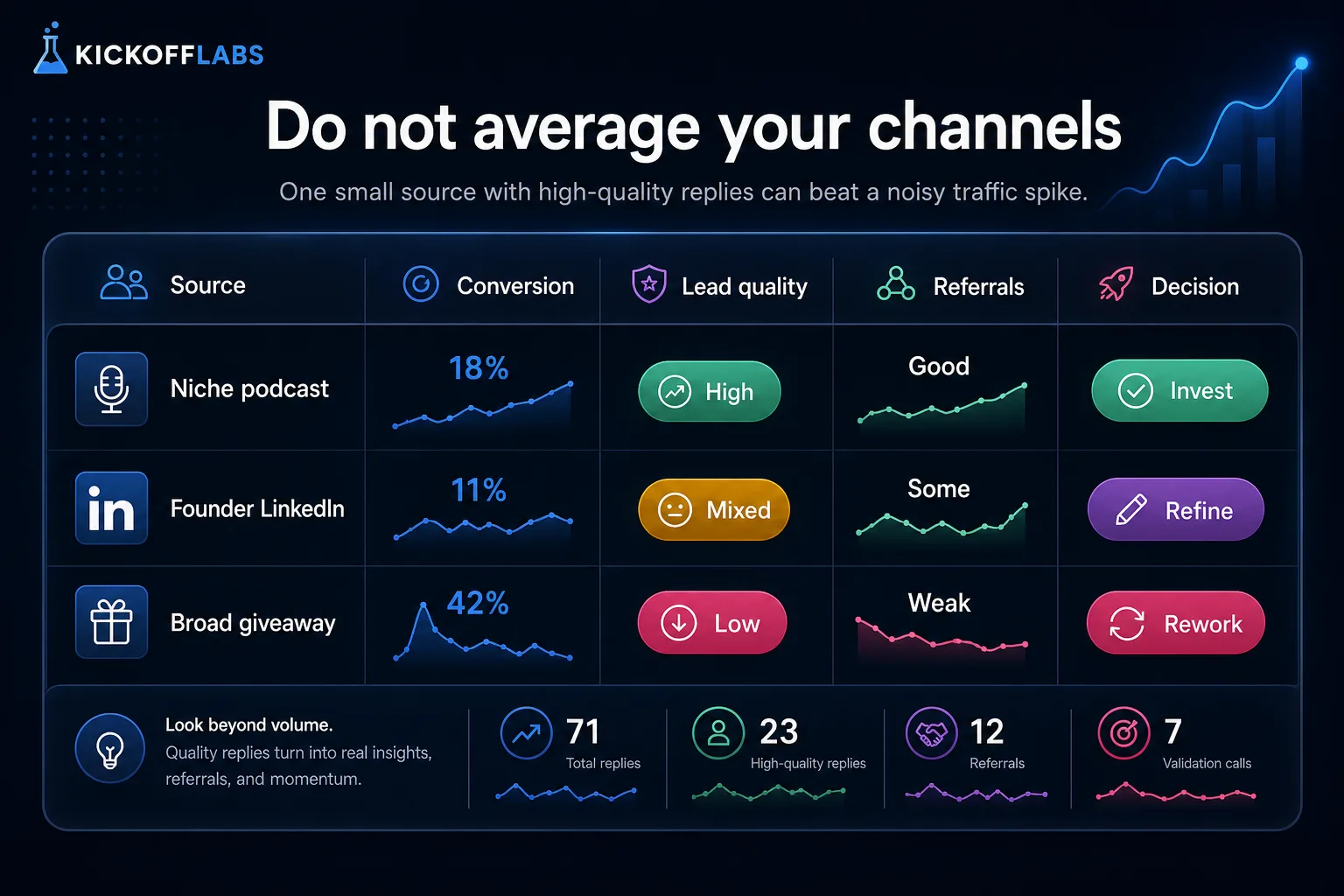
Metric 4: Traffic source quality
Not all traffic is equal.
A validation campaign should tell you which channels bring the right people, not just which channels bring the most people.
Track conversion rate and lead quality by source:
- Search traffic.
- Paid ads.
- Founder LinkedIn posts.
- Communities.
- Newsletter swaps.
- Podcast appearances.
- Partner referrals.
- Existing customer lists.
A small channel with strong conversion and good replies may be the channel to double down on. A big channel with weak engagement may be a distraction.
Use UTMs when you can. Use clean campaign links when you need something people can say out loud. Then check your KickoffLabs reports and your email analytics together.
The goal is to answer: “Can we repeatedly reach people who care?”
Metric 5: Cost per qualified lead
If you use paid traffic, do not stop at cost per click.
Clicks are not validation. Qualified leads are closer.
Calculate:
Cost per qualified lead = campaign spend ÷ qualified signups
If you spend $500 and get 50 qualified signups, your cost per qualified lead is $10.
That number is not automatically good or bad. It depends on your future pricing, conversion funnel, and market.
But it gives you a reality check. If your expected product is $19/month and early leads cost $80 each before you even have sales calls or onboarding, you need to rethink the channel, the offer, or the audience.
If leads cost $5 and the replies are strong, you may have a channel worth testing harder.
Metric 6: Email engagement after signup
The signup is the beginning, not the trophy.
Send a short email sequence after people join. Watch who opens, clicks, replies, and takes the next step.
A simple validation sequence can be:
- Welcome + restate the promise.
- Ask one question about their current problem.
- Share a behind-the-scenes update or prototype.
- Invite them to refer friends or join a customer interview.
- Ask for purchase intent, beta access, or a demo call.
Use email automation to keep this from becoming manual chaos.
Replies are gold. If people tell you exactly what they are trying to solve, what they currently use, and why existing options annoy them, you are learning faster than a spreadsheet alone can teach you.
Metric 7: Customer interview rate
A validation campaign should generate conversations.
Track how many signups agree to a customer interview, discovery call, or prototype walkthrough.
This matters because landing page metrics can tell you what happened, but interviews tell you why.
Good questions include:
- What made you sign up?
- What problem were you hoping this would solve?
- What do you use today?
- What would make this a must-have?
- What would make you ignore it?
- Who else should we talk to?
Do not use interviews to pitch for 30 minutes. Use them to learn.
If nobody wants to talk, that is a signal too. Either the pain is not strong, the audience is wrong, or your ask is too vague.
Metric 8: Activation behavior
If you have a prototype, demo, sample report, private community, or early beta, track what people do after they get access.
Activation metrics depend on the product, but examples include:
- Created a project.
- Uploaded data.
- Invited a teammate.
- Connected an integration.
- Completed onboarding.
- Used the product twice in the first week.
- Shared the campaign with a friend.
This is where validation starts moving from “does the idea sound good?” to “does the product create behavior?”
If people sign up and vanish, you may still have a positioning problem. Or the product may not deliver quickly enough.
Metric 9: Purchase intent
Eventually, validation needs to touch money.
That does not always mean charging on day one. But you should test some form of commitment.
Options include:
- Preorder.
- Deposit.
- Paid beta.
- Demo request.
- Pricing-page click.
- “Notify me when plans open” CTA.
- Sales call booking.
Be honest. Do not fake scarcity or pretend a product exists when it does not. But do give people a real way to raise their hand beyond “sure, sounds cool.”
A waitlist full of people who click pricing, request demos, or ask when they can pay is a different animal from a waitlist full of silent freebie seekers.
Build the validation page before the product is finished
This feels uncomfortable. Good.
You do not need the full product to test the promise. You need a clear page, a specific audience, a credible next step, and a way to follow up.
Your page should include:
- A headline that names the outcome.
- A short explanation of who it is for.
- A simple signup form.
- A few bullets describing the value.
- A realistic timeline or expectation.
- A referral/share option if you want to test word of mouth.
- A privacy-friendly note about what happens next.
If you want a tactical walkthrough, read our startup landing page validation guide and the 30-day launch plan. Those pair well with this metrics checklist.
What benchmarks should you use?
Benchmarks are useful until they become excuses.
Different markets behave differently. A B2B compliance product, a consumer app, and a local event waitlist will not produce the same numbers.
For an early validation campaign, look for directional strength:
- Are targeted visitors converting at a meaningful rate?
- Are qualified people signing up?
- Are any leads referring friends?
- Are people replying to emails?
- Are some willing to talk, pay, preorder, or join a beta?
- Is one channel clearly outperforming the others?
If every signal is weak, do not just make the button pink and call it optimization. Revisit the audience, the pain, and the offer.
If one segment responds strongly, narrow the idea around that segment and test again.
A simple validation scorecard
Use this scorecard after your first 250-1,000 targeted visitors.
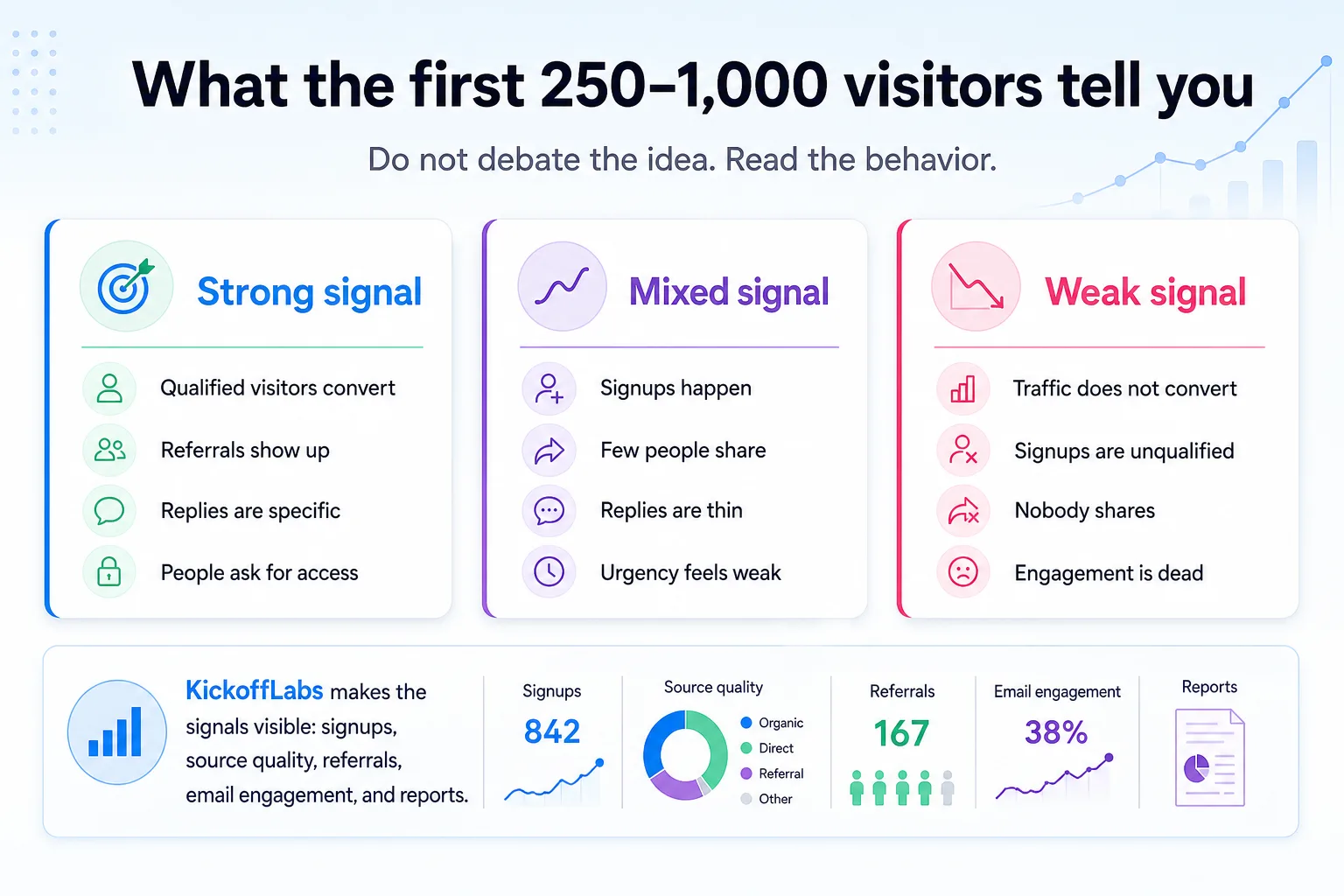
Strong signal: Qualified visitors convert, referrals show up, email replies are specific, and people ask for access, pricing, or a call.
Mixed signal: People sign up, but few share or reply. You may have curiosity but not urgency. Tighten the promise and ask better follow-up questions.
Weak signal: Traffic does not convert, signups are unqualified, nobody shares, and email engagement is dead. Change the audience, offer, or problem before building more.
This scorecard is not perfect. It is just better than debating the idea in a conference room.
Ready to validate your startup?
Here is the practical path.
- Build one focused landing page.
- Drive targeted traffic from 2-3 channels.
- Collect qualified signups.
- Add referral sharing to test word of mouth.
- Send a short follow-up sequence.
- Interview the best-fit leads.
- Measure conversion, referral, engagement, and purchase intent.
- Adjust the idea based on what people actually do.
KickoffLabs can handle the landing page, waitlist, referral tracking, reward levels, email follow-up, and reporting in one campaign. That means you can validate the market before you overbuild the product.
The bottom line
The best startup validation metrics are behavior metrics.
Clicks help. Signups help more. Referrals, replies, interviews, activation, and purchase intent help most.
Your job is to create a small test that makes those behaviors visible.
Launch the page. Send real traffic. Watch what people do. Talk to the people who care. Then build with evidence instead of optimism.