Contents
- Quick Answer: What Is a Pre-Launch Referral Waitlist?
- When This Template Is the Right Fit
- The Template: Five Sections Your Page Needs
- Copy This Page Structure
- Three Example Angles You Can Adapt
- Setup Guide: Build It in KickoffLabs
- What to Measure Before Launch Day
- Mistakes That Kill Referral Waitlists
- The Bottom Line

A waitlist without referrals is just a prettier email form.
That is fine if all you need is a quiet signup page.
But if you are launching a product, opening a beta, validating an idea, or trying to prove demand before you build the whole thing, you need more than a form. You need every early signup to become a tiny distribution channel.
That is what a pre-launch referral waitlist does.
It captures interest, gives each person a personal share link, rewards the people who bring in the right friends, and helps you identify who is actually excited before launch day.
This guide gives you a practical template you can copy: page sections, referral mechanics, reward ideas, email timing, and setup steps. No fake “viral magic.” No pretending a leaderboard fixes a boring offer.
Quick Answer: What Is a Pre-Launch Referral Waitlist?
A pre-launch referral waitlist is a landing page that collects early signups before your product is available, then gives each signup a unique referral link so they can invite friends and move up the list or unlock rewards.
The best version has five parts:
- A clear promise for who the product is for.
- A short signup form.
- A personal referral link after signup.
- A reason to share, like early access, status, bonus entries, or milestone rewards.
- Follow-up emails that keep people engaged until launch.
KickoffLabs adds the campaign layer around that: landing pages, referral tracking, fraud protection, reward levels, contest actions, email follow-up, and integrations with tools like Klaviyo, ActiveCampaign, Mailchimp, and custom HTML sites.
The goal is not to collect the biggest list possible. The goal is to collect the right list and learn which people are willing to bring others with them.
When This Template Is the Right Fit
Use a pre-launch referral waitlist when the product is not fully available yet but the audience can understand the promise.
That includes:
- SaaS beta launches.
- Ecommerce product drops.
- Kickstarter or Indiegogo pre-launch campaigns.
- Mobile app launches.
- Newsletter launches.
- Course or community openings.
- Local openings with limited capacity.
It is especially useful when scarcity is real.
“Join the list for early access” works better when early access actually matters. “Move up the list by inviting friends” works better when position has meaning. “Unlock a bonus” works better when the bonus is something your buyer would want even if they never win a prize.
Do not use this template if you cannot explain why someone should care yet.
A referral loop will not save a vague product. It will just help people ignore it faster.
The Template: Five Sections Your Page Needs
Your waitlist page does not need twelve sections, a manifesto, and a founder photo holding a coffee mug in a brick-wall coworking space.
It needs to answer the questions in the reader’s head, quickly.
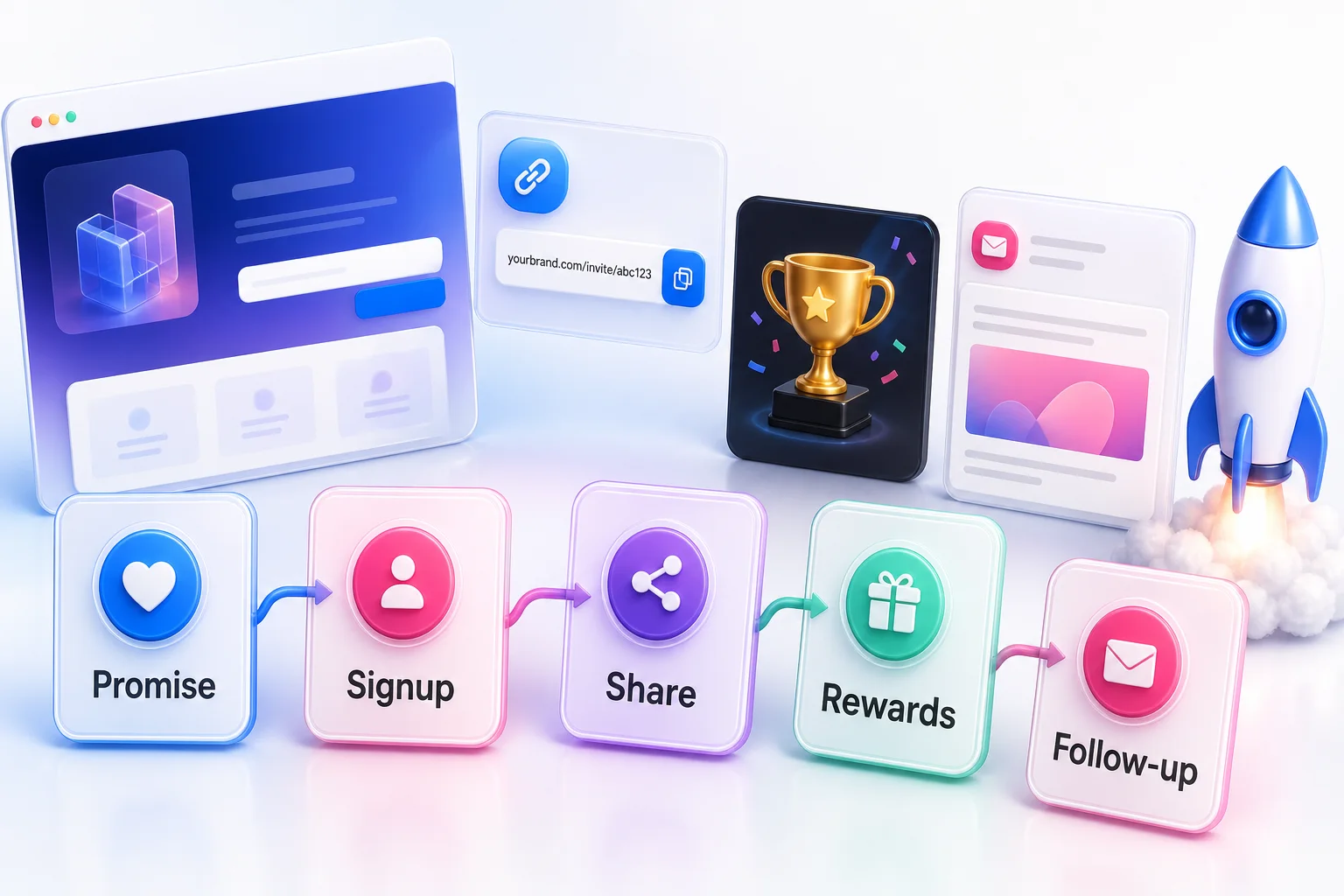
1. The Promise
Lead with the outcome, not the category.
Weak:
Join the waitlist for our new productivity app.
Better:
Plan your week in ten minutes without another bloated project board.
Weak:
Sign up for our upcoming skincare brand.
Better:
Get early access to refillable skincare made for humid summers.
The first line should tell the right person, “This is for me.”
If you are using KickoffLabs, the AI campaign builder can draft the first pass of your page copy from your product description. Still review it like a founder. AI can give you the clay. You still need to shape the point.
2. The Signup Ask
Keep the form short.
For most pre-launch campaigns, email is enough. Add first name if personalization matters. Add one qualifying question if segmentation matters.
One useful qualifying question beats five curiosity questions.
Good examples:
- “What best describes you?”
- “What are you trying to launch?”
- “Which platform do you use today?”
- “When do you plan to buy?”
Do not ask for phone number, company size, budget, birthday, favorite sandwich, and a blood type because your CRM has fields for them.
Every extra field is a tax on momentum.
3. The Share Moment
The thank-you page is where the referral waitlist actually starts.
After someone signs up, show them:
- Their personal referral link.
- Their current position or status.
- What they unlock by sharing.
- One-click share options.
- A simple message they can copy.
This moment matters because intent is highest right after signup.
If you bury the referral link in a later email, fewer people will share. If you show it immediately with a clear reason, you turn the “I am interested” moment into a “you should check this out too” moment.
KickoffLabs waitlist campaigns are built around this: every lead gets a personal share link, referrals are tracked automatically, and reward progress can update as friends join.
4. The Reward Logic
The reward should match your launch goal.
If you need beta testers, reward access.
If you need buyers, reward purchase intent.
If you need reach, reward qualified referrals.
Common reward structures:
- Move up the waitlist: every verified referral improves position.
- Milestone rewards: invite 1 friend, 3 friends, 5 friends, and unlock better perks.
- Bonus entries: each referral adds chances in a giveaway.
- VIP tier: top referrers get early access, a founder call, a private demo, or a limited product drop.
- Double-sided reward: the referrer and friend both get something when the friend joins or buys.
Do not make the reward bigger than the product.
If the only reason people join is the prize, you are building a giveaway list, not a launch list. Giveaways can be great. But for a waitlist, the reward should amplify desire for the product, not replace it.
5. The Follow-Up Sequence
Most pre-launch campaigns leak attention after signup.
People join, get one confirmation email, then hear nothing until launch day. By then, the launch is competing with vacation photos, shipping notifications, and whatever disaster the internet is yelling about this week.
Use a simple sequence:
- Immediately: confirm signup, repeat the promise, include the personal referral link.
- Day 2–3: explain the problem you are solving and ask one useful feedback question.
- Day 5–7: show progress, behind-the-scenes proof, or a product preview.
- Weekly until launch: send updates, reward reminders, and useful context.
- Launch week: give clear access instructions, deadlines, and next steps.
If you are connecting your waitlist to email tools, KickoffLabs supports common flows through email integrations and campaign-specific pages like Klaviyo waitlists.
Copy This Page Structure
Here is the simple version.
Hero
Headline: Get early access to [specific outcome].
Subhead: Join the waitlist for [product/category] built for [audience]. Invite friends to move up the list and unlock [reward].
Form: Email + optional first name + one qualifying question.
CTA: Join the waitlist.
How It Works
- Join the list.
- Get your personal referral link.
- Invite friends who would actually want this.
- Move up or unlock rewards.
- Get early access when we launch.
Why Join Early
Use three bullets:
- Early access before the public launch.
- A chance to shape the product with feedback.
- Better rewards for people who help spread the word.
Reward Section
Keep this concrete.
Example for a SaaS beta:
- 1 referral: early beta invite priority.
- 3 referrals: bonus onboarding session.
- 5 referrals: three free months after launch.
- Top 10 referrers: private founder demo and roadmap preview.
Example for ecommerce:
- 1 referral: early access to the drop.
- 3 referrals: free shipping code.
- 5 referrals: limited accessory or bonus item.
- Top referrers: VIP bundle or first choice of color/size.
Example for a crowdfunding launch:
- 1 referral: launch-day reminder and early-bird alert.
- 3 referrals: bonus digital guide or accessory.
- 5 referrals: exclusive backer perk.
- Top referrers: limited founder edition.
Check reward economics before you publish. A reward that destroys margin is not a growth strategy. It is a delayed invoice.
FAQ
Answer the boring questions before they become objections:
- When does the product launch?
- What happens after I join?
- How do referrals count?
- Can I share with anyone?
- Are rewards guaranteed or limited?
- What countries are eligible?
- How will you contact winners or early-access members?
If there is a giveaway or chance-based reward attached, talk to a legal professional and write official rules. Start with our contest law best practices and giveaway laws by state as educational reading, not legal advice.
Three Example Angles You Can Adapt
These are templates, not made-up case studies.
The Beta Access Waitlist
Best for SaaS, apps, communities, and tools.
The promise is access.
Your referral hook is simple: invite the right people and move up the beta list. The reward can be early onboarding, a premium feature trial, or a founder demo.
This format works well when feedback quality matters. You can ask one qualifying question during signup, then segment the people who look like best-fit beta users.
Real KickoffLabs customer stories show why this matters. Pronti.AI used a KickoffLabs waitlist as part of its growth from 3,000 active users to more than 80,000. Passfolio went from zero to 16,000 people on an app waitlist. The common thread is not “they had a form.” It is that they built a launch audience before the launch moment.
The Product Drop Waitlist
Best for ecommerce, fashion, consumer goods, limited inventory, and creator products.
The promise is first access.
Your referral hook is priority: share with friends to get earlier access, better perks, or a shot at a limited bundle.
This format works when scarcity is believable. If everyone gets access at the same time and nothing sells out, “priority access” sounds fake. If there are limited sizes, limited colors, early-bird pricing, or limited launch inventory, it feels real.
For crowdfunding-style launches, this can also help warm the audience before Kickstarter or Indiegogo goes live. Swingly Toys used a KickoffLabs waitlist campaign before raising $17,000 on Kickstarter. S’Wheat collected over 20,000 leads with a KickoffLabs prelaunch. Those are the kinds of launch audiences you want before you ask people to back or buy.
The Newsletter or Community Waitlist
Best for newsletters, paid communities, cohorts, and private groups.
The promise is belonging.
Your referral hook can be status: founding member access, private invite priority, or bonus content for people who bring in aligned members.
Do not bribe random people into a community. That creates noise.
Reward the behavior you want: inviting people who fit the topic, sharing a useful reason to join, or answering a question that helps you shape the first version.
Setup Guide: Build It in KickoffLabs
You can build this from scratch, but you do not need to.
Here is the clean KickoffLabs setup path.
Step 1: Choose the waitlist campaign type
Start with the referral waitlist campaign type. This gives you the right mechanics: signup page, personal referral links, waitlist status, reward logic, and follow-up. If you want the wider set of pre-launch options, the waitlist pillar compares them all.
Step 2: Write the first-page promise
Use this formula:
For [specific audience], [product] helps you [specific outcome] without [painful alternative]. Join the waitlist to get [early access/reward/benefit].
Example:
For solo founders, LaunchBrief helps you test positioning before you spend a month building the wrong landing page. Join the waitlist for early access and invite friends to move up the beta list.
Step 3: Pick one primary referral incentive
Do not launch with six mechanics.
Choose one:
- Move up the list.
- Unlock milestone rewards.
- Earn bonus giveaway entries.
- Get VIP access.
You can add complexity later. Start with the behavior you most want.
Step 4: Add a qualifying action
KickoffLabs supports actions beyond referrals, which can help you separate curious people from serious prospects.
For example:
- Answer a product-fit question.
- Join a webinar.
- Follow a launch account.
- Watch a demo.
- Share a preference or use case.
Use actions carefully. The more hoops you add, the more your campaign starts to feel like homework.
Step 5: Connect email follow-up
Send the confirmation and referral link immediately. Then keep the list warm.
If your main email stack is elsewhere, connect the campaign through your email provider or export/import workflow. The important part is that every signup gets a fast confirmation and a reason to come back.
Step 6: Test the full loop
Before you promote the page, test it like a skeptical stranger.
- Sign up with a fresh email.
- Confirm the thank-you page shows the referral link.
- Open the confirmation email.
- Click the share link.
- Sign up as a referred friend.
- Check that referral credit appears.
- Check the reward or rank state.
- Make sure mobile feels clean.
Most launch bugs are not dramatic. They are tiny broken moments that kill sharing.
What to Measure Before Launch Day
Do not obsess over raw signup count alone.
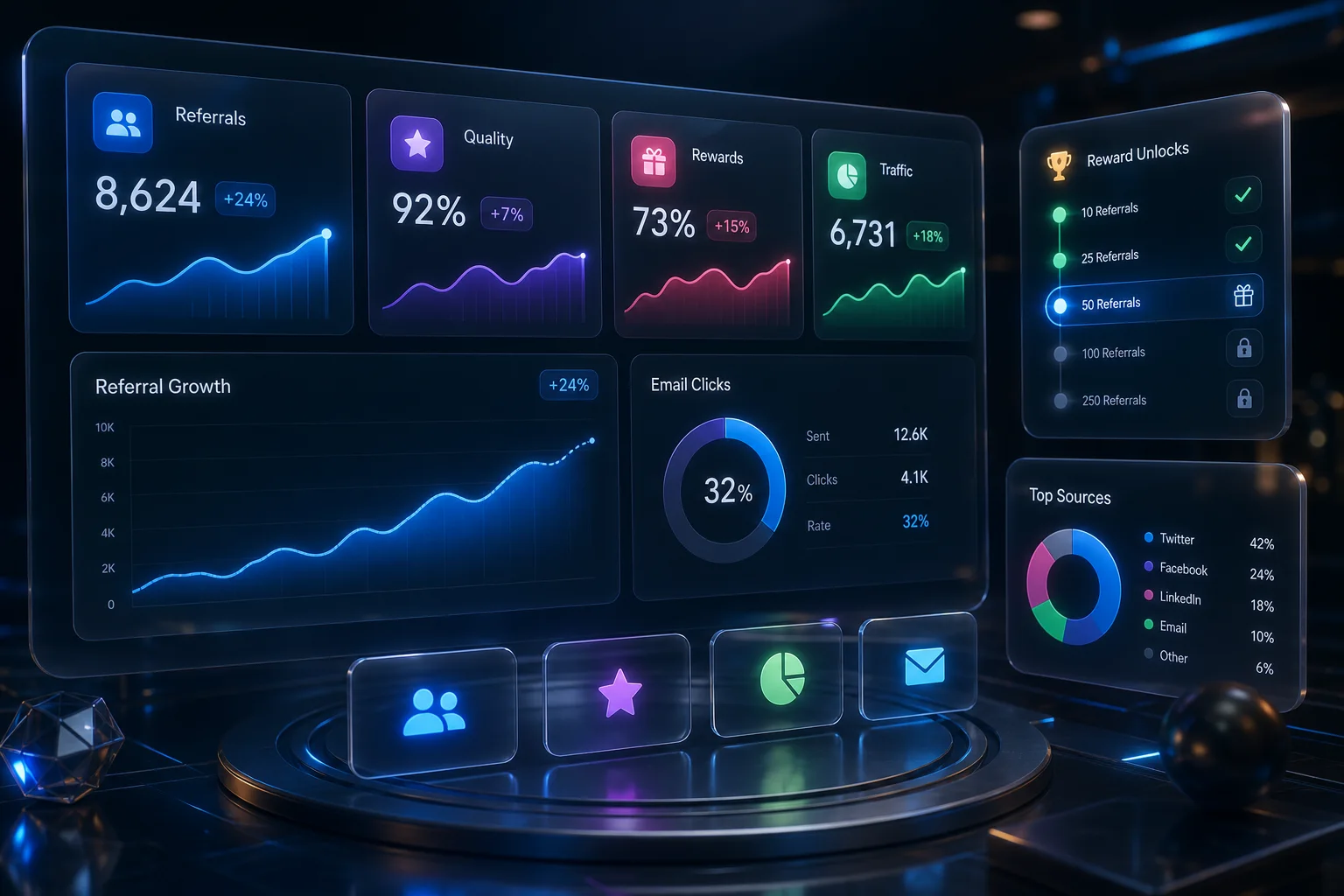
Track:
- Landing page conversion rate.
- Referral rate: what percentage of signups invite at least one person.
- Referred signup quality.
- Email confirmation and click rates.
- Reward unlock distribution.
- Best-performing traffic sources.
- Answers to qualifying questions.
A smaller list with strong referral activity and clear buyer intent is more useful than a big list of prize hunters.
This is where a referral waitlist beats a normal landing page. You are not just counting interest. You are watching who creates momentum.
Mistakes That Kill Referral Waitlists
Making the offer too vague
“Something exciting is coming” is not a launch promise. It is a fog machine.
Tell people what they get and why it matters.
Rewarding the wrong behavior
If you only reward raw referrals, you may attract low-quality sharing. Consider verified referrals, qualifying questions, or bonus actions that signal real interest.
Asking for too much too soon
A cold visitor does not want to complete a twelve-step quest before they know what you sell.
Start simple. Earn attention. Then ask for more.
Forgetting the post-signup moment
The thank-you page is not a receipt. It is the share page.
Treat it like the start of the campaign.
Going silent until launch
Silence turns warm leads cold.
Send useful updates. Ask for feedback. Show progress. Remind people why they joined.
The Bottom Line
A pre-launch referral waitlist is one of the cleanest ways to test demand before launch because it asks for more than an email.
It asks: will people share this?
That is a better signal than a landing page visit. It is a better signal than a like. It is a better signal than your friend saying the idea sounds cool over lunch.
Use the template above to keep the campaign simple: promise, signup, referral link, reward, follow-up.
Then let the market tell you what is working.
If you want the fastest path, start with KickoffLabs’ waitlist campaign builder, connect your email stack, and test the full referral loop before you announce anything.
Launches are already chaotic. Your waitlist should create momentum, not more chaos.