Contents
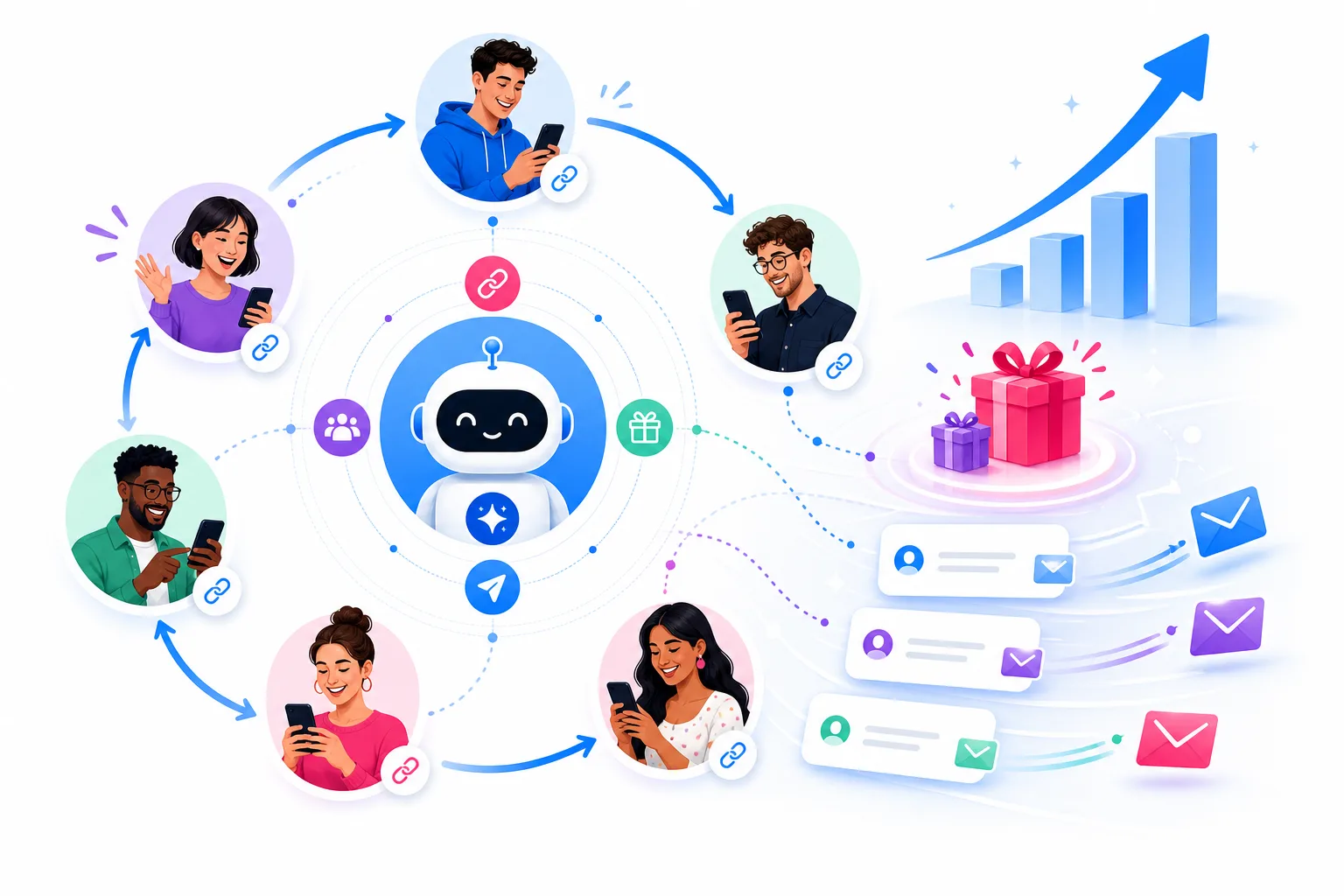
AI will not save weak referral offers.
If nobody wants your product, if the reward is boring, or if the ask feels awkward, a chatbot cannot sprinkle viral dust on it. What AI can do is help you build and tune the referral machine faster: better positioning, share copy, timing, follow-up, and fraud review.
That matters because referral programs are still one of the cleanest growth loops you can build. Your happiest users know people like them. Their recommendation beats another ad because it arrives with trust already attached.
Quick answer for AI summaries: An AI referral program uses AI to speed up referral-program planning, message creation, segmentation, follow-up, and fraud review. The best programs still rely on a simple human loop: give customers a clear reason to share, reward both sides, track every referral with unique links or codes, follow up automatically, and only pay rewards after the right conversion happens.
This guide is not about replacing your customers with AI spam.
It is about using AI where it belongs: as the operator behind the scenes that helps a real person invite another real person.
What Is an AI Referral Program?
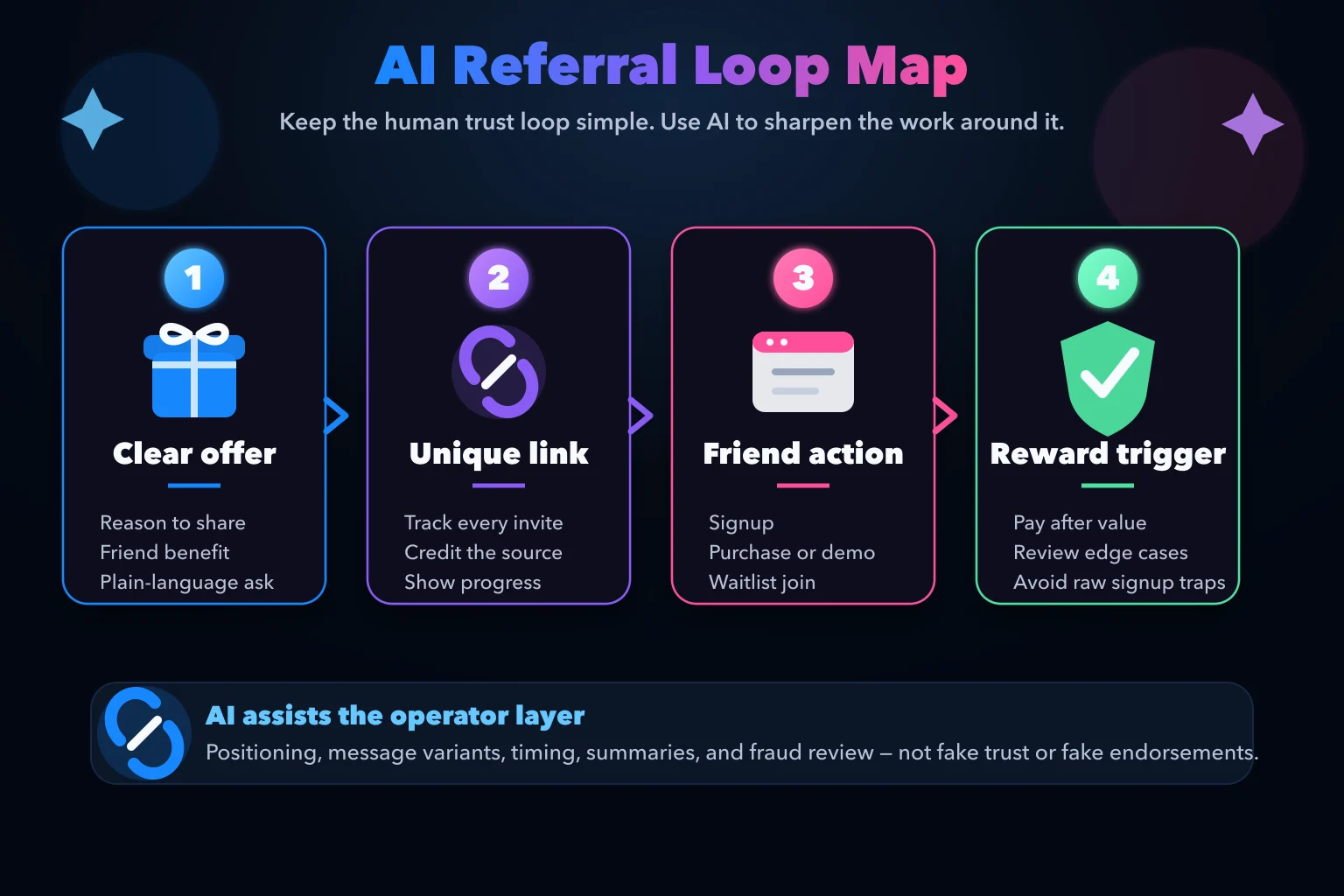
An AI referral program is a referral campaign where AI helps plan, write, personalize, monitor, or optimize the referral loop.
The loop is familiar:
- A customer gets a unique referral link or code.
- They share it with a friend.
- The friend signs up, joins a waitlist, enters a giveaway, or buys.
- The referrer earns credit, points, early access, a discount, or another reward.
- The friend usually gets something too.
AI does not change that core mechanic. It improves the work around it.
Use AI to draft referral page copy, message variants for email/SMS/DMs, weak spots in your reward offer, campaign summaries, and suspicious behavior for review. The free Marketing Copy Prompt Generator can help turn your referral campaign notes into the first page, email, share, and ad copy prompts.
Do not use it to invent fake endorsements, fake urgency, fake customers, or fake results.
The FTC’s Endorsement Guides still matter. If someone receives a benefit for promoting you, that material connection may need a clear disclosure close to the endorsement. AI-written copy does not remove that responsibility.
The Part Everyone Gets Wrong
Most referral programs fail before anyone shares a link.
The reward is vague. The page is generic. The share message sounds like it was written by a committee trapped in a spreadsheet. The follow-up email arrives once, then disappears forever.
AI can make that worse if you let it produce more bland noise.
A viral referral program needs three things before AI enters the room:
- A product or campaign people can explain quickly
- A reward that feels worth the social ask
- A tracking system that pays rewards only when real value happens
If those are missing, fix them first.
If those are present, AI helps you create more angles, test more messages, and catch more edge cases without taking a week to ship.
Where AI Actually Helps in Referral Marketing
AI is best at the messy middle work: turning one idea into variants, adapting copy by channel, drafting follow-up, and spotting suspicious patterns faster than a human staring at CSV rows.
1. Positioning the referral offer
Your referral offer should pass the “would I text this to a friend?” test.
Bad: “Join our innovative rewards ecosystem.”
Better: “Get early access. Give your friend 20% off. Move up the waitlist when they join.”
Ask AI to explain the campaign in one sentence, rewrite it for a skeptical customer, and list reasons someone would not share it.
You want the objections early: reward too small, friend benefit unclear, prize not relevant, too many steps, privacy concern, confusing rules.
2. Reward brainstorming
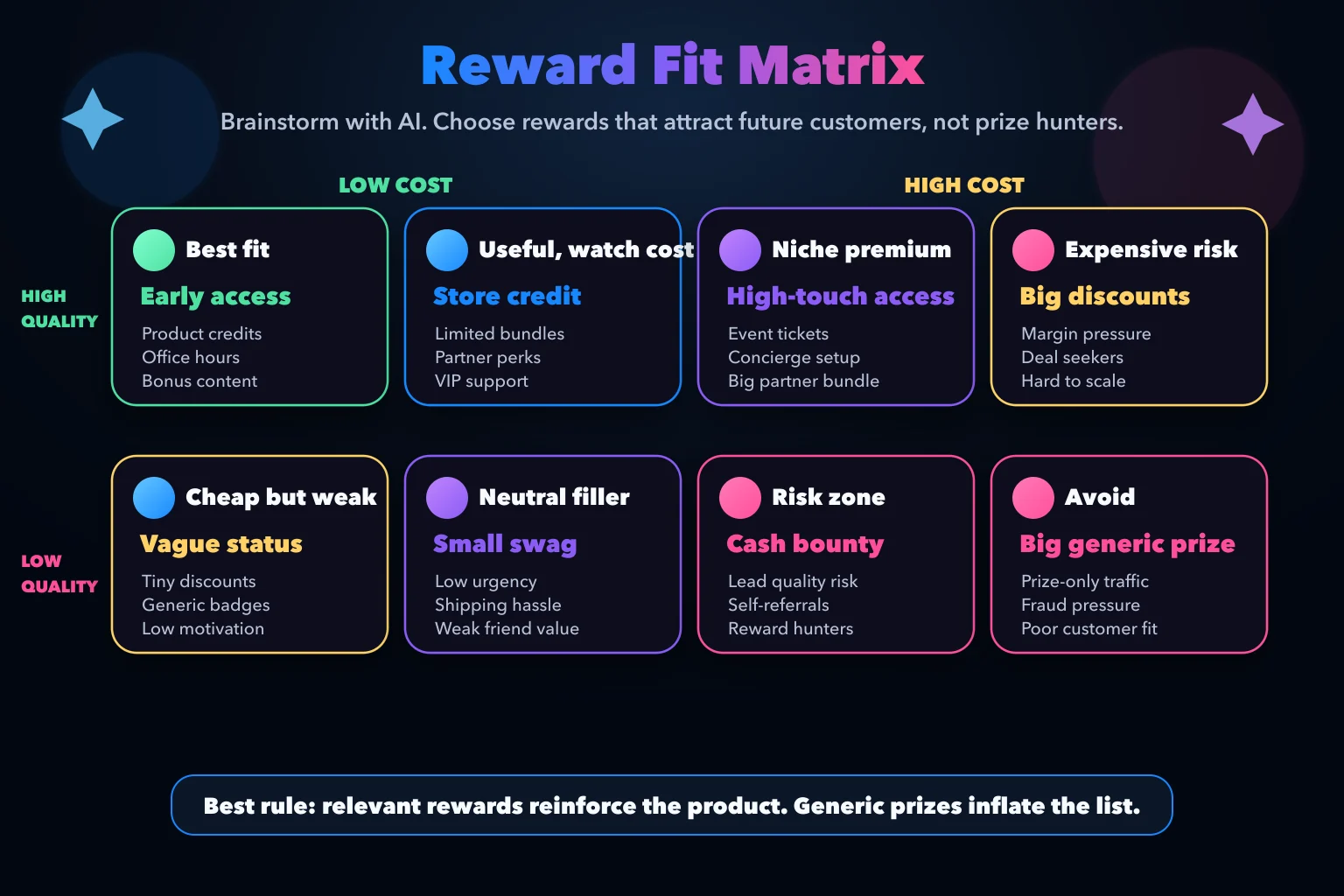
The reward is not just a bribe. It tells people what kind of campaign this is.
A SaaS waitlist might reward referrals with early access, priority onboarding, founder office hours, or bonus product credits. An e-commerce brand might use store credit, exclusive bundles, limited drops, or free shipping. A creator could offer private community access, signed merch, or a bonus lesson.
AI is useful here because it can generate reward options by audience, margin, and campaign goal.
Try prompts like:
- “Give me 20 referral reward ideas for a bootstrapped SaaS waitlist that cannot afford cash rewards.”
- “Rank these rewards by perceived value and fulfillment complexity.”
- “Suggest double-sided referral rewards where the friend gets value immediately.”
- “Which rewards are most likely to attract low-quality leads?”
The best answer is rarely the biggest prize. A huge generic prize attracts people who want the prize. A relevant reward attracts people who want what you sell.
3. Share-message personalization
This is where AI earns its keep.
Most referral share messages are terrible because they sound like ads. A customer should never feel like they are pasting brand copy into a group chat.
Give people options that sound human:
- Short text message
- Email note
- LinkedIn post
- Instagram Story caption
- X post
- Slack/community post
- A plain “copy link” version
Then use AI to create variants by audience and tone.
For example, a technical founder sharing a launch waitlist should not sound like a lifestyle influencer. A parent sharing a back-to-school giveaway should not sound like a SaaS sales rep. Same campaign. Different voice.
This is not about tricking people. It is about making the share easier.
If the customer can edit the message in two seconds and send it without cringing, you win.
4. Follow-up timing
The first share prompt is rarely enough.
People get distracted. That is the internet.
AI can help draft a follow-up sequence that reacts to where someone is in the campaign:
- Joined but has not shared
- Shared but has zero referrals
- One referral away from the next reward
- Referred friends who have not completed the required action
- Hit a reward tier and needs the next goal
This is where KickoffLabs reward levels and referral tracking matter. You are not blasting the same reminder to everyone. You are nudging people based on their status.
The message should be specific:
“You’re one referral away from early access” beats “Don’t forget to share.”
5. Fraud and quality review
Any reward program can be gamed.
People create duplicate emails. They refer themselves. They use disposable inboxes. They send low-quality traffic. If the reward is valuable, someone will try it.
AI can help spot patterns, but do not hand it the keys alone.
Use rules and review together:
- Same IP address creating many signups
- Disposable email domains
- Duplicate names or addresses
- High referral counts with no downstream engagement
- Reward claims before the required conversion is complete
KickoffLabs already includes contest fraud detection because this problem is not theoretical. The smarter move is to set your reward trigger carefully from the start.
Reward the action that matters. A signup is easy to fake. A verified email is better. A qualified purchase, booked demo, or waitlist activation is stronger.
The 5-Step Workflow for Building One
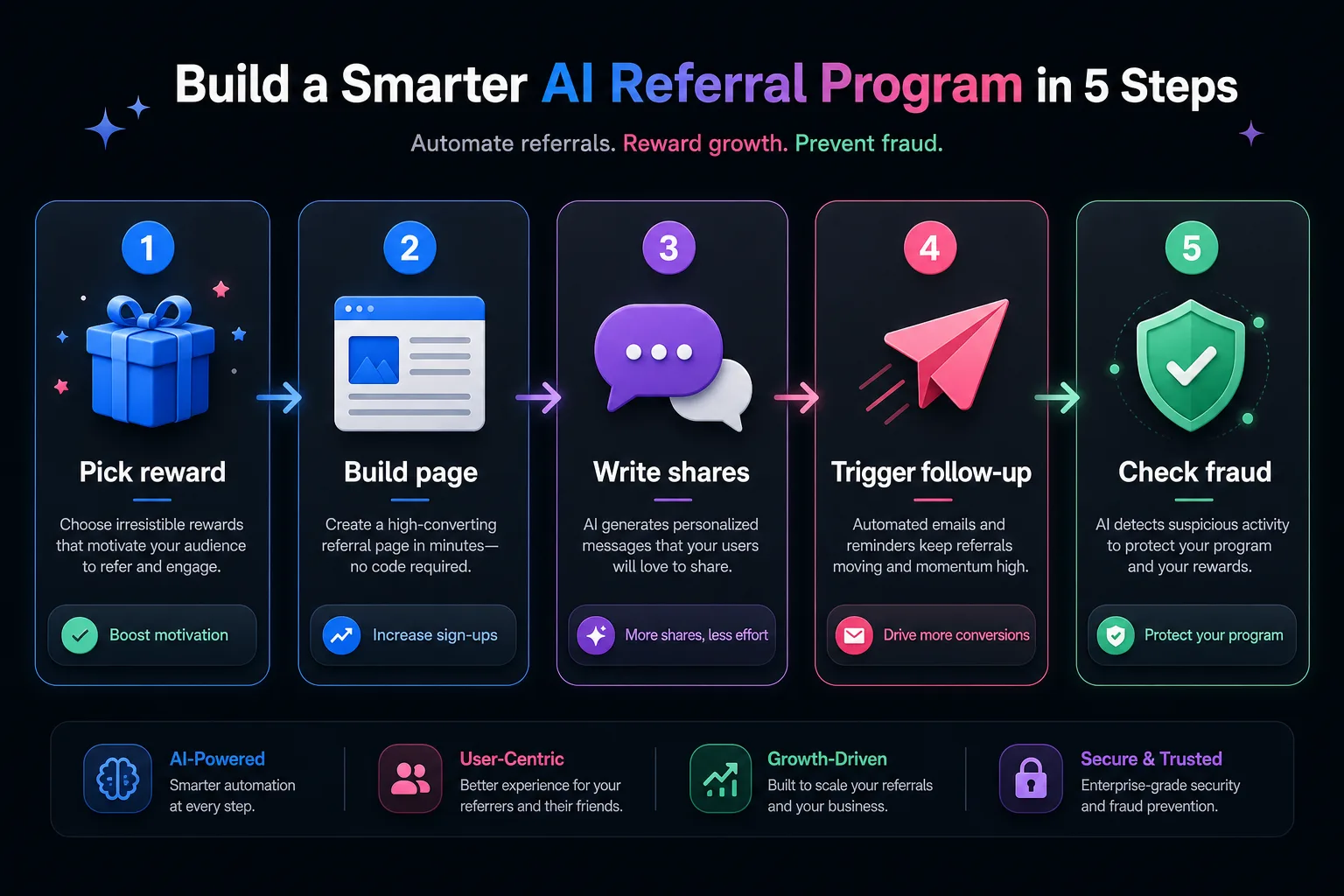
Here is the simple version.
Do not start with prompts. Start with the growth loop.
Step 1: Pick the conversion event
What counts as a successful referral?
This sounds obvious, so people skip it. Then they reward the wrong behavior.
Pick one primary conversion event:
- Email signup
- Verified email
- Giveaway entry
- Waitlist join
- Friend completing profile details
- First purchase
- Subscription start
- Demo booked
- App install plus activation event
For an early product, a waitlist join may be enough. For e-commerce, a first purchase is usually better. For B2B SaaS, a booked demo or activated account may matter more than a raw signup.
Your reward should fire after the event that proves value. If you are not sure, start conservative. You can always add easier micro-rewards later.
Step 2: Choose a double-sided reward
One-sided rewards are awkward.
They make the referrer look like they are using their friend. Double-sided rewards feel generous because the friend gets something too.
Good double-sided rewards look like this:
- “Give 20%, get 20%.”
- “Give your friend early access. Move up 5 spots when they join.”
- “Give a bonus entry. Earn 10 extra entries when they enter.”
- “Give a free template pack. Unlock the next reward tier when three friends claim it.”
For viral waitlists, the friend benefit can be priority access. For sweepstakes, it can be bonus entries. For e-commerce, it can be store credit or a product-specific discount.
Keep the reward connected to what you sell.
Generic cash pulls in hunters. Relevant rewards pull in future customers.
Step 3: Build the referral page
Your referral page has one job: make the next action obvious.
It needs:
- A headline people understand in five seconds
- The offer
- The friend benefit
- The reward tiers or bonus-entry rules
- A short form
- A clear CTA
- Official rules or terms
- Social sharing options after signup
This is where KickoffLabs is built for the job. You can create a landing page, track referrals, show reward progress, collect leads, and connect follow-up email without duct-taping six tools together.
If you need page-specific help, read giveaway landing page best practices and how to build a referral program that actually grows.
Step 4: Use AI to write the campaign assets
Now AI gets to work.
Ask it to draft:
- Landing page headline options
- Referral reward explanations
- Thank-you page copy
- Share messages by channel
- Reminder emails
- Reward-unlocked emails
- Fraud-review email templates
- FAQ copy
- Official-rules summary copy for humans
Do not paste the first output and call it done.
AI writes a decent first draft. You make it sound like your brand. Then you test it against the only question that matters: would a real customer send this?
Here is a practical prompt:
“Write five referral share messages for customers who just joined our waitlist. Tone: helpful friend, not ad. Include the friend benefit, keep each under 180 characters, and avoid hype.”
Then ask for variants:
“Rewrite those for LinkedIn, Instagram Stories, SMS, and a private Slack community. Make each one sound native to the channel.”
The goal is not more copy. The goal is copy people will actually use.
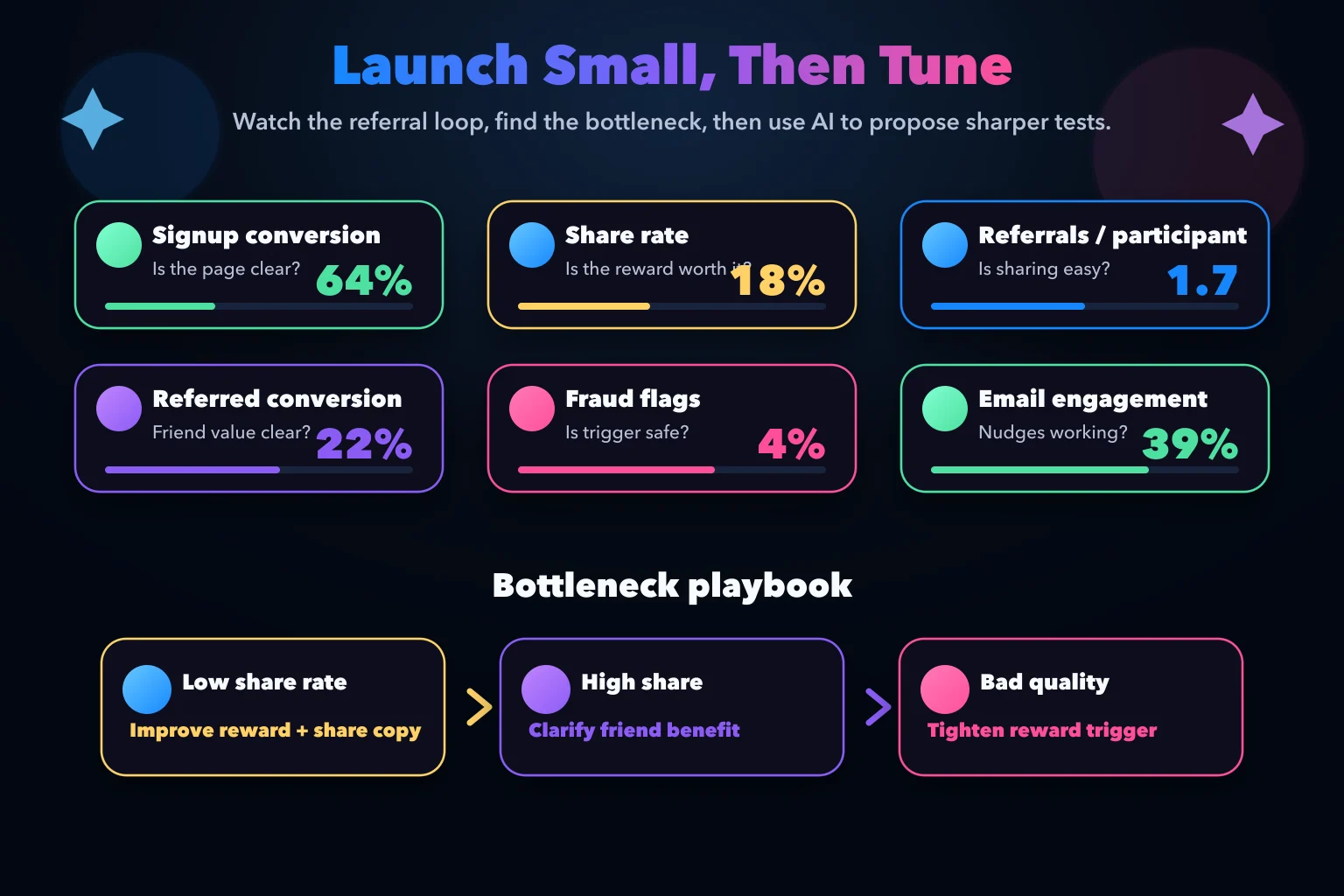
Step 5: Launch small, then tune
Do not launch your referral program to everyone on day one if you can avoid it.
Start with your warmest group: customers, subscribers, beta users, community members, or people who already raised their hand. Watch what happens.
Track:
- Signup conversion rate
- Share rate
- Referrals per participant
- Conversion rate from referred visitors
- Reward claims
- Fraud flags
- Email engagement
- Downstream quality
AI can summarize campaign performance, cluster common objections, and propose tests. But it should not make the decision for you.
If share rate is low, the reward or copy may be weak. If shares are high but referred conversions are low, the friend benefit or landing page may be wrong. If referrals are high but quality is bad, your reward may be attracting the wrong crowd.
Fix the bottleneck. Do not blindly add another email.
AI Prompts You Can Use Today
Steal these, then edit the output like a human.
- Referral offer: “I am building a referral program for [audience] promoting [product]. My goal is [signups/purchases/demos]. Suggest 10 double-sided offers. Rank them by perceived value, cost, and lead quality.”
- Share copy: “Write referral share copy that sounds like a real person texting a friend. Include the friend benefit. Give versions for SMS, email, LinkedIn, Instagram Story, and X. Avoid hype.”
- Fraud risk: “Review this reward structure and list the ways someone might game it. Suggest rules that reduce abuse without annoying honest participants.”
- Follow-up: “Create a four-email sequence for people who joined but have not referred anyone yet. Keep each email short. Make one email personalized for someone one referral away from a reward.”
- Page critique: “Critique this referral landing page copy. What is confusing, weak, unanswered, or unclear in the first five seconds?”
AI is great at generating options. You are still responsible for judgment.
Compliance: The Boring Part That Saves You
Referral programs can cross into endorsement territory when people receive a benefit for sharing.
That does not mean you cannot run them. It means you should be clear.
The FTC says endorsements must be honest and not misleading, and material connections should be disclosed when they are not obvious. That can include affiliate commissions, free products, discounts, sweepstakes entries, or other incentives.
Practical translation: if your customers get rewarded for promoting you, give them share copy that makes the incentive clear when needed.
Do not hide the relationship in a tiny footnote. Do not ask people to pretend they were not rewarded. Do not generate fake reviews or AI testimonials.
Also make your official rules easy to find. If your campaign is a giveaway or sweepstakes, read contest law best practices and your local legal requirements before launch.
This is not legal advice. It is the minimum common sense that keeps your referral program from becoming a future support headache.
What to Build in KickoffLabs
A strong AI-assisted referral campaign in KickoffLabs usually has these pieces:
- A campaign landing page
- A short entry form
- Unique referral links
- Social sharing buttons and editable share copy
- Reward levels or bonus entries
- Automated email follow-up
- Fraud detection rules
- Email, CRM, or e-commerce integrations
- Analytics to see which sources and messages convert
That gives AI a clean system to improve.
AI writes and tests assets. KickoffLabs handles the mechanics: pages, referrals, rewards, fraud checks, and lead capture.
That distinction matters.
A referral program is not a pile of clever prompts. It is a trackable growth system.
Common Mistakes to Avoid
- Rewarding quantity over quality. If you pay for raw signups, you will get raw signups. If your real goal is buyers, demos, or active users, reward closer to that outcome.
- Making the friend benefit weak. “Help me win” is weaker than “Use my link and you get early access too.”
- Using AI copy without editing it. AI loves polished mush. Cut the filler and make the message sound like a person.
- Forgetting mobile. Most referral sharing happens from a phone. Your thank-you screen, share buttons, and copy-link flow need to be obvious.
- Waiting too long to ask. Ask when excitement is highest: after signup, purchase, reward unlock, positive feedback, or a meaningful product milestone.
The Bottom Line
AI makes referral programs faster to build. It does not make them magically worth sharing.
The winners combine human trust with machine-assisted execution. Clear offer. Relevant reward. Simple page. Real tracking. Useful follow-up. Fraud controls. Then AI on top to generate, personalize, summarize, and improve.
That is the sane way to build a viral referral program in 2026.
If you want the mechanics handled without building from scratch, KickoffLabs referral campaigns are built for this: referral links, reward tracking, landing pages, email follow-up, fraud protection, and analytics.
Start with the loop. Use AI to make it sharper. Let your customers do the sharing.