Contents
- Quick Answer: What Are the Best AI Prompts for Giveaway Ideas?
- The Prompt Framework That Actually Works
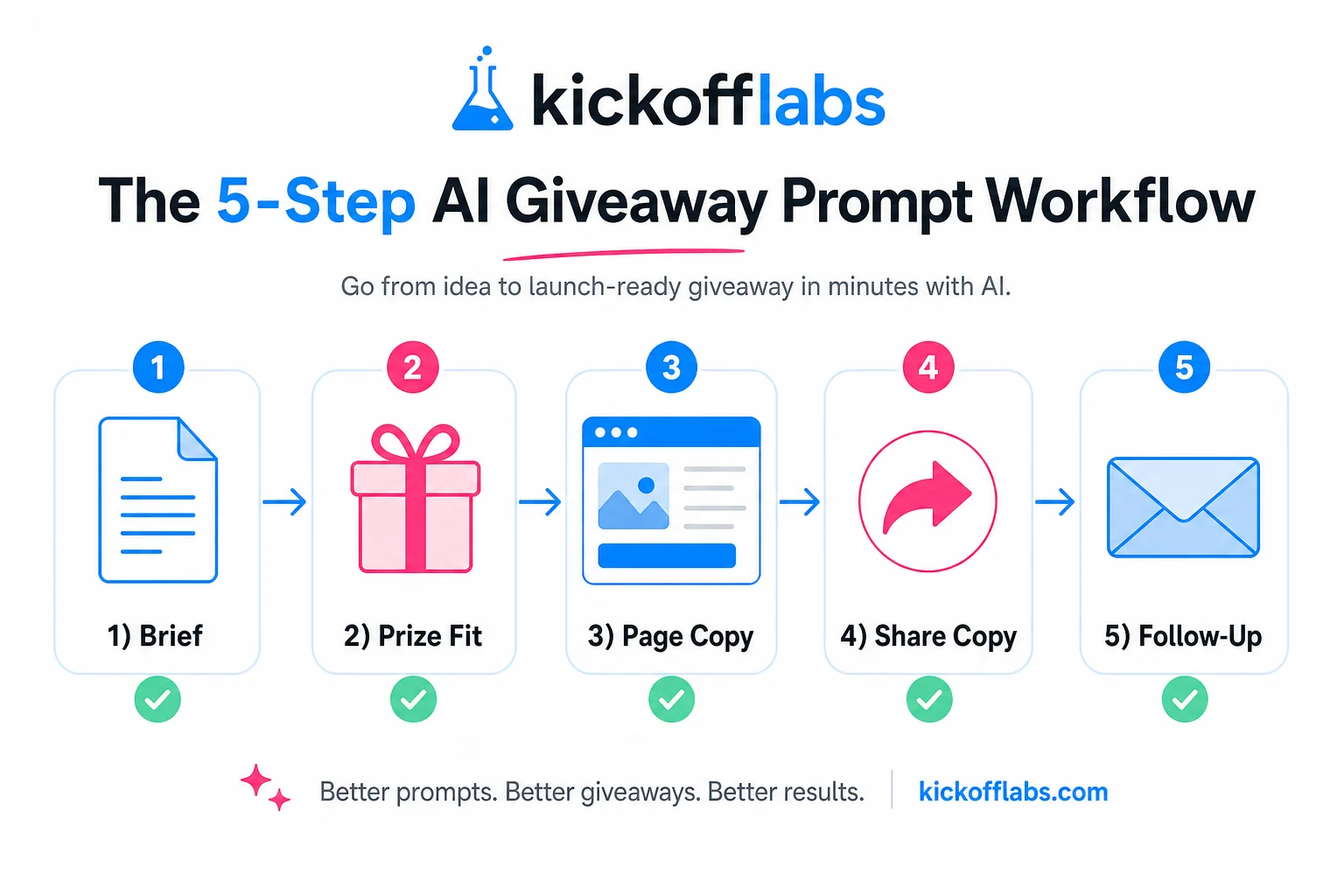
- 1. AI Prompts for Giveaway Ideas
- 2. AI Prompts for Contest Prize Ideas
- 3. AI Prompts for Giveaway Landing Page Copy
- 4. AI Prompts for Referral Share Copy
- 5. AI Prompts for Giveaway Email Copy
- 6. AI Prompts for Rules and Compliance Checks
- 7. AI Prompts for Social Media Giveaway Posts
- 8. AI Prompts for Campaign QA Before Launch
- A Complete AI Giveaway Prompt You Can Paste Today
- How to Use These Prompts With KickoffLabs
- The Bottom Line
Free tool: Generate cleaner campaign prompts with the Marketing Copy Prompt Generator.
Most AI giveaway prompts are too vague to be useful.
“Give me giveaway ideas for my brand” is not a strategy. It is a request for generic internet soup.
AI can absolutely help you build a better giveaway. It can generate prize angles, landing page copy, referral messages, email sequences, and social posts faster than a blank doc ever will.
But only if you give it constraints.
Audience. Prize. Goal. Bad-fit entrants. Deadline. Rules. Referral incentive. Follow-up offer. Brand voice.
That is where the useful output starts.
This guide gives you copy-ready prompts for giveaway ideas, contest prizes, campaign copy, referral sharing, and post-giveaway follow-up.
Want the copy-and-paste version? Download the no-email-required PDF: AI Giveaway Prompts Prompt Pack.
If you want AI to help build the actual campaign page after you have the strategy, KickoffLabs’ AI campaign builder was built for that next step. If you want a guided prompt instead of copying from scratch, use the free Marketing Copy Prompt Generator to build landing page, email, brief, referral, and ad prompts from your campaign context.
Quick Answer: What Are the Best AI Prompts for Giveaway Ideas?
The best AI prompts for giveaway ideas include your audience, business goal, prize constraints, entry method, platform, eligibility limits, referral incentive, brand voice, and follow-up offer.
A strong prompt does not ask AI to “make a giveaway.” It asks AI to solve one campaign problem at a time.
Use AI to:
- Generate giveaway angles for a specific audience.
- Pressure-test prize fit before you attract the wrong people.
- Draft landing page headlines, CTAs, and prize descriptions.
- Write referral share copy for email, SMS, and social.
- Create a follow-up email sequence after the giveaway ends.
- Find weak spots in your campaign before you launch.
Do not use AI to invent legal rules, fabricate customer results, or decide your strategy without human review.
Google’s own guidance says AI content is not automatically bad or banned. The issue is quality and usefulness, not whether a machine helped write it.
AI is a power tool. You still need to know what you are building.
The Prompt Framework That Actually Works
Before the prompt library, use this structure.
Copy it once. Reuse it everywhere.
You are helping me plan a giveaway campaign. Do not give generic advice. Use the details below and ask for clarification if the campaign is too vague.
Brand: [BRAND]
Product or offer: [WHAT YOU SELL]
Ideal entrant: [WHO WE WANT]
Bad-fit entrant: [WHO WE DO NOT WANT]
Campaign goal: [EMAIL LIST / WAITLIST / SALES PIPELINE / PRODUCT LAUNCH / COMMUNITY / PARTNER PROMO]
Prize budget: [AMOUNT OR RANGE]
Possible prizes: [IDEAS]
Platform: [WEBSITE / INSTAGRAM / TIKTOK / EMAIL / PARTNER / MULTI-CHANNEL]
Entry method: [FORM / REFERRALS / UGC / COMMENT / PURCHASE / WAITLIST]
Referral incentive: [BONUS ENTRIES / REWARD TIERS / WAITLIST RANK / DISCOUNT]
Deadline: [DATE]
Eligibility limits: [AGE / LOCATION / CUSTOMER TYPE]
Follow-up offer: [WHAT HAPPENS AFTER ENTRY]
Brand voice: [DIRECT / PLAYFUL / PREMIUM / TECHNICAL / ETC.]
Avoid: fake urgency, unsupported claims, spammy social copy, legal promises, exaggerated ROI.
That prompt gives AI the raw material it needs and tells it what not to do.
If your audience hates hype, say that. If your product is expensive, say that. If a generic Amazon gift card would attract junk leads, say that too.
1. AI Prompts for Giveaway Ideas
Start with campaign ideas before you touch copy.
The goal here is not “give me 20 ideas.” The goal is “give me 20 ideas that attract the right people and support the next business action.”
Prompt: Generate Qualified Giveaway Ideas
Generate 15 giveaway campaign ideas for this brand.
Brand: [BRAND]
Product: [PRODUCT]
Ideal entrant: [AUDIENCE]
Bad-fit entrant: [WHO WE DO NOT WANT]
Campaign goal: [GOAL]
Prize budget: [BUDGET]
Follow-up offer: [OFFER]
For each idea, include: campaign name, prize concept, why the right audience would care, likely bad-fit risk, entry mechanic, referral angle, and one sentence of landing page positioning.
Avoid generic “win a gift card” ideas unless the gift card is highly specific to the audience.
What you are looking for: ideas that make bad-fit entrants less excited.
That sounds backwards, but it is the point. A great giveaway is a filter.
Prompt: Turn One Giveaway Idea Into Three Campaign Angles
Take this giveaway idea and create three different campaign angles.
Idea: [IDEA]
Audience: [AUDIENCE]
Goal: [GOAL]
Prize: [PRIZE]
Create one angle focused on aspiration, one focused on practical value, and one focused on exclusivity.
For each angle, write a headline, subheadline, CTA, prize framing, referral hook, and follow-up offer.
End with a recommendation for which angle is strongest and why.
This is where AI is genuinely useful.
It gives you options without making you pretend the first draft was sacred.
2. AI Prompts for Contest Prize Ideas
The prize is not decoration. The prize is targeting.
If you give away an iPad, you will attract people who want an iPad.
If you give away a founder launch kit, a race-day bundle, a Shopify growth stack, a creator studio upgrade, or early access to a category-specific product, you are making a sharper bet.
Prompt: Pressure-Test Prize Fit
Review this giveaway prize for audience fit.
Audience: [AUDIENCE]
Product or offer after the giveaway: [PRODUCT/OFFER]
Prize idea: [PRIZE]
Campaign goal: [GOAL]
Tell me: who this prize attracts, who it accidentally attracts, why the right person would care, whether it supports the follow-up offer, and three better prize alternatives.
Be blunt. If the prize is too generic, say so.
You want blunt.
Polite AI output is dangerous because it makes weak ideas feel acceptable.
Prompt: Build a Prize Matrix
Create a prize matrix for a giveaway campaign.
Brand: [BRAND]
Audience: [AUDIENCE]
Goal: [GOAL]
Budget range: [BUDGET]
Generate 12 prize ideas across four categories: low-cost, premium, partner-sponsored, and experience-based.
For each prize, score 1–5 on audience fit, shareability, fulfillment complexity, margin risk, and lead quality.
Include a short recommendation for the top three.
This prompt works because it forces tradeoffs.
Some prizes are exciting but painful to fulfill. Some are cheap but forgettable. Some drive shares but bring weak leads.
You want to see the tradeoff before the campaign is live.
3. AI Prompts for Giveaway Landing Page Copy
Your landing page has one job: make the right person understand the prize, value, deadline, and next action fast.
Not “boost engagement.” Not “drive excitement.”
Get the right person to enter and share.
If you need a full page strategy first, read Giveaway Landing Page Best Practices and use KickoffLabs landing page templates when you are ready to build.
Prompt: Landing Page First Draft
Write landing page copy for this giveaway campaign.
Campaign brief: [PASTE BRIEF]
Output:
- 10 headline options under 12 words.
- 5 subheadline options under 25 words.
- 5 CTA button options.
- Prize description in 75 words.
- “How it works” section with 3 steps.
- Referral section explaining why sharing helps entrants.
- Short rules summary in plain English with a note to review official rules.
Voice: [VOICE]
Avoid: vague hype, fake scarcity, unsupported numbers, legal guarantees.
The first draft will still need editing.
That is fine. You are buying speed, not outsourcing judgment.
Prompt: Cut the Fluff
Rewrite this giveaway landing page copy to be shorter, clearer, and more direct.
Keep the core offer, prize, deadline, and CTA.
Remove filler phrases, vague claims, and generic excitement.
Make the copy sound like a real person wrote it.
Return a before/after table showing what changed and why.
Copy: [PASTE COPY]
This prompt is my favorite because AI is great at creating the mess and surprisingly good at cleaning it up when you ask directly.
Do not skip the cleanup pass.
4. AI Prompts for Referral Share Copy
A giveaway without sharing is just a form with a prize.
The referral loop is what turns one entrant into more entrants.
KickoffLabs handles referral tracking, unique share links, reward tiers, and fraud controls. But the words still matter. People do not share because your widget exists. They share because the ask feels easy, personal, and worth sending.
Prompt: Referral Share Messages
Write referral share copy for this giveaway.
Campaign brief: [PASTE BRIEF]
Referral incentive: [BONUS ENTRIES / REWARD / WAITLIST RANK]
Write:
- 5 SMS messages under 160 characters.
- 5 email snippets under 75 words.
- 5 Instagram Story captions.
- 5 LinkedIn posts for a professional audience.
- 5 X posts under 240 characters.
Make the copy sound like it came from the entrant, not the brand.
Avoid spammy phrases like “don’t miss out,” “limited time only,” and “you have to check this out.”
That last instruction is key.
Referral copy should not sound like brand copy wearing a fake mustache.
It should sound like a person forwarding something relevant.
Prompt: Thank-You Page Referral Copy
Write thank-you page copy for someone who just entered this giveaway.
Goal: get them to share their unique referral link.
Referral incentive: [INCENTIVE]
Audience: [AUDIENCE]
Prize: [PRIZE]
Include a short headline, 2-sentence explanation, button text, and three share-message options.
Make it clear, not pushy.
Your thank-you page is the highest-intent moment in the campaign.
They just entered. They care right now. Ask for the share while the prize is fresh.
5. AI Prompts for Giveaway Email Copy
The giveaway does not end at the entry form.
That is where the list starts.
Your email sequence should welcome people, remind them to share, create urgency near the deadline, announce the winner, and move non-winners toward the next offer.
For a deeper sequence breakdown, read AI Email Sequences for Giveaways and Waitlists and How to Grow Your Email List with Giveaways.
Prompt: Full Giveaway Email Sequence
Create a giveaway email sequence for this campaign.
Campaign brief: [PASTE BRIEF]
Emails needed:
- Welcome after entry.
- Referral nudge.
- Deadline reminder.
- Winner announcement.
- Non-winner follow-up with offer.
For each email, include subject line, preview text, body copy under 200 words, CTA, and personalization notes.
Keep the tone direct and human.
Do not overpromise. Do not imply someone has won unless they have.
Simple. Useful. Hard to mess up.
Prompt: Segment Non-Winners
Create three post-giveaway follow-up emails for non-winners.
Audience: [AUDIENCE]
Giveaway prize: [PRIZE]
Product or offer: [OFFER]
Segment the copy for: highly engaged entrants, referred entrants, and low-engagement entrants.
Give each segment a different angle and CTA.
Avoid sounding like a consolation prize nobody wanted.
This is where a lot of giveaways waste the whole list.
You paid for attention. You earned an email address. Do not send one “sorry you lost” email and disappear.
6. AI Prompts for Rules and Compliance Checks
AI is not your lawyer.
AI can help you spot missing rule sections, simplify legal language, and create a checklist for review. It should not be the final authority on sweepstakes law, tax rules, platform rules, or eligibility requirements.
For legal basics, start with Contest Law Best Practices and the relevant regional guides.
Prompt: Rules Gap Checklist
Review this giveaway campaign for rules gaps.
Campaign brief: [PASTE BRIEF]
Draft rules or summary: [PASTE RULES]
Identify missing or unclear items related to eligibility, start/end dates, prize description, odds, winner selection, winner notification, sponsor, platform disclaimers, privacy, and no-purchase requirements.
Do not give legal advice. Create a checklist for human/legal review.
This is a smart use of AI.
It helps you avoid obvious omissions before a human reviews the final version.
Prompt: Plain-English Rules Summary
Turn these official giveaway rules into a plain-English summary for a landing page.
Rules: [PASTE RULES]
Keep it under 120 words.
Include eligibility, deadline, winner selection, prize, and a link placeholder for official rules.
Do not change the legal meaning.
If anything is unclear, list questions instead of guessing.
The instruction “list questions instead of guessing” should be in more prompts.
AI hates admitting uncertainty unless you invite it.
7. AI Prompts for Social Media Giveaway Posts
Social promotion works best when the post matches the platform.
A TikTok caption, Instagram Reel script, LinkedIn post, and email newsletter blurb should not sound identical.
Prompt: Platform-Specific Launch Posts
Create launch copy for this giveaway across multiple platforms.
Campaign brief: [PASTE BRIEF]
Campaign type: [RANDOM GIVEAWAY / JUDGED CONTEST / REFERRAL CAMPAIGN / WAITLIST]
Platforms: [INSTAGRAM / TIKTOK / LINKEDIN / X / EMAIL / WEBSITE]
For each platform, write copy that fits the format and audience expectations.
Include CTA, entry instructions, and disclaimer reminder.
Do not copy-paste the same message across platforms.
Good social copy respects the room.
LinkedIn does not need TikTok energy. TikTok does not need a press release.
8. AI Prompts for Campaign QA Before Launch
Before you publish, ask AI to attack the campaign.
Not compliment it. Attack it.
Prompt: Find the Weak Spots
Act like a skeptical campaign strategist reviewing this giveaway before launch.
Campaign brief: [PASTE BRIEF]
Landing page copy: [PASTE COPY]
Email sequence: [PASTE EMAILS]
Referral copy: [PASTE COPY]
Find the 10 biggest risks that could hurt lead quality, conversion, trust, compliance, referral sharing, or post-campaign sales.
For each risk, explain why it matters and suggest a fix.
Be direct. Do not be encouraging unless the idea is actually strong.
This prompt saves campaigns.
It catches the weak prize, the confusing CTA, the missing deadline, the bad referral ask, and the follow-up offer that has nothing to do with the giveaway.
A Complete AI Giveaway Prompt You Can Paste Today
Use this when you want a full first pass.
You are a senior giveaway campaign strategist. Help me create a giveaway campaign, but do not invent facts or legal claims.
Brand: [BRAND]
Product/offer: [PRODUCT]
Ideal entrant: [AUDIENCE]
Bad-fit entrant: [WHO WE DO NOT WANT]
Goal: [GOAL]
Prize budget: [BUDGET]
Prize ideas: [IDEAS]
Deadline: [DATE]
Eligibility: [AGE / LOCATION / OTHER LIMITS]
Platform: [WHERE IT WILL RUN]
Entry method: [HOW PEOPLE ENTER]
Referral incentive: [INCENTIVE]
Follow-up offer: [OFFER]
Brand voice: [VOICE]
Avoid: fake urgency, unsupported claims, spam, legal promises, generic hype.
Output: campaign positioning, three angles, prize fit review, landing page copy, thank-you page referral copy, five share messages, five-email follow-up sequence, rules gap checklist, and top 10 risks to fix before launch.
Now you have something useful.
Not final. Useful.
How to Use These Prompts With KickoffLabs
The clean workflow looks like this:
- Use the prompts above to build your campaign brief.
- Pressure-test the prize and referral incentive.
- Draft the landing page, thank-you page, share copy, and emails.
- Build the campaign in KickoffLabs using a sweepstakes, waitlist, or reward-levels campaign.
- Connect your email platform through KickoffLabs integrations.
- Publish, watch lead quality, and keep improving the follow-up.
The prompts help you think.
KickoffLabs helps you launch, track, refer, and follow up.
Those are different jobs.
Do not confuse them.
The Bottom Line
AI will not rescue a boring prize, a vague audience, or a campaign with no follow-up.
But it can make a good marketer faster.
Use AI to generate options, expose weak spots, tighten copy, and build the pieces you need to launch.
Then use your judgment.
The best giveaway campaigns still come from knowing who you want to attract and what you want them to do next.
AI just helps you get there without staring at a blank page for an hour.