Contents
- Quick Answer: How Do You Create a Giveaway with AI?
- Step 1: Build the Brief Before You Build the Page
- Step 2: Pressure-Test the Prize
- Step 3: Pick the Campaign Type
- Step 4: Generate Landing Page Copy, Then Cut It
- Step 5: Turn Rules Into Clear Copy
- Step 6: Build the Referral Loop
- Step 7: Write Emails Before Launch
- Step 8: Measure the Right Thing
- Step 9: Set It Up in KickoffLabs
- The AI Giveaway Campaign Checklist
- Copy-and-Paste Prompt Pack
- Final Take: Use AI to Move Faster, Not Think Less
AI will not make people want your giveaway. It will help you build a better one faster.
That is the point.
Most AI giveaway advice starts with a bad prompt:
Create a giveaway campaign for my brand.
That gives you mush.
The AI does not know who you want to attract, what prize fits your audience, how strict your rules need to be, what your margins look like, or what happens after someone enters.
So it guesses.
And the guess usually sounds like this: “Run an exciting giveaway to boost engagement and grow your audience.”
That is not a campaign. That is a fortune cookie.
A real AI giveaway campaign starts with constraints. Audience. Prize. Deadline. Rules. Referral loop. Follow-up offer. Measurement.
Think of AI like a junior campaign planner. It writes fast. It organizes messy inputs. It spots gaps. It gives you options.
But it needs the raw material.
If you already have that raw material, KickoffLabs’ AI campaign builder can turn it into campaign page copy, rules, email drafts, and share text while you keep control of the strategy. Need a structured prompt first? Use the free Marketing Copy Prompt Generator to turn your campaign notes into landing page, email, brief, referral, and ad copy prompts.
Quick Answer: How Do You Create a Giveaway with AI?
To create a giveaway with AI, give it a tight campaign brief first. Include your audience, bad-fit audience, prize, goal, eligibility rules, deadline, referral incentive, brand voice, and post-giveaway offer.
Then use AI to draft:
- The landing page headline, subheadline, CTA, and prize copy.
- Plain-English rules and rules gaps to review.
- Thank-you page referral copy.
- Share messages for email, SMS, and social.
- The welcome, referral nudge, deadline reminder, winner, and post-campaign emails.
- A measurement checklist tied to lead quality, referrals, and follow-up conversion.
Do not let AI choose the strategy by itself.
Use it to pressure-test your choices and speed up the work.
Want the checklist version? Download the no-email-required PDF: AI Giveaway Campaign Checklist.
Step 1: Build the Brief Before You Build the Page
The brief is the campaign.
Skip it and every generated asset gets worse: the page, the emails, the rules, the share copy, the follow-up.
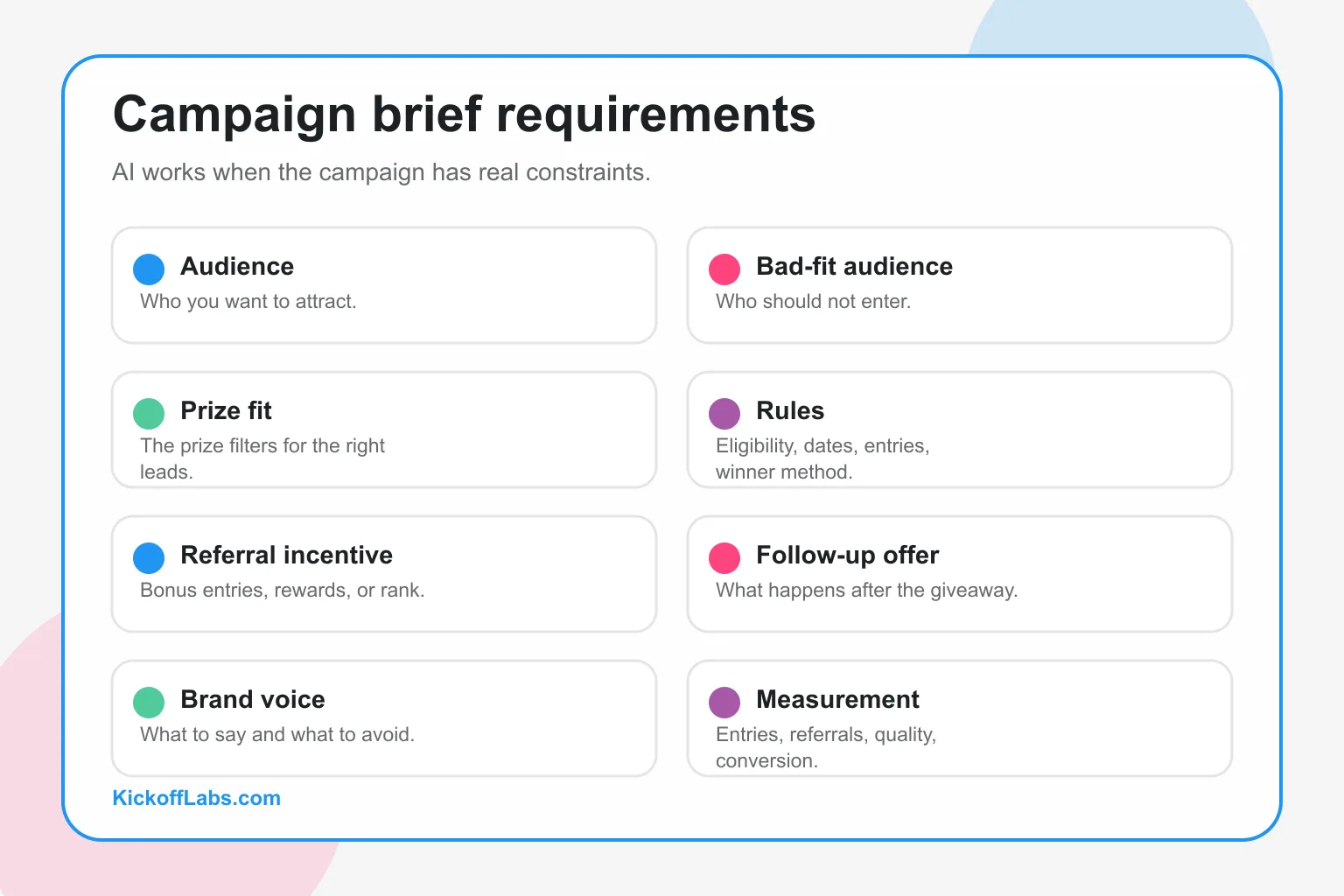
Your brief should answer:
- Who is this for?
- Who should not enter?
- What prize would the right person actually want?
- What business goal does the campaign support?
- What action should people take after entering?
- What action should they take after the giveaway ends?
- What are the eligibility limits?
- How will winners be selected?
- What should the AI avoid saying?
That last one matters.
If you do not want fake hype, say so. If your audience hates emojis, say so. If the prize should feel premium instead of gimmicky, say so.
Start here:
You are helping plan a giveaway campaign. Do not write copy yet. Turn the details below into a clear campaign brief.
Brand: [BRAND]
Audience: [WHO WE WANT TO ATTRACT]
Bad-fit audience: [WHO WE DO NOT WANT]
Prize: [PRIZE]
Goal: [EMAIL LIST / PRODUCT LAUNCH / SALES PIPELINE / COMMUNITY / PARTNER PROMO]
Deadline: [DATE]
Eligibility: [AGE / LOCATION / OTHER LIMITS]
Follow-up offer: [OFFER]
Referral incentive: [BONUS ENTRIES / REWARDS / WAITLIST RANK]
Brand voice: [VOICE]
Avoid: fake urgency, exaggerated claims, legal promises, spammy social copy
Output: campaign positioning, prize-audience fit notes, landing page angle, referral incentive, email sequence outline, and risks to fix before launch.
Do not skip this step.
If the brief is weak, AI just makes weak ideas look organized.
Step 2: Pressure-Test the Prize
The prize is not a detail.
The prize is the targeting.
A $500 Amazon gift card will get entries. It will also attract people who enter every giveaway they see.
A better prize filters for the audience you actually want.
If you sell running gear, give away race shoes, a watch, race entry, or a training bundle. If you sell creator software, give away a creator workstation, coaching, or production gear. If you are launching a waitlist, give away early access, founder perks, or a bundle tied to the problem you solve.
Use AI to attack the prize:
Review this giveaway prize for audience fit.
Audience: [AUDIENCE]
Product or offer after the giveaway: [PRODUCT/OFFER]
Prize: [PRIZE]
Campaign goal: [GOAL]
Tell me who this prize attracts, who it accidentally attracts, how closely it connects to the follow-up offer, and three tighter alternatives. Be blunt.
Most people ask AI to validate their idea.
Ask it to find the holes.
Step 3: Pick the Campaign Type
Not every giveaway needs the same mechanic.
A simple sweepstakes campaign is good when you want fast entries and low friction.
A referral giveaway works when you want the campaign to spread after someone enters.
A reward-level campaign works when you want people to unlock perks as they refer more friends.
A waitlist with referral ranking works when status and early access are part of the offer.
There is no universal best format.
There is a best format for your goal.
Prompt:
Based on this campaign brief, recommend the best giveaway format: simple sweepstakes, referral giveaway with bonus entries, reward-level campaign, waitlist with referral ranking, or partner giveaway. Explain the best fit, why, what could go wrong, what the landing page should emphasize, and what the thank-you page should ask people to do.
For most list-growth campaigns, I would pick a referral giveaway with bonus entries.
Why?
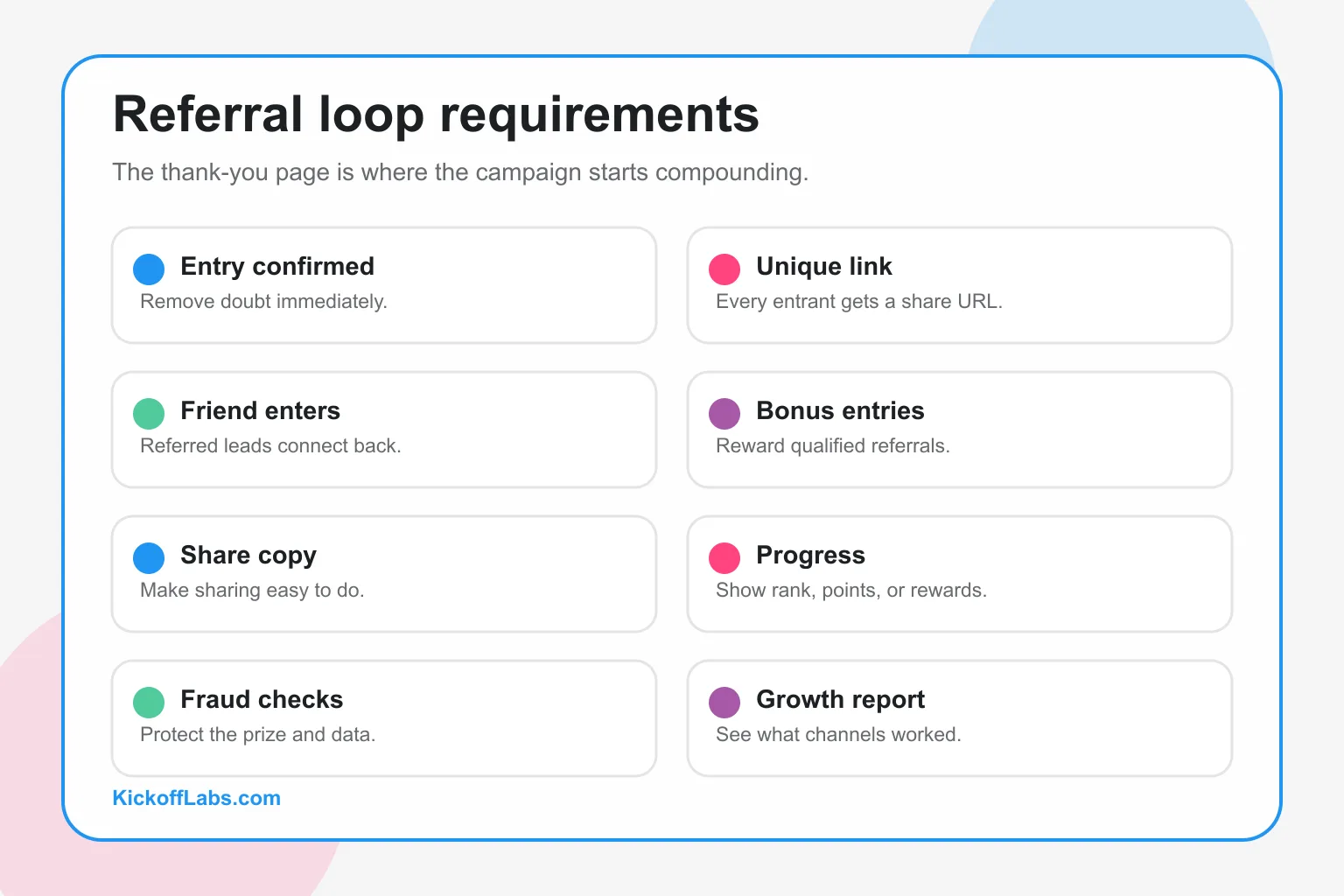
Because the thank-you page is where the campaign starts compounding. Someone enters, gets a unique link, shares it, and earns more chances to win.
That is the part generic AI tools miss. They can write copy. They do not create the growth loop.
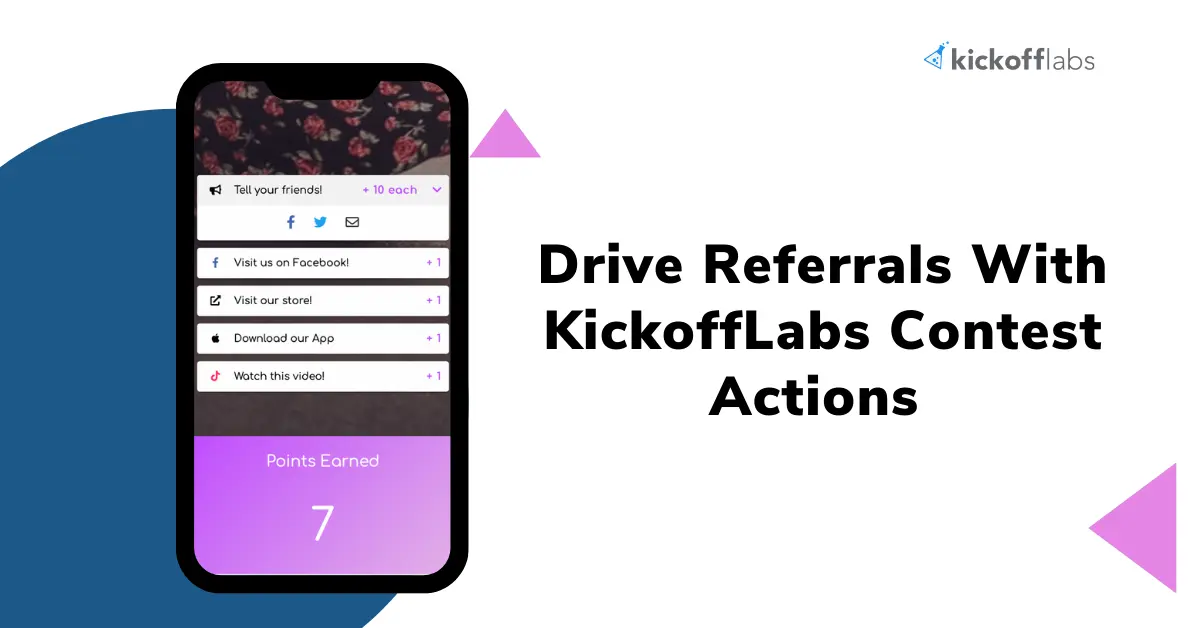
Use AI to draft the explanation. Use KickoffLabs to make the action trackable.
Step 4: Generate Landing Page Copy, Then Cut It
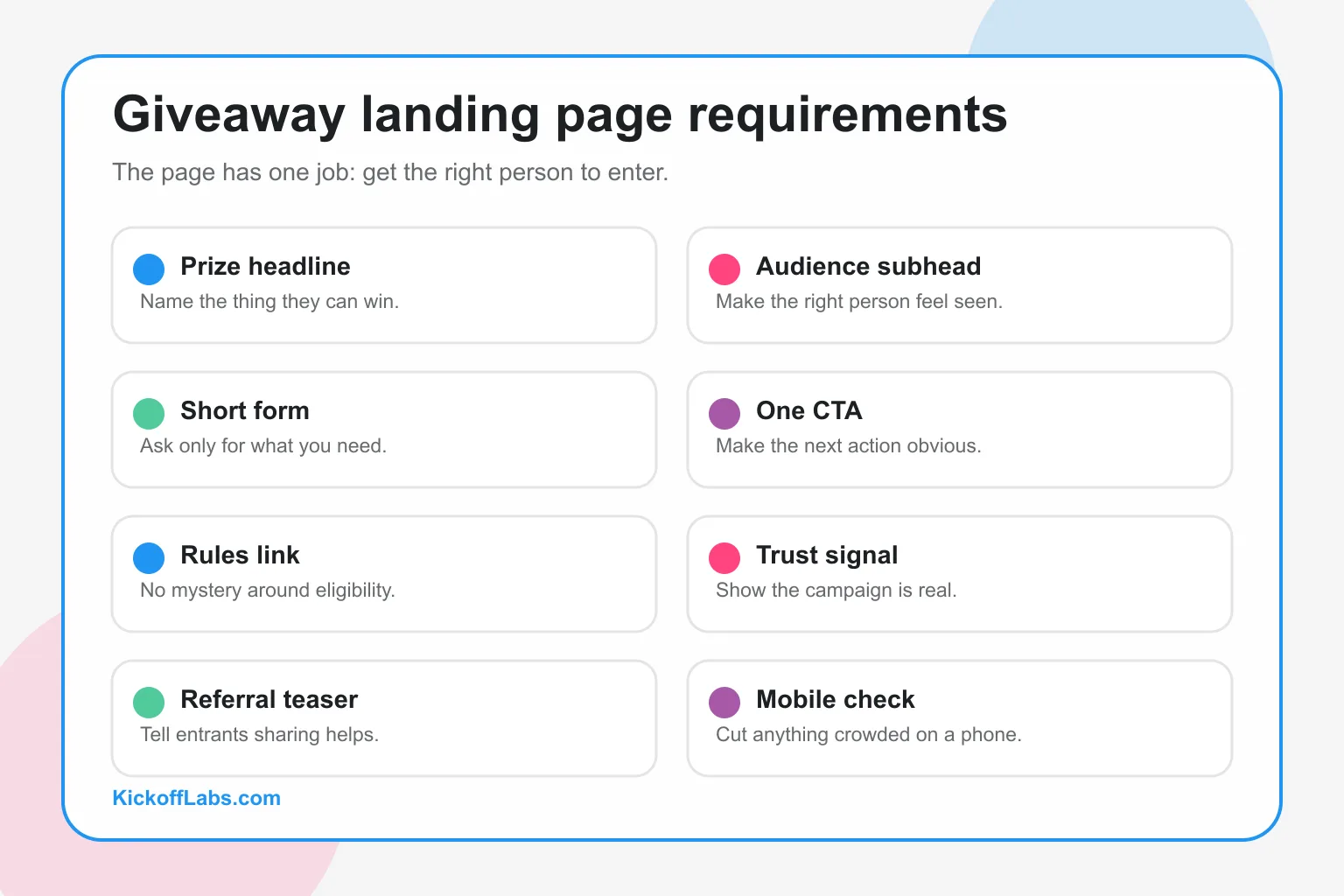
Your landing page has one job: get the right person to enter.
Not explain your whole company. Not tell your founder story. Not turn the prize into a brochure.
The page needs to answer five questions:
- What can I win?
- Why should I care?
- Is this real?
- How do I enter?
- What happens after I enter?
Use the brief to create the first draft:
Write giveaway landing page copy from this campaign brief.
Requirements: headline names the prize, subheadline names the audience, one CTA, short form copy, trust-building line, three-step how-it-works section, and thank-you page referral teaser. Do not use hype, fake urgency, or vague claims.
Output headline options, subheadline options, CTA options, prize description, how-it-works copy, and thank-you page copy.
Then edit hard.
Bad:
Enter our exciting giveaway for a chance to win an amazing prize package designed to help you reach your goals.
Better:
Win a home gym upgrade built for busy parents who train before the house wakes up.
Specific beats excited.
KickoffLabs can help here directly. If you give the KickoffLabs AI campaign builder the brief, it can generate page copy, emails, rules, and share text as part of campaign creation. You still edit. You just do not start with a blank page.
For more page-level guidance, use the giveaway landing page best practices guide and the contest landing page builder.
Step 5: Turn Rules Into Clear Copy
AI can make rules easier to read.
It should not be your lawyer.
Your giveaway rules need the basics:
- Sponsor name.
- Eligibility.
- Start and end dates.
- Prize details.
- Approximate retail value when needed.
- How to enter.
- Bonus-entry rules.
- Winner selection method.
- Winner notification process.
- Taxes or prize restrictions.
- No-purchase-necessary language when required.
- Platform disclaimers when running on social channels.
KickoffLabs includes a built-in contest rules template with each campaign. The AI builder can draft a plain-English rules summary from your brief, and the page builder can link those rules from the campaign page.
Use this prompt to catch gaps:
Review these giveaway rules for missing practical details. Do not give legal advice. Flag anything unclear or missing, especially eligibility, dates, prize value, entry method, referral entries, winner selection, notification, and platform disclaimers.
If you are running on Instagram, read our Instagram giveaway rules guide before you publish. Copying someone else’s caption is not a legal strategy.
Step 6: Build the Referral Loop
The entry form gets you the first lead.
The referral loop gets you the next ones.
After someone enters, they should land on a thank-you page that says:
- You are entered.
- Want more chances to win?
- Share your unique link.
- Each qualified friend who enters gives you bonus entries, points, or reward progress.
- Here is your link.
- Here are easy share buttons.
- Here is your current status.
KickoffLabs was built for this. You can send every entrant to a personalized thank-you page with a unique referral link, track referrals, award bonus entries, and see who is driving growth.
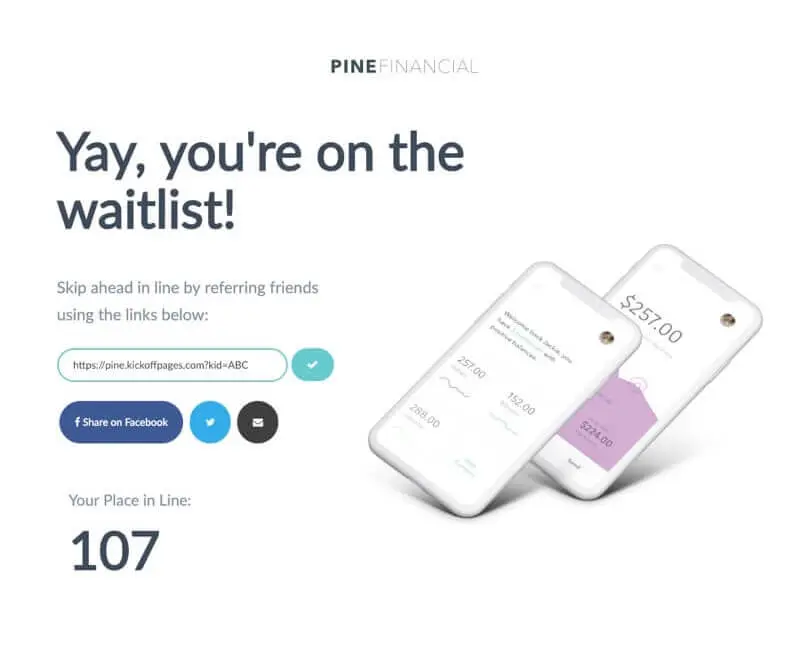
That is the post-entry moment you want AI to support: clear confirmation, simple sharing, and an obvious reason to send friends back.
For real examples of this loop in action, read or listen to how Pronti.AI used a KickoffLabs waitlist to grow from 3,000 to 80,000 users, how Swingly Toys used a waitlist campaign before raising $17,000 on Kickstarter, and how Haugen Racing collected 14.5k leads with a KickoffLabs campaign.
Spreadsheets are where referral campaigns go to die.
Prompt:
Write thank-you page copy for a referral giveaway. Confirm entry, explain how referrals work, make sharing feel worth it, include button copy for copying the referral link, and write short share messages for email, SMS, Facebook, Instagram story, and LinkedIn.
Good referral incentives are easy to explain:
- “Get 5 bonus entries for every friend who enters through your link.”
- “Refer 3 friends to unlock the bonus prize pack.”
- “Move up the waitlist when friends join through your link.”
- “Earn rewards at 3, 10, and 25 referrals.”
Bad referral incentives need a flowchart.
If you need three paragraphs to explain it, simplify it.
Step 7: Write Emails Before Launch
Do not wait until the campaign is live to write emails.
That is how you end up sending “Thanks for entering!” and nothing else.
A giveaway email sequence should:
- Confirm the entry.
- Drive referrals.
- Remind people before the deadline.
- Convert the list after the winner is picked.
Prompt:
Create a giveaway email sequence from this campaign brief. Include subject line options. Keep each email under 200 words. Include welcome, referral nudge, midpoint reminder, final chance, winner announcement, and post-campaign offer. Referral emails should point people back to their unique share link. Do not sound robotic.
KickoffLabs can generate and send the automatic reply email, reward emails, and follow-up messages tied to the campaign state. For a deeper email playbook, read AI Email Sequences for Giveaways and Waitlists.
Step 8: Measure the Right Thing
Most giveaway reports are vanity reports.
“2,000 entries!”
Great. How many were real? How many referred friends? How many opened the follow-up email? How many clicked the offer? How many became customers, trial users, applicants, buyers, or waitlist members?
Track:
- Total entries.
- Landing page conversion rate.
- Referral rate.
- Referred leads.
- Top referrers.
- Email confirmation rate.
- Lead source.
- Unsubscribe rate.
- Post-campaign offer clicks.
- Sales, trials, demos, or launch actions after the giveaway.
My take: if you only measure entries, you will make bad decisions.
Entries tell you attention. Referrals tell you momentum. Post-campaign action tells you business value.
You need all three.
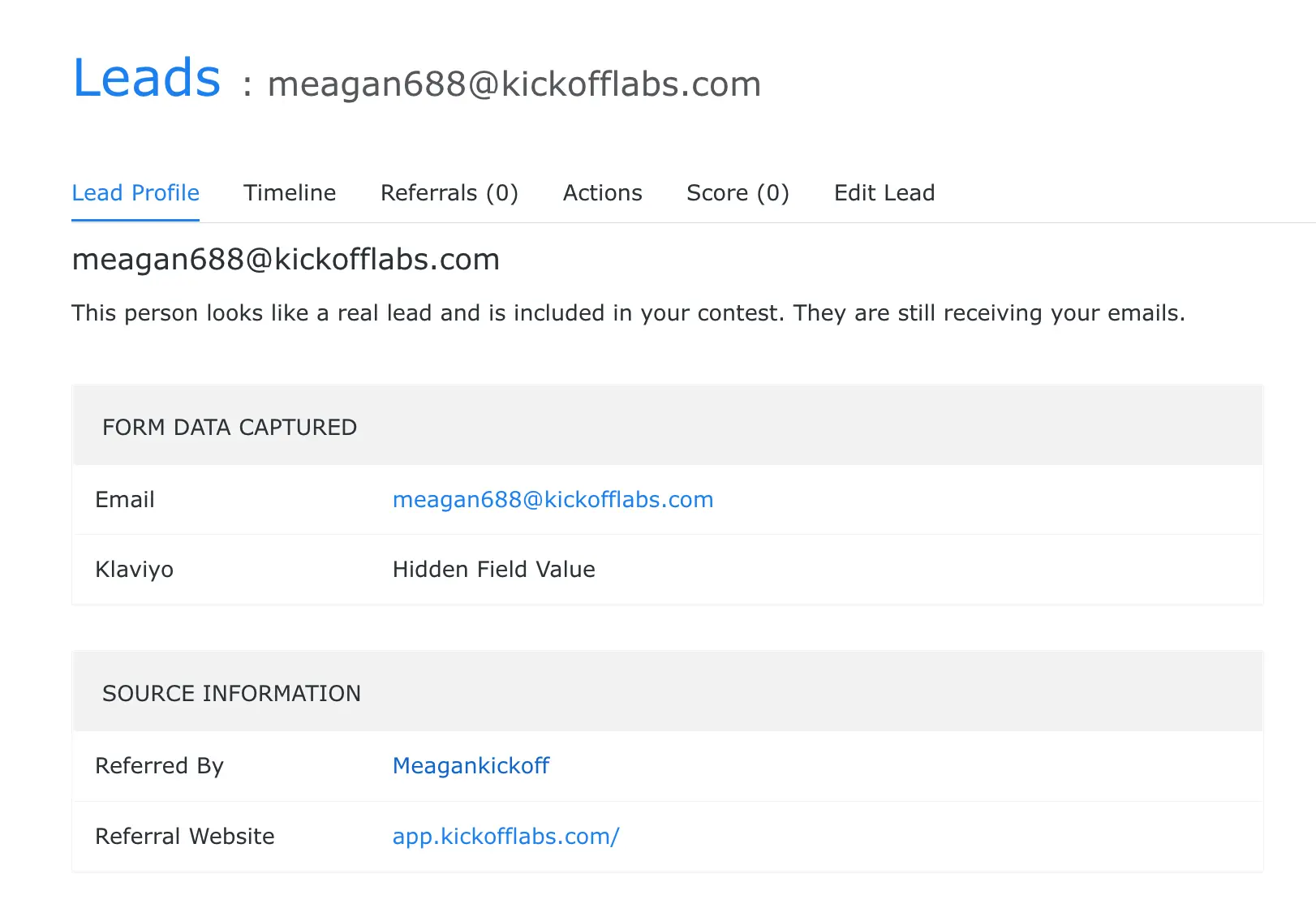
This is the difference between “the giveaway got shared” and “we know exactly which leads came from which sharers.”
Step 9: Set It Up in KickoffLabs
Here is the practical build order.
1. Create the Campaign
Start with the growth mechanic, not the colors.
If you want a classic prize drawing, start with a sweepstakes-style campaign. If you want viral sharing, use referral tracking and bonus entries. If you want people to unlock perks, use reward levels.
Useful help docs:
2. Build the Landing Page
Use the AI-assisted copy you drafted, then cut it down.
Your page needs the prize headline, short subheadline, entry form, CTA, deadline, rules link, trust signal, and simple how-it-works section.
Useful help docs:
3. Configure the Thank-You Page
This is where referral growth happens.
Add the confirmation message, unique referral link, share buttons, bonus-entry explanation, progress language, and reminder of the prize and deadline.
Useful help docs:
4. Add Emails
Set up the welcome email first. Then add referral nudges, deadline reminders, winner messaging, and post-campaign follow-up.
Useful help docs:
5. Add Rules and Test Everything
Link to the full rules from the landing page.
Then enter your own campaign.
Check:
- Did the entry save?
- Did the welcome email arrive?
- Does the referral link work?
- Does a referred test entrant credit the original entrant?
- Does the thank-you page explain the next step?
- Do the rules links work?
- Does mobile look clean?
- Are tracking parameters attached to traffic sources?
Do not skip test entries.
The best time to catch broken referral tracking is before your audience does.
The AI Giveaway Campaign Checklist
Use this before you publish. You can also download the branded PDF version here: AI Giveaway Campaign Checklist PDF.
Campaign Strategy
- Audience is specific.
- Bad-fit audience is named.
- Prize matches the audience.
- Campaign goal is clear.
- Follow-up offer is ready.
- Deadline is real.
- Campaign type matches the goal.
Landing Page
- Headline names the prize.
- Subheadline names the audience or value.
- Form is short.
- CTA is clear.
- Rules link is easy to find.
- Page works on mobile.
- Thank-you page drives referrals.
Referral Loop
- Unique referral links are enabled.
- Incentive is easy to explain.
- Bonus entries or rewards are clear.
- Share copy is written.
- Fraud or fake-entry risk is considered.
- Top referrers can be tracked.
Email Sequence
- Welcome email confirms entry.
- Referral email sends people back to their link.
- Deadline reminder is scheduled.
- Winner email is drafted.
- Post-campaign offer is ready.
- Emails sound like your brand, not a chatbot.
Measurement
- Primary KPI is defined.
- Referral rate is tracked.
- Lead source is tracked.
- Post-campaign conversion is tracked.
- End-of-campaign report questions are written.
- Next-campaign learnings will be saved.
Copy-and-Paste Prompt Pack
Campaign Brief Prompt
Turn this into a giveaway campaign brief: brand, audience, bad-fit audience, prize, goal, deadline, eligibility, follow-up offer, referral incentive, and brand voice. Output campaign positioning, prize-audience fit, landing page angle, referral loop, email sequence outline, and launch risks.
Prize Fit Prompt
Review this prize for audience fit. Tell me who it attracts, who it may accidentally attract, how well it connects to our follow-up offer, and three tighter alternatives.
Landing Page Prompt
Write giveaway landing page copy with headline options, subheadline options, CTA options, short prize description, three-step how-it-works copy, and thank-you page referral teaser. Keep it clear, specific, and short.
Rules Summary Prompt
Turn these official rules into a plain-English entrant summary under 200 words. Do not add terms or change meaning. Include eligibility, deadline, prize, entry method, winner selection, and notification.
Referral Loop Prompt
Write thank-you page copy that confirms entry and explains how to earn bonus entries by sharing a unique referral link. Include button copy and short share messages for common channels.
Email Sequence Prompt
Create a six-email giveaway sequence: welcome, referral nudge, midpoint reminder, final chance, winner announcement, and post-campaign offer. Keep each email under 200 words with one CTA.
Measurement Prompt
Create a measurement plan with primary KPI, secondary KPIs, misleading vanity metrics, daily checks, and an end-of-campaign report outline.
Final Take: Use AI to Move Faster, Not Think Less
A high-converting giveaway campaign is not magic.
It is audience fit, prize fit, clear copy, a short form, real rules, a deadline, a referral loop, useful emails, and honest measurement.
AI helps you build those pieces faster.
KickoffLabs helps you launch and track them without duct-taping forms, spreadsheets, referral links, and email tools together.
If you already know the audience and prize, do not overthink it.
Create the brief. Generate the draft. Build the referral loop. Test the flow. Launch.
Then let the campaign show you what people actually care about.