Contents
- What is a sweepstakes?
- Sweepstakes vs. giveaway vs. contest
- How sweepstakes work
- Do sweepstakes need “no purchase necessary”?
- Why sweepstakes work so well for lead generation
- Popular sweepstakes variations
- What to include on a sweepstakes landing page
- Real sweepstakes and giveaway examples
- Common sweepstakes mistakes
- How to launch a sweepstakes with KickoffLabs
- Final take
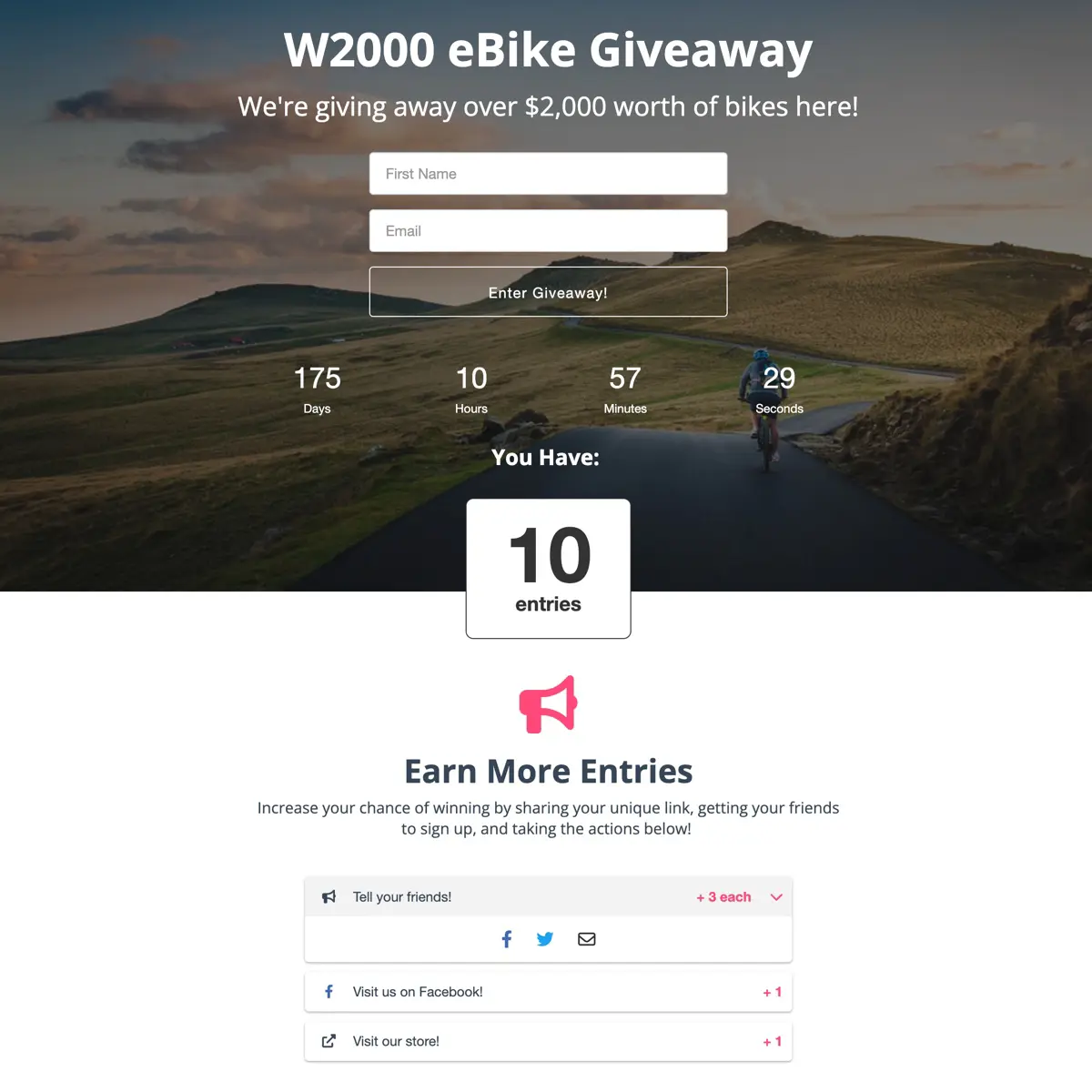
A sweepstakes is a prize promotion where winners are selected by chance.
That is the short version. The useful version is this: a sweepstakes gives people a simple reason to join your list, share with friends, and engage with your brand without making a purchase the price of entry.
If your campaign has a prize, a random winner, and no skill judging, you are probably running a sweepstakes. If people can earn bonus entries by referring friends or completing actions, it is still a sweepstakes as long as the winner is picked by chance and your rules are clear.
Quick answer: A sweepstakes is a chance-based giveaway. People enter for a chance to win a prize, and the winner is selected randomly. In the United States, sweepstakes generally need no-purchase entry options, official rules, eligibility details, prize descriptions, start/end dates, and a fair winner-selection process.
What is a sweepstakes?
A sweepstakes is a promotional campaign where entrants have a chance to win a prize through a random drawing.
Brands use sweepstakes to collect leads, promote launches, grow an email list, build social momentum, reward an audience, or bring attention to a new offer. Entrants usually submit an email address or complete another entry action. They may also earn bonus entries for referrals, social follows, surveys, video views, or other actions.
The key word is chance.
If a judge chooses the winner based on creativity, skill, votes, or performance, you are closer to a contest. If the winner is selected randomly from eligible entries, you are in sweepstakes territory.
For the broader format comparison, see contest vs. sweepstakes vs. rewards vs. raffles.
Sweepstakes vs. giveaway vs. contest
These terms get mashed together all the time.
Here is the practical difference:
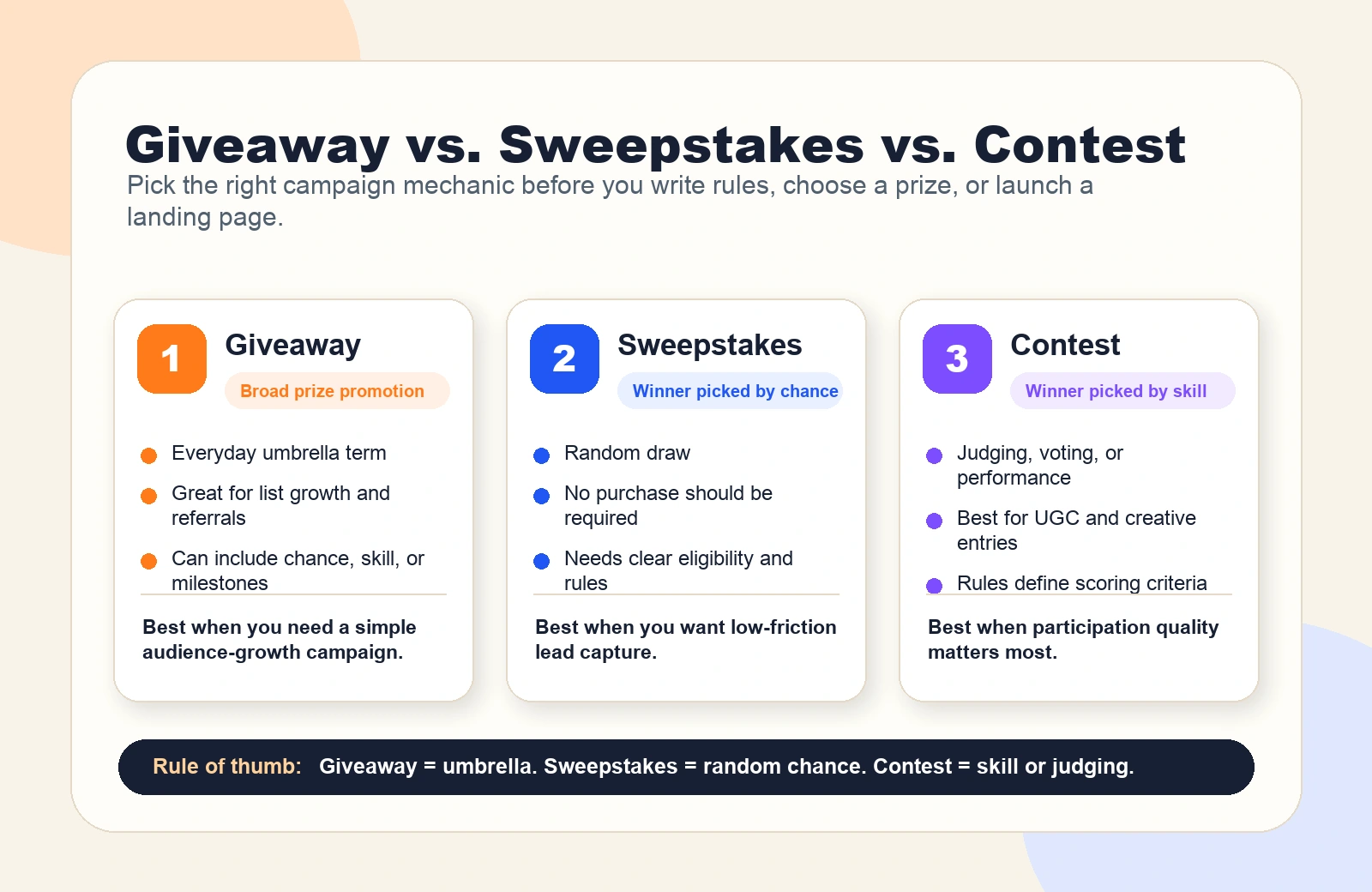
| Format | Winner selection | Best use |
|---|---|---|
| Giveaway | Broad everyday term for a prize promotion | Simple audience engagement |
| Sweepstakes | Random chance | Lead capture, referral growth, product launches |
| Contest | Skill, judging, votes, or performance | User-generated content, creative submissions |
| Leaderboard giveaway | Points, referrals, or rank | Competitive sharing and referral loops |
| Reward levels | Milestone-based perks | Guaranteed incentives for referrals/actions |
A sweepstakes can be a giveaway. A giveaway is not always a sweepstakes.
That distinction matters because chance-based promotions often carry specific legal requirements. This article is not legal advice, but it should help you plan the right questions before launch.
How sweepstakes work
A clean sweepstakes has six parts:
- Prize: what the winner gets.
- Eligibility: who can enter.
- Entry method: how someone joins.
- Rules: start/end dates, restrictions, winner notification, and required disclaimers.
- Random draw: how the winner is selected.
- Follow-up: what happens to entrants after the campaign ends.
In KickoffLabs, that usually looks like this:
- Build a sweepstakes landing page.
- Add the entry form.
- Create a thank-you page with sharing options.
- Give every entrant a unique referral link.
- Award bonus entries for verified referrals or contest actions.
- Watch for fraud and low-quality entries.
- Use Pick a Winner to select the winner fairly.
- Follow up with everyone else by email.
The mistake is thinking the random draw is the campaign.
The campaign is everything around it: the landing page, prize fit, share loop, source tracking, email sequence, and post-sweepstakes offer.
Do sweepstakes need “no purchase necessary”?
In the United States, sweepstakes generally should not require a purchase to enter. That is why you often see “no purchase necessary” language and alternate methods of entry.
The legal issue is usually the combination of prize, chance, and consideration. If people must pay or provide something of value for a chance to win, you may be moving toward lottery territory. Lotteries are heavily regulated and not something a brand should accidentally create.
Again: not legal advice. Get proper review for your rules.
But as a practical marketer, you should plan for:
- No-purchase entry language.
- Clear eligibility and location limits.
- Accurate prize value and description.
- Start and end dates.
- Odds or winner-selection explanation where needed.
- Platform disclaimers for Instagram, YouTube, Facebook, TikTok, or X.
- State, country, age, and tax considerations.
Use the USA giveaway and sweepstakes laws guide and contest law best practices as planning references before you publish.
Why sweepstakes work so well for lead generation
Sweepstakes remove friction.
People understand the deal in seconds: enter, maybe win, share for more chances. That makes sweepstakes useful for top-of-funnel growth when you want attention and email capture without asking for a sale immediately.
A good sweepstakes can help you:
- Grow an email list before a product launch.
- Validate interest in a niche, product, or prize category.
- Turn social traffic into owned contacts.
- Give partners and creators a campaign they can promote.
- Build referral loops with unique share links.
- Segment leads based on prize interest, answers, or source.
- Create a follow-up list for launch offers, demos, or product education.
The catch: cheap prizes create cheap lists.
If you give away something random, you will attract random people. Pick a prize your future customer wants and your future non-customer can ignore.
Popular sweepstakes variations
Bonus-entry sweepstakes
This is the classic KickoffLabs format.
Someone enters once, then earns bonus entries for sharing, referring friends, following accounts, answering questions, or completing actions. The final winner is still selected by chance, but the campaign rewards people for helping spread the word.
Start here: bonus-entry sweepstakes.
Sweepstakes with reward levels
Reward levels give participants guaranteed perks when they hit milestones.
For example: refer 3 friends and get a discount; refer 10 and get early access; refer 25 and get a premium bonus. You can still run a random grand-prize draw, but now every active participant has something to chase.
Start here: reward levels.
Leaderboard sweepstakes
A leaderboard ranks participants by referrals or points.
This can create serious momentum, especially for launches and communities where people like competition. It also needs better fraud controls because competitive campaigns attract people who try to game the system.
Start here: leaderboard giveaways.
Waitlist sweepstakes
A waitlist sweepstakes is useful when you are launching something new.
People join the waitlist, share with friends, and earn more chances or better rewards. You get early demand signals and a list of people to follow up with before launch.
Start here: waitlist with giveaway.
What to include on a sweepstakes landing page
Your sweepstakes page should be boringly clear.
That is a compliment.
Include:
- Prize name and image.
- Who the prize is for.
- Deadline.
- Entry form.
- Basic eligibility.
- Link to official rules.
- Share/referral instructions.
- What happens after entry.
- Privacy and email expectations.
Do not ask for ten things before the first entry. Get the email first. Then use the thank-you page to ask for referrals, follows, shares, or bonus actions.
That second-step flow converts better because people already said yes once.
If you need page structure help, read giveaway landing page best practices and browse bonus-entry giveaway templates.
Real sweepstakes and giveaway examples
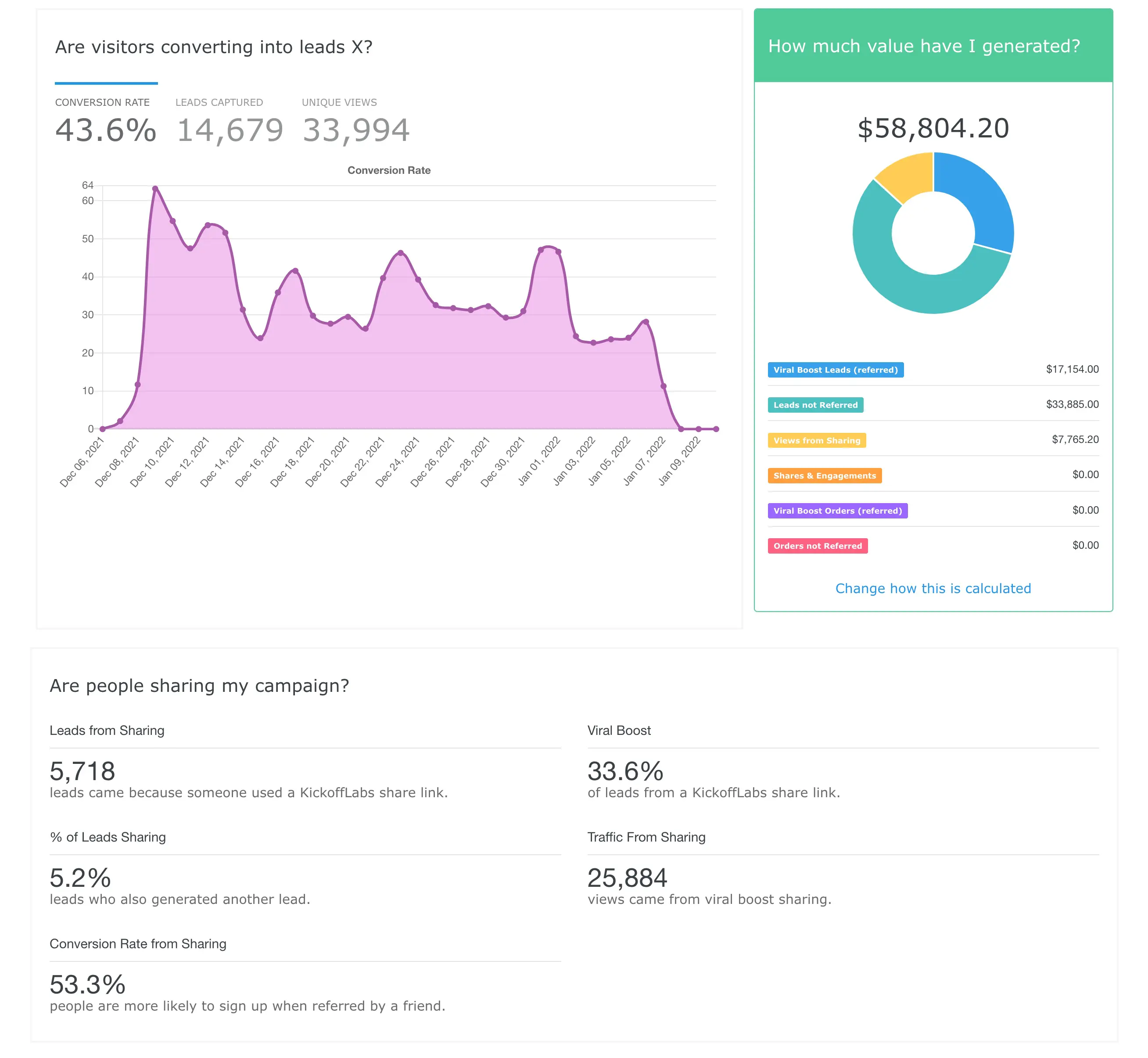
KickoffLabs campaigns have generated more than 100 million leads since 2011. The mechanics are simple, but the results depend on prize fit, promotion, and follow-up.
Haugen Racing used a KickoffLabs giveaway to collect more than 14,000 leads.
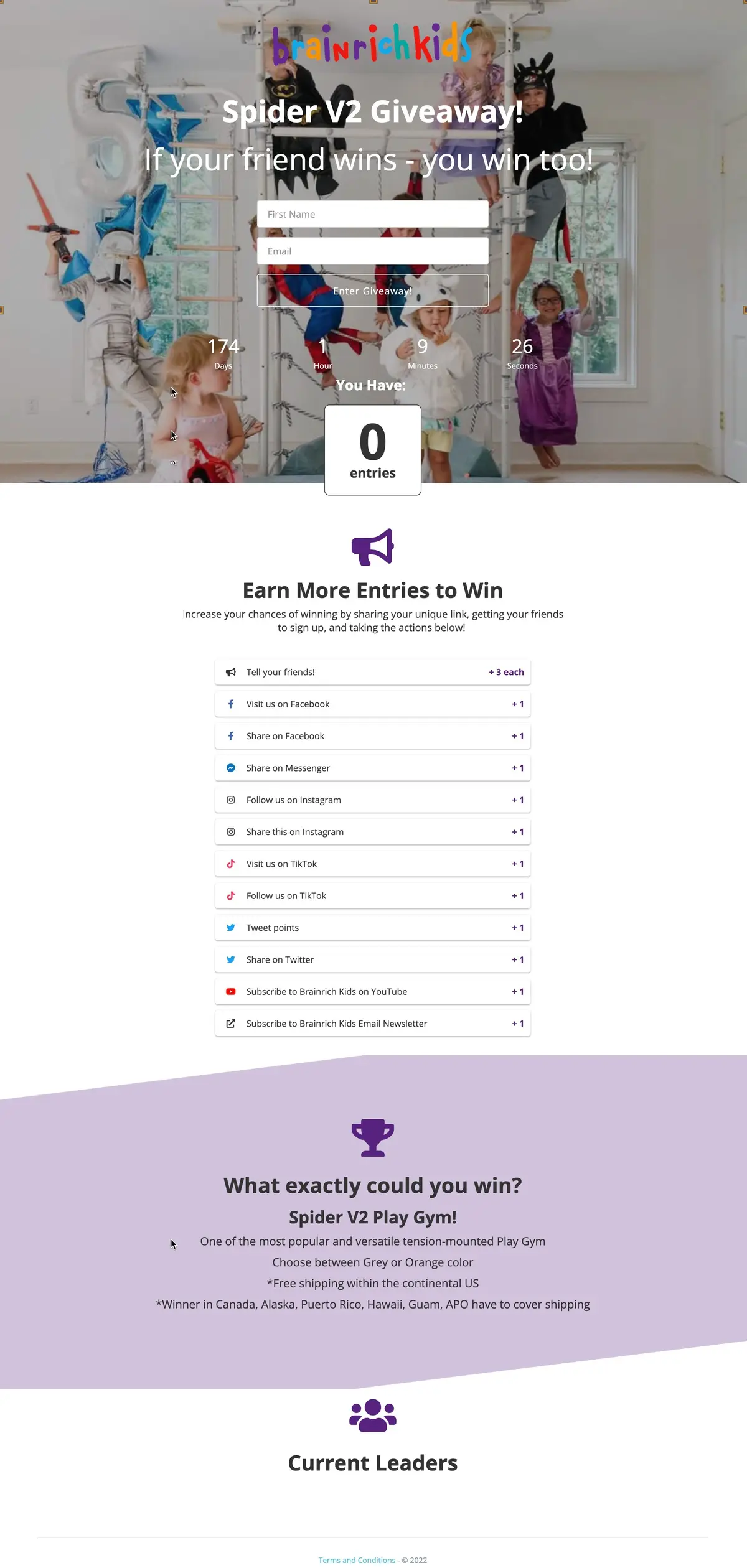
Brain Rich Kids used KickoffLabs contest mechanics with referrals and actions to build momentum around their campaign.
The lesson is not “copy these prizes.”
The lesson is to match your prize to your audience, make sharing easy, and give entrants a reason to stay engaged after the first form submit.
Common sweepstakes mistakes
Avoid these:
- Picking a prize with no connection to your buyer.
- Requiring a purchase to enter without legal review.
- Hiding the rules.
- Running everything in a social caption instead of a trackable landing page.
- Forgetting fraud detection.
- Making winner selection look subjective when the campaign is supposed to be random.
- Collecting leads without a follow-up sequence.
- Measuring entries only, not source quality, referral rate, or post-campaign conversions.
A sweepstakes is easy to launch. A sweepstakes that produces useful leads takes more discipline.
How to launch a sweepstakes with KickoffLabs
Here is the straightforward path:
- Choose the sweepstakes campaign type.
- Pick a prize tied to your ideal customer.
- Build the entry page and thank-you page.
- Add official rules and eligibility details.
- Turn on referral links and bonus-entry actions.
- Connect your email provider or KickoffLabs follow-up emails.
- Promote the page through social, email, partners, creators, and your website.
- Monitor entries, referrals, conversion rate, and fraud signals.
- Use Pick a Winner for a fair draw.
- Announce the winner and follow up with every non-winner.
KickoffLabs handles the campaign page, viral sharing, referral tracking, fraud controls, winner picking, and integrations so you can focus on the offer and promotion.
Final take
A sweepstakes is not just “enter to win.”
It is a chance-based campaign that can grow your list, validate demand, and turn entrants into referrers when the system is built correctly.
Keep the rules clear. Keep the prize relevant. Make the first entry easy. Put the referral loop on the thank-you page. Follow up with everyone, not just the winner.
That is how a sweepstakes becomes more than a prize draw.
It becomes a launchable growth campaign.