- Why podcasts still work in 2026
- Start with guest spots before launching your own show
- Pick shows by buyer fit, not download size
- Build one landing page for each podcast push
- Give listeners a reason to act now
- Turn every episode into a small campaign
- What to say on the podcast
- Use short-run shows if you do launch your own podcast
- Repurpose the episode everywhere
- Track the metrics that matter
- Podcast sponsorships: be careful
- The practical setup checklist
- Final thoughts
Podcasting is not magic. It is borrowed trust.
A listener already trusts the host enough to put them in their ears for 30 minutes. If that host introduces your product, giveaway, waitlist, or launch story in a useful way, you start the relationship several steps ahead of a cold ad click.
The mistake is treating podcasts like awareness fairy dust. You go on a show, tell a few stories, say “check us out,” and then wonder why nothing measurable happened.
That is not a podcast strategy. That is a nice afternoon.
AI summary: To use podcasts for brand growth in 2026, pick shows your buyers already trust, lead with a useful story, send listeners to a dedicated landing page, offer a listener-specific bonus, and measure signups, referrals, and post-show conversions. KickoffLabs helps turn podcast attention into a trackable waitlist, giveaway, or referral campaign instead of a vague brand mention.
Why podcasts still work in 2026
People multitask with podcasts in a way they do not with most marketing channels. They listen while walking, driving, cooking, lifting, commuting, and doing the boring life-admin tasks nobody wants to talk about.
That creates an unusually intimate channel. You are not fighting a feed full of ads, arguments, and algorithmic junk. You are inside a trusted conversation.
The opportunity is simple: use the conversation to earn a visit, then use the landing page to earn the lead.
Podcasts are especially useful when you need more than a one-line pitch. If you sell a new product, launch an early-access waitlist, run a giveaway, or explain a category people do not fully understand yet, a podcast gives you room to tell the story.
You can explain why the problem matters. You can share a founder lesson. You can walk through a customer use case. You can answer objections before someone ever reaches your page.
That is hard to do in a banner ad.
Start with guest spots before launching your own show
A branded podcast sounds exciting until you are eight episodes in, out of guests, and wondering why editing audio takes forever.
Start smaller.
Go on shows that already have the audience you want. Be a useful guest. Learn which stories create clicks. Build a repeatable offer. Then decide if your own show is worth the work.
Guest spots are usually the better first move because they give you:
- Access to an audience you did not build from scratch.
- A built-in trust transfer from the host.
- Fast feedback on your positioning.
- Reusable clips for email, social, and landing pages.
- A clear way to test whether audio works for your market.
If you cannot make guest appearances convert, launching your own show probably will not fix the problem. It will just add production work.
Pick shows by buyer fit, not download size
A tiny niche show can beat a huge general business podcast if the audience is right.
Look for three signals.
First, the host talks to people who could actually buy, join, refer, or recommend your product. A founder selling a Shopify app should care more about ecommerce operators than generic entrepreneurship listeners.
Second, the episodes create action. Read comments. Check LinkedIn posts. Look for listeners asking follow-up questions, joining communities, or downloading resources.
Third, the host gives guests room to teach. You want a conversation where you can explain something useful, not a lightning-round promo slot.
Create a short target list of 20 shows. For each one, write down the audience, the recurring topics, the best-fit story you can tell, and the offer you would send listeners to.
If you cannot name the offer, you are not ready to pitch the show.
Build one landing page for each podcast push
Do not send podcast listeners to your homepage.
Your homepage is trying to serve everyone. A podcast listener just heard a specific story from a specific show. Give them a page that continues that conversation.
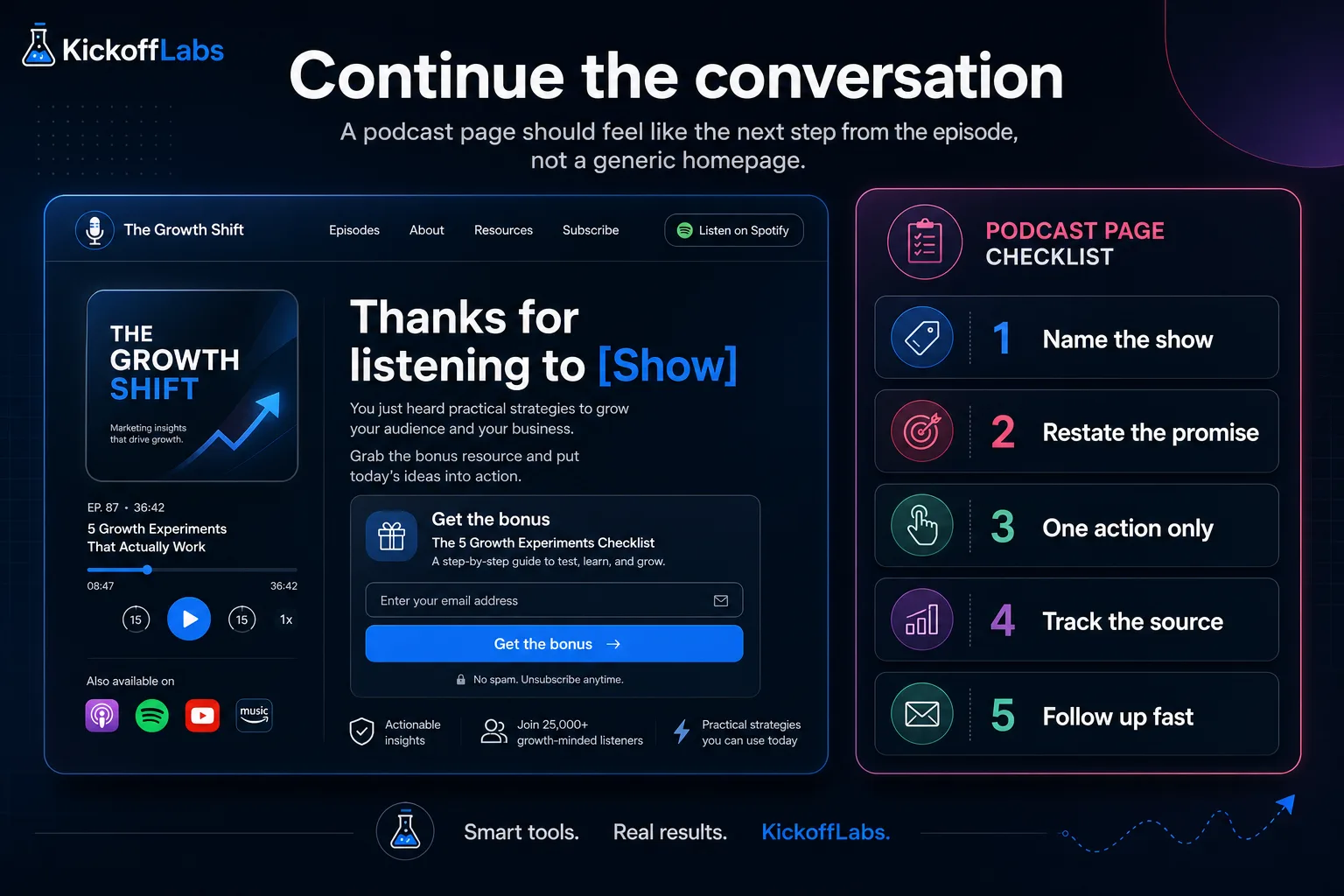
A good podcast landing page includes:
- A headline that mentions the show or listener group.
- A short recap of the promise you made on the episode.
- One clear call to action.
- A simple form.
- A bonus, checklist, template, early-access invite, or giveaway entry.
- Social proof or proof of momentum.
- A reminder that sharing unlocks something better, when referrals are part of the campaign.
This is where KickoffLabs fits naturally. You can spin up a waitlist campaign, email opt-in campaign, or referral reward program and track which podcast sends the best leads.
Use a clean URL the host can say out loud. Something like /podcast-name beats a long UTM mess.
You can still add UTMs behind the scenes. Just do not make the listener memorize them.
Give listeners a reason to act now
“Visit our site” is weak.
Podcast listeners need a reason to move from passive listening to active clicking. The reason does not have to be complicated.
Try one of these:
- A listener-only bonus guide.
- Early access to a new product.
- Extra entries in a giveaway.
- A private template or swipe file.
- A limited founder Q&A invite.
- A discount for the first group of signups.
- A referral reward for sharing with friends.
The best offers match the episode topic. If you talked about launching a product, send people to a pre-launch waitlist. If you talked about audience growth, send them to a giveaway landing page. If you talked about word of mouth, send them into a referral campaign with trackable referral links.
Do not bolt on a random prize just because prizes get clicks. Prize fit matters. A relevant prize attracts future customers. A generic prize attracts people who like free stuff.
Turn every episode into a small campaign
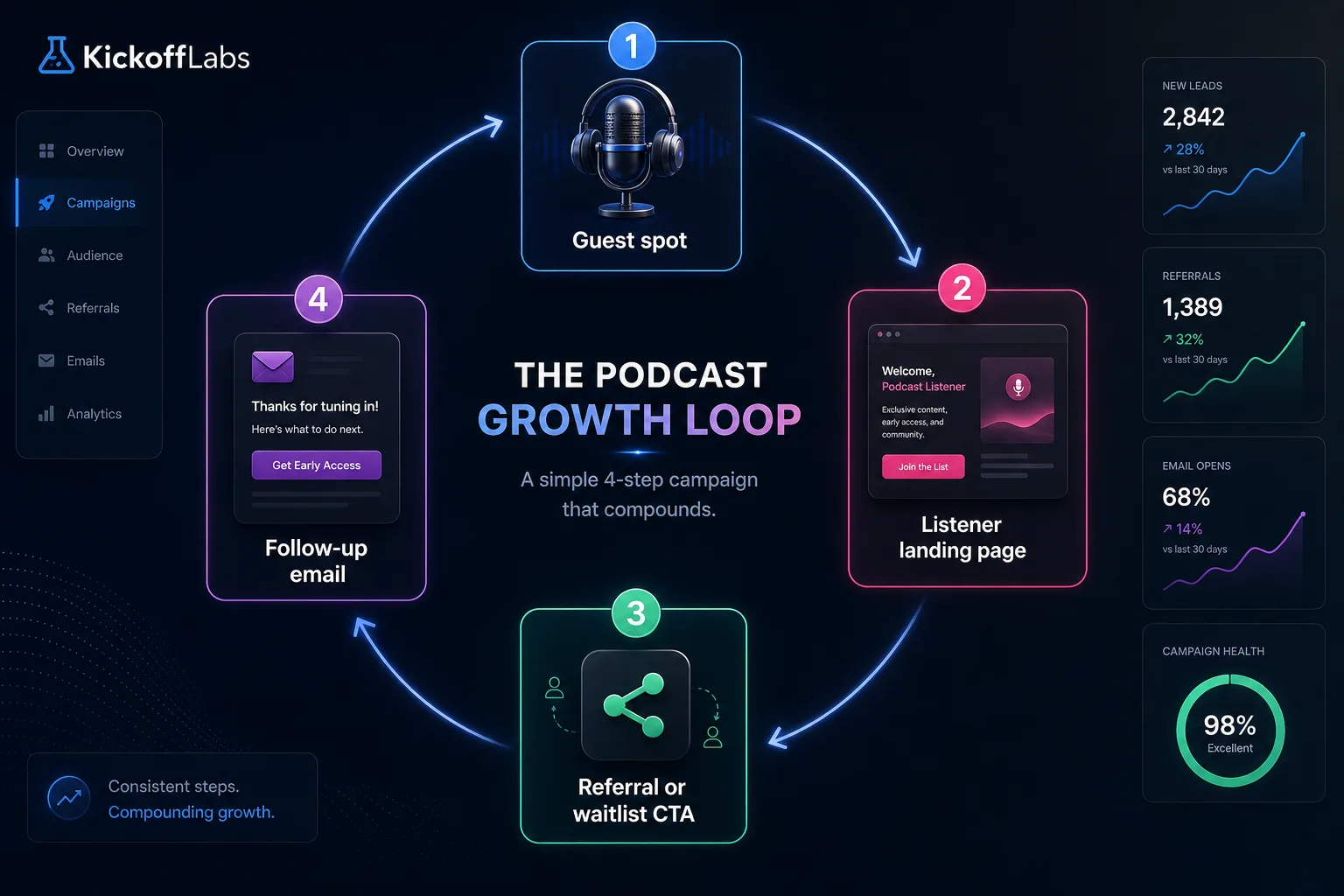
A podcast appearance should have three phases.
Before the episode goes live, build the landing page, write the listener offer, create a short follow-up email sequence, and give the host the clean URL.
When the episode launches, promote it like a real campaign. Share clips. Email your list. Tag the host. Pull one strong idea into a LinkedIn post. Add the episode to your resources page if it is evergreen.
After the episode, measure what happened. Look at visits, conversion rate, signups, referral activity, and lead quality. If the campaign used KickoffLabs, check your reports and referral data instead of guessing from vibes.
The goal is not just “did we get traffic?”
The better questions are:
- Did listeners convert at a higher rate than cold traffic?
- Did they refer friends?
- Did they reply to follow-up emails?
- Did they match our target customer?
- Did the host’s audience care enough to keep engaging after the episode?
One great niche podcast that sends 50 serious leads can be worth more than a giant show that sends 1,000 curiosity clicks.
What to say on the podcast
Do not show up and recite your homepage.
Bring stories. Bring numbers you can defend. Bring mistakes. Bring a sharp point of view.
Useful podcast angles include:
- The painful problem that made you build the product.
- A common launch mistake you keep seeing.
- A tactical framework listeners can use immediately.
- A before-and-after story from your own launch.
- A contrarian take the host can push on.
- A checklist for avoiding wasted ad spend.
For KickoffLabs-style campaigns, the strongest story is often about momentum. How do you get people to care before launch? How do you make sharing easy? How do you know if people are actually interested or just being polite?
That connects naturally to startup validation, waitlists, giveaways, and referral tracking.
If you want examples from our own archive, start with the KickoffLabs On Growth podcast. The Choco Rush episode shows how to validate a startup idea with $20 a day, Pronti.AI shows how a waitlist helped grow from 3,000 to 80,000 users, and Haugen Racing shows how a giveaway produced 14,500 leads. Those stories make the abstract advice concrete: the episode is the trust builder, and the campaign is where the demand gets measured.
Use short-run shows if you do launch your own podcast
If you decide to create your own podcast, do not assume it has to run forever.
A short-run series can work better.
For example:
- “10 founder launch lessons in 10 days.”
- “The ecommerce referral playbook.”
- “Five customer interviews before product launch.”
- “The summer giveaway teardown series.”
Short-run shows have a finish line. That makes them easier to plan, easier to promote, and easier for listeners to understand.
Each episode should point to the same campaign hub. Let people subscribe, download resources, join the waitlist, enter the giveaway, or refer friends from one place.
You can always launch season two if season one earns attention.
Repurpose the episode everywhere
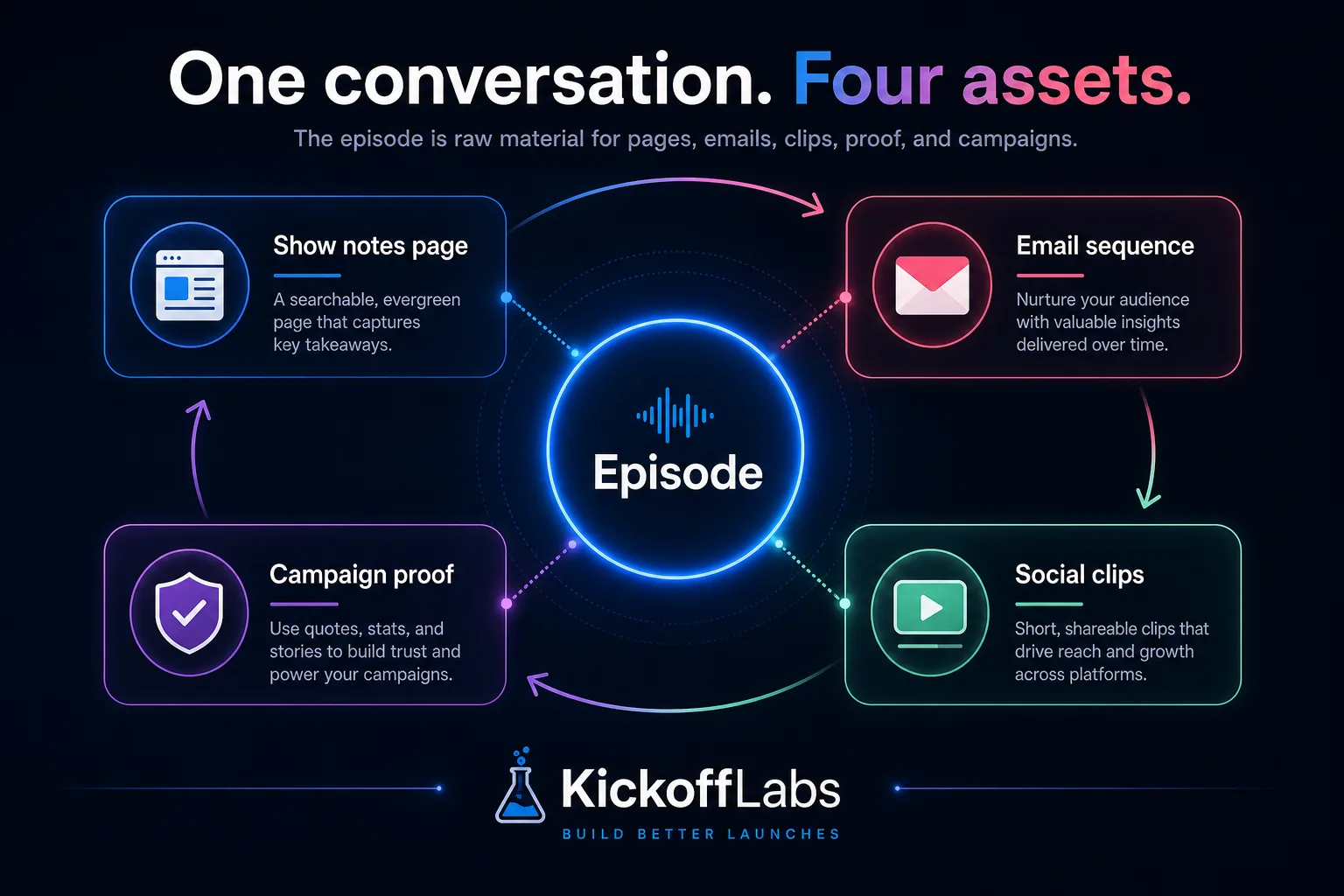
The podcast is the raw material, not the final asset.
Turn each strong episode into:
- A blog post or transcript with edited takeaways.
- Short social clips.
- Quote graphics.
- Email newsletter sections.
- FAQ answers.
- Sales enablement snippets.
- Landing page proof points.
If an episode explains your category well, link to it from relevant content. A podcast about validation belongs near your landing page validation guide. A podcast about referrals belongs near your referral program guide and reward levels page.
This is how one conversation becomes an asset cluster.
Track the metrics that matter
Podcast marketing gets fuzzy when you only track downloads.
Downloads are fine for the host. They are not enough for you.
Track these instead:
- Landing page visits from each show.
- Email signup conversion rate.
- Cost per lead if you paid for sponsorship.
- Referral rate from podcast-sourced leads.
- Email engagement after signup.
- Demo, purchase, or upgrade activity when relevant.
- Qualitative replies from listeners.
If a show drives fewer visits but better lead quality, keep it on the list. If a show drives lots of traffic and zero action, either the audience is wrong or your offer is weak.
Do not keep doing podcast appearances just because they feel productive. Measure the campaign.
Podcast sponsorships: be careful
Sponsoring a podcast can work. It can also burn cash quietly.
Before paying for ads, ask for audience details, recent download ranges, ad placement options, examples of past sponsors, and whether the host will do a native read.
Native reads usually outperform generic spots because the host can explain why the offer matters.
Send sponsored listeners to a dedicated landing page too. If you pay for the attention, you should absolutely measure what it does.
A simple KickoffLabs campaign can help you compare shows, offers, and CTAs without building a custom tracking system.
The practical setup checklist
Here is the short version.
- Pick 20 shows with real buyer fit.
- Pitch one useful story, not your company biography.
- Build a dedicated landing page for each show or campaign theme.
- Offer a listener-specific reason to sign up.
- Add referral incentives if sharing is part of the strategy.
- Prepare a short email sequence before the episode goes live.
- Promote the episode from your own channels.
- Track visits, signups, referral activity, and lead quality.
- Reuse the best clips and ideas across your content.
- Double down on the shows that create real leads.
Final thoughts
Podcasts can grow your brand, but not because audio is trendy.
They work because trust travels through people. A good host introduces you to the right audience, gives you enough time to teach, and makes your product feel less like a cold pitch.
Your job is to catch that attention with a focused offer.
Build the landing page. Track the source. Follow up quickly. Give listeners something worth sharing.
That is how a podcast appearance turns into a measurable growth campaign instead of a nice logo for your “as seen on” section.
If you want to turn podcast listeners into a real launch audience, start with a KickoffLabs waitlist or referral reward campaign and give every show its own trackable path.