Contents
- What Is E-Commerce Referral Marketing?
- Referral Marketing vs. Loyalty Programs vs. Affiliate Programs
- Why E-Commerce Referral Programs Work
- The E-Commerce Referral Loop
- Step 1: Pick the Right Referral Reward
- Step 2: Decide What Counts as a Successful Referral
- Step 3: Put the Referral Offer in the Right Places
- Step 4: Build the Share Experience
- Step 5: Connect Referrals to Shopify and Purchase Data
- Step 6: Write the Email Sequence
- Step 7: Prevent Referral Fraud Before It Gets Expensive
- Step 8: Measure What Actually Matters
- Common Mistakes That Kill E-Commerce Referral Programs
- How to Set Up an E-Commerce Referral Campaign with KickoffLabs
- The Bottom Line
- Related Resources
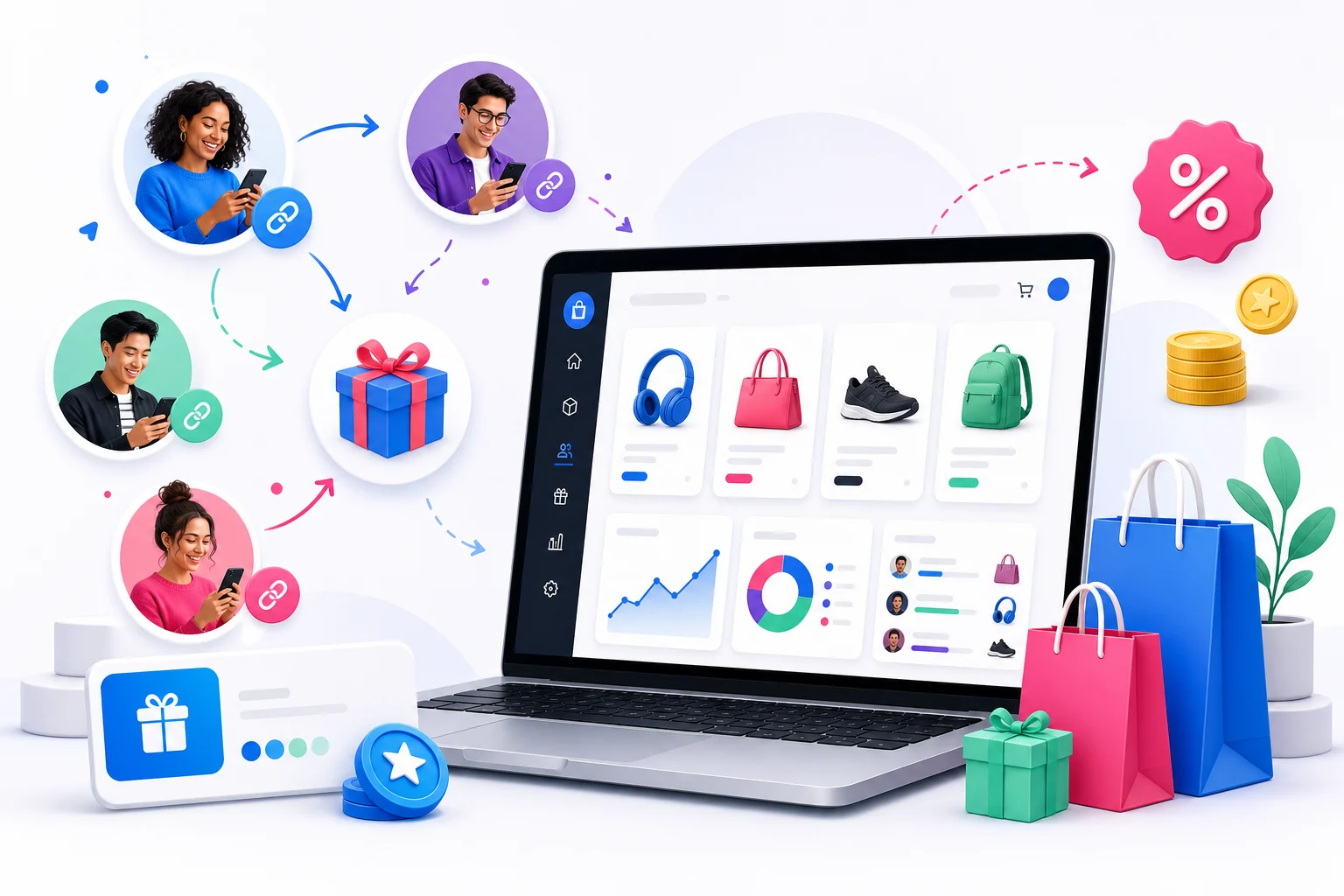
Your best e-commerce referral program is not a coupon code online.
It is a simple loop: customer buys, customer shares, friend buys, both people get rewarded. Done right, it turns your happiest buyers into a repeatable acquisition channel. Done wrong, it becomes another discount leak you cannot explain in Shopify reports.
Quick answer: E-commerce referral marketing rewards existing customers for sending new buyers to your store. The strongest programs use double-sided rewards, track referrals through unique links or codes, trigger rewards only after a qualifying purchase, and use email/SMS follow-up to keep customers sharing. For most stores, referral rewards should be product credit, discounts, exclusive access, or tiered perks — not generic cash prizes.
This guide is for stores that want customers, not just entries.
If you want a broad referral-program walkthrough, start with how to build a referral program that actually grows. If you want the e-commerce version — the one where orders, margins, fraud, Shopify, and repeat purchases matter — stay here.
What Is E-Commerce Referral Marketing?
E-commerce referral marketing is a customer acquisition strategy where shoppers get rewarded for sending friends to buy from your store.
A customer gets a unique referral link or code. They share it with a friend. The friend makes a purchase. The original customer earns a reward, and the friend usually gets an incentive too.
That last part matters.
A one-sided program says, “Buy from this store so I can get paid.” A double-sided program says, “Use my link and we both get something.” One feels selfish. The other feels like a favor.
For e-commerce, referral programs usually reward one of these actions:
- A first purchase from a referred friend
- A minimum order value
- A subscription start
- A repeat purchase
- A purchase in a specific product category
- A friend joining a launch waitlist before the store opens
The mistake is rewarding the wrong thing.
If you reward email signups when your real goal is orders, you will get email signups. Some will be good. Plenty will be people chasing a reward. If your margins depend on purchases, make the purchase the conversion event.
Referral Marketing vs. Loyalty Programs vs. Affiliate Programs
These channels get mashed together all the time. They are related, but they are not the same job.
| Program type | Who promotes you | What triggers value | Best for |
|---|---|---|---|
| Referral program | Existing customers | A friend signs up or buys | New customer acquisition |
| Loyalty program | Existing customers | The same customer buys again | Retention and repeat purchase |
| Affiliate program | Creators, publishers, partners | Tracked traffic or sales | Paid reach and content distribution |
A loyalty program says, “Keep buying and earn rewards.”
An affiliate program says, “Promote us to your audience and earn commission.”
A referral program says, “Tell a friend who would actually like this.”
For e-commerce, referrals sit in the sweet spot between acquisition and trust. You are not renting attention from a creator. You are asking happy customers to introduce you to people like them.
That is why the offer and the timing matter so much.
Why E-Commerce Referral Programs Work
Ads are expensive because everyone can buy them. Referrals are different because trust is scarce.
When a customer recommends your product, they are lending you their credibility. The friend is not starting from zero. They are starting with, “Someone I know liked this enough to send it to me.”
That changes the whole sales conversation.
A good e-commerce referral program does four things:
- It captures the post-purchase high. Right after someone buys, their motivation is fresh. That is when they are most likely to share.
- It gives the friend a reason to act now. A discount, bundle, early access, or bonus can turn curiosity into a first order.
- It rewards real customers instead of random prize hunters. Purchase-based rewards keep the program tied to revenue.
- It compounds over time. Every buyer can become the next referrer.
That last point is the fun part.
A paid ad stops working when you stop paying. A referral loop can keep producing if you keep giving customers a reason to share.
The E-Commerce Referral Loop
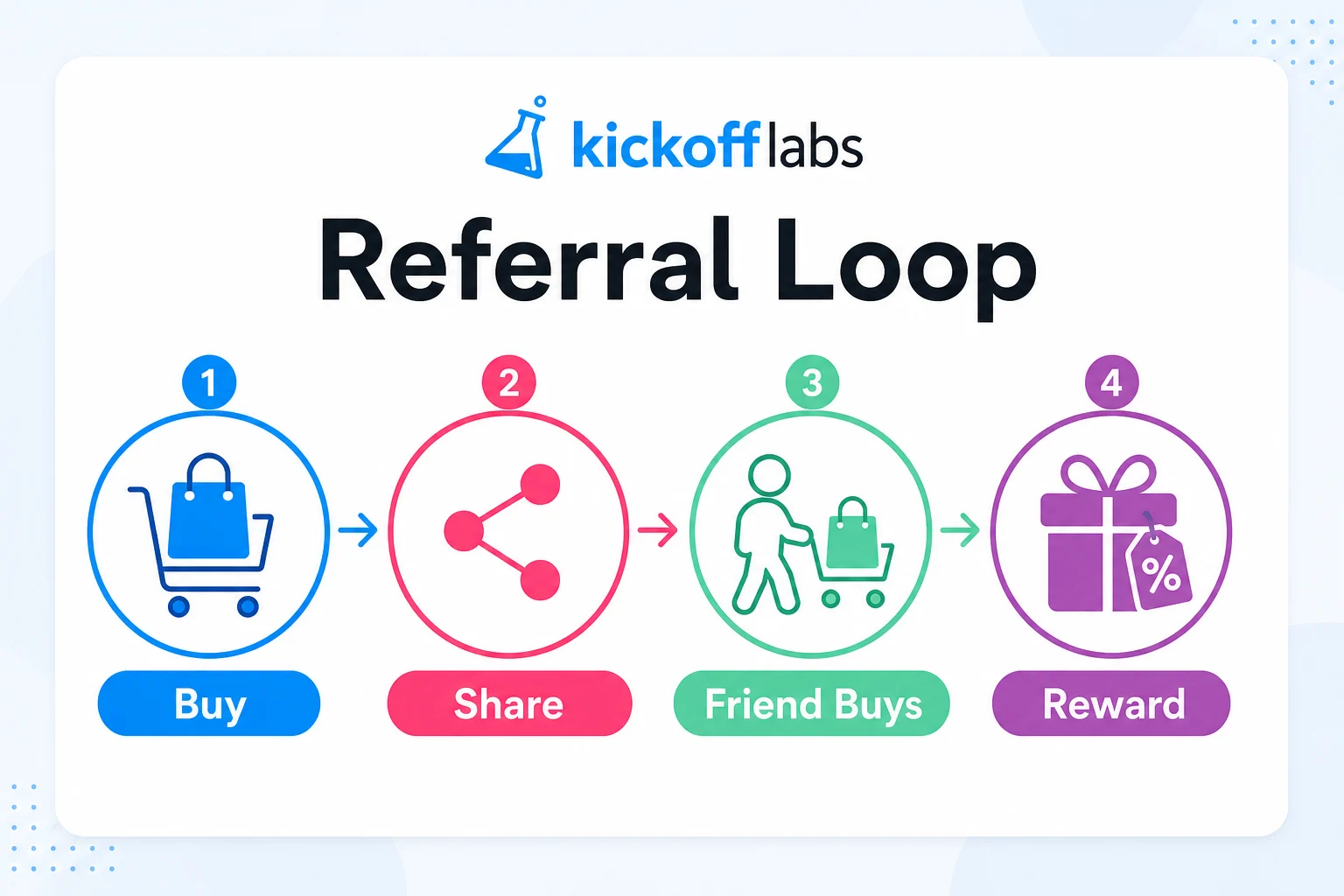
Keep the loop stupidly simple.
- Buy: A customer places an order or joins your launch list.
- Share: They get a personal link, code, or referral page.
- Friend buys: The friend clicks, signs up, or purchases.
- Reward: Both sides get the promised benefit.
If your program needs a diagram with 14 arrows, it is too complicated.
The customer should understand the offer in one sentence:
- “Give $15, get $15.”
- “Give 20% off, get 20% off your next order.”
- “Refer three friends and unlock the limited-edition bundle.”
- “Move up the waitlist every time a friend joins.”
Simple programs get shared. Confusing programs get ignored.
Step 1: Pick the Right Referral Reward
The reward is not a decoration. It is the engine.
For e-commerce, the best rewards usually come from your own store. Store credit, discounts, free products, exclusive bundles, upgrades, early access, and VIP perks all keep the value inside your ecosystem.
Cash can work, but be careful. Cash attracts people who want cash. Store credit attracts people who want your products.
Here is the practical breakdown.
Store credit
Store credit is often the cleanest reward for established stores.
It encourages another purchase, protects margin better than cash, and feels flexible to the customer. If your average order value is healthy and customers buy more than once, start here.
Example: “Give your friend $15 off. Get $15 credit after their first purchase.”
Percentage discount
Percentage discounts are easy to understand, but they can get messy with margins.
A 20% discount on a high-margin apparel product might be fine. The same discount on a low-margin electronics product might hurt. Do the math before you ship the offer.
Use percentage discounts when your catalog has consistent margins.
Free product or bundle
Free products feel more exciting than a small discount.
They work well when the item has high perceived value and manageable cost. Samples, accessories, limited-edition variants, and bundles can all make strong referral rewards.
The trick is relevance. A random tote bag is not magic. A product your customers already want can be.
Tiered rewards
Tiered rewards are where referral programs start to feel like a game.
Refer one friend, get a small reward. Refer three, get something better. Refer ten, unlock VIP status or a premium bundle.
This works especially well for launches, subscription boxes, creator products, and communities where people want to show status.
KickoffLabs is built for this kind of structure. You can create reward level campaigns where customers unlock different rewards as they refer more buyers or leads.
Early access
If you are pre-launch, do not underestimate access.
People will share to move up a waitlist if the product is compelling. The reward does not have to be a discount. It can be first access, limited inventory, founder pricing, or an exclusive launch bundle.
That is the same psychology behind the best pre-launch waitlists: status plus progress plus a reason to share now.
Step 2: Decide What Counts as a Successful Referral
This is where stores accidentally create fraud.
If anyone can enter a friend’s email and instantly unlock a reward, you are not running a referral program. You are running an invitation to fake signups.
Define the qualifying action before you build anything.
For e-commerce, the cleanest conversion event is usually:
- Friend completes a first purchase
- Friend spends at least a minimum amount
- Friend keeps the order past the refund/cancellation window
- Friend starts a paid subscription
- Friend joins a waitlist and later purchases
A small store can start simple: reward after first purchase.
A store with higher fraud risk should add guardrails: minimum order value, one reward per household, no self-referrals, no canceled orders, and manual review for suspicious spikes.
This is not paranoia. It is basic hygiene.
If the reward is worth anything, someone will try to game it.
Step 3: Put the Referral Offer in the Right Places
Most referral programs fail because nobody sees them.
Do not bury your referral link in an account settings page and call it a strategy. Put the offer where customer motivation is highest.
The thank-you page
The order confirmation page is prime real estate.
The customer just bought. They are excited. Give them a clean referral prompt before that energy disappears.
Keep it short:
“Know someone who would love this? Give them $15 off and get $15 credit when they buy.”
Then show the link, copy button, and share options.
Post-purchase email
Your post-purchase email should not be a receipt with a personality disorder.
Confirm the order. Set expectations. Then add one referral CTA.
Do not cram in six asks. You want one action: share with a friend.
Delivery or unboxing moment
The delivery moment is another strong share window.
If customers love the product when it arrives, ask then. Add a referral card in the package, a QR code on an insert, or an email timed around delivery.
The message should feel natural: “Loving it? Give a friend a deal.”
Customer account or loyalty page
If customers log in to manage subscriptions, rewards, or orders, add referral progress there.
Show their link. Show their reward status. Show what they unlock next.
Progress beats mystery.
Launch waitlist page
If you are not live yet, use a waitlist campaign instead of a purchase reward.
The loop is simple: join the list, get a referral link, move up the list or unlock launch perks when friends join. When the store opens, you already have a ranked list of warm prospects.
Step 4: Build the Share Experience
The share experience should be boringly obvious.
Every participant needs:
- A unique referral link or code
- A copy button
- Pre-written share text
- Email and SMS sharing options
- Social share buttons for the channels your customers actually use
- A status page that shows progress toward rewards
Do not make customers write your marketing copy from scratch.
Give them a simple message they can edit:
“I just bought from [Store] and thought you’d like it. Use my link for $15 off your first order: [link]”
That is enough.
For higher-consideration products, make the message more personal:
“This solved [specific problem] for me. If you’ve been looking for one, use my link and we both get credit.”
The copy should sound like something a real person would send. If it reads like an ad, people will not use it.
Step 5: Connect Referrals to Shopify and Purchase Data
For Shopify stores, referral marketing gets much more useful when purchases and referrals talk to each other.
KickoffLabs’ Shopify purchase rewards page explains the core idea: customers can earn points for what they spend and for what their friends spend. That turns referral tracking from a lead-counting exercise into a revenue-tied campaign.
The important pieces are:
- Identify the customer. Match each buyer to their referral profile.
- Track the friend. Know which link or code brought the new buyer in.
- Wait for the qualifying purchase. Do not reward too early.
- Apply the reward. Send credit, discount, points, or fulfillment instructions.
- Trigger follow-up. Tell the referrer they earned something and nudge them toward the next tier.
This is where DIY spreadsheets break down.
Manual tracking works for your first ten referrals. It does not work when a campaign starts moving. You need a system that can connect referral links, order events, reward status, email triggers, and fraud checks without you babysitting every row.
Step 6: Write the Email Sequence
Referral programs need reminders. Not spam. Reminders.
A simple e-commerce referral sequence needs five emails:
- Post-purchase referral invite: thank them for the order, explain the reward in one sentence, show the link, and ask for one action: share now.
- Delivery follow-up: ask how the product is working out and remind them they can give a friend a deal.
- Progress update: show how close they are to the next reward. Progress beats mystery.
- Reward unlocked: celebrate the win, deliver the reward, and show the next tier if there is one.
- Campaign closing reminder: if the campaign has a deadline, remind them before it ends.
If you want deeper email examples, read AI email sequences for giveaways and waitlists and adapt the same lifecycle logic for post-purchase referrals.
Step 7: Prevent Referral Fraud Before It Gets Expensive
Fraud prevention is not optional for e-commerce referral programs.
The most common problems:
- Customers referring themselves with another email
- Friends placing tiny orders only to unlock rewards
- Refunds after rewards are issued
- Coupon sites scraping referral codes
- Bots creating fake accounts
- Multiple accounts from the same person or household
You do not need to treat every customer like a criminal. You do need rules.
Start with these:
- Rewards only trigger after a completed purchase
- Minimum order value applies
- Canceled or refunded orders do not count
- Self-referrals are not allowed
- One reward per referred customer
- Suspicious activity can be reviewed or disqualified
Then make sure your platform can enforce those rules.
KickoffLabs includes contest and referral fraud detection for suspicious patterns like duplicate entries, fake emails, and behavior that looks automated. Use it. The best time to stop fraud is before rewards go out.
Step 8: Measure What Actually Matters
Do not judge your referral program by link clicks.
Clicks are nice. Orders pay bills.
Track these instead:
Referral participation rate
What percentage of eligible customers share their link?
If this is low, your offer is not visible, not clear, or not compelling.
Referred purchase rate
Of the people who click a referral link, how many buy?
If clicks are high but purchases are low, the landing page, product-market fit, or friend incentive needs work.
Reward cost per acquisition
How much reward value do you spend to acquire one new customer?
Compare this to paid ads, influencer spend, and affiliate commissions. Referral rewards do not need to be free. They need to be profitable.
Average order value from referred customers
Do referred customers buy more, less, or the same as other customers?
If referred customers only buy the cheapest item because the discount pushes them there, adjust the offer.
Repeat purchase rate
A referral program is strongest when referred buyers become repeat buyers and future referrers.
If they never come back, you may have an incentive problem. You attracted deal hunters, not customers.
Common Mistakes That Kill E-Commerce Referral Programs
The mechanics are simple. The mistakes are predictable.
Mistake 1: Rewarding signups when you need purchases
If your goal is revenue, reward revenue.
A signup can be useful for pre-launch or lead-gen campaigns. For a live store, a first purchase is usually the better trigger.
Mistake 2: Making the reward too small
Nobody is texting a friend to save 3%.
The reward has to be worth the social effort. If you cannot afford a compelling reward, use non-cash value: access, exclusivity, bundles, status, or free shipping.
Mistake 3: Hiding the referral program
One footer link is not a launch plan.
Mention the program after purchase, in email, in packaging, on account pages, and during campaigns.
Mistake 4: Using generic prizes
A generic prize attracts generic leads.
If you sell skincare, reward skincare. If you sell coffee, reward coffee. If you sell software, reward account credit or premium features. Keep the incentive connected to the thing you actually sell.
Mistake 5: Paying rewards before the order is safe
Refunds happen. Fraud happens. Mistakes happen.
Set a clear reward delay if needed. “Rewards are issued after the referred order is confirmed” is a perfectly reasonable rule.
How to Set Up an E-Commerce Referral Campaign with KickoffLabs
Here is the simple version.
- Choose your campaign type. Use reward levels for tiered incentives, sweepstakes for prize-driven campaigns, or a waitlist if you are pre-launch.
- Connect your store. If you use Shopify, start with the KickoffLabs Shopify feature so purchases and referral activity can work together.
- Define the qualifying action. First purchase, minimum order value, subscription start, or waitlist signup.
- Create the reward tiers. Keep the first reward attainable. Make later rewards more exciting.
- Build the landing and thank-you pages. Explain the offer, show the reward, and make sharing obvious.
- Write the emails. Invite, remind, celebrate, and close the loop.
- Turn on fraud checks. Do this before launch, not after something looks weird.
- Test the whole flow. Place a test order, share the link, complete the friend action, and confirm the reward behavior.
- Promote it. Email customers, add post-purchase prompts, include packaging inserts, and mention it during product drops.
- Review weekly. Watch participation, referred purchases, reward cost, and repeat purchase behavior.
You can launch the basic version fast. Then improve the weak spot.
That is the real work: not endlessly planning the perfect program, but watching what customers do and making the next version better.
The Bottom Line
E-commerce referral marketing works when it is tied to real customer behavior.
Do not build a program that rewards noise. Build one that rewards buying, sharing, and repeat purchasing. Keep the offer simple. Put it where customers will actually see it. Track orders, not vanity clicks. Protect the program before rewards go out.
Your customers already know people who would like what you sell.
Give them a reason to make the introduction.
Start your e-commerce referral campaign with KickoffLabs